

When do we use ‘used to’?
Wir verwenden used to + base form of the verb to talk about things that happened regularly or were true in the past but do not happen or are not true anymore.
- It can describe past habits (repeated actions).
- It can describe past states (situations or conditions).
The form used to is the same for all subjects (I, you, he, she, it, we, they).
✍️ Du bist dir nicht sicher, auf welchem Niveau du bist?
Machen Sie unseren kostenlosen Einstufungstest und erhalten Sie individuelles Feedback von zertifizierten Cambridge-Prüfern.
Machen Sie unseren KOSTENLOSEN EinstufungstestHow do we form 'used to'?
The structure for used to is simple:
- Positive: Subject + used to + base verb
Beispiel: She used to play tennis every weekend. - Negative: Subject + didn't use to + base verb (oder never used to)
Beispiel: I didn't use to like vegetables. / I never used to like vegetables. - Question: Did + subject + use to + base verb?
Beispiel: Did you use to live in that house?
When do we use 'would' for past habits?
Wir verwenden would + base form of the verb to talk about repeated actions or routines in the past. It is often used in stories or when reminiscing about the past.
- Would can ONLY describe repeated actions.
- Would CANNOT describe past states (e.g., feelings, beliefs, locations).
Like used to, would is the same for all subjects.
How do we form 'would' for past habits?
The structure for would for past habits is:
- Positive: Subject + would + base verb
Beispiel: Every summer, we would go to the beach.
We generally do not use would in negative or question forms when talking about past habits. For those, used to or the past simple are more common.
What is the difference between 'used to' and 'would'?
The main difference is about states versus actions:
- Used to: Can describe both past states (e.g., I used to be shy) and past repeated actions (e.g., I used to walk to school).
- Would: Can ONLY describe past repeated actions (e.g., I would walk to school). It cannot describe past states.
If you are unsure which one to use for a repeated action, used to is always a safe choice because it works for both.
Are 'be used to' and 'get used to' the same?
Nein, be used to und get used to have completely different meanings from used to. They refer to familiarity or adaptation.
- Be used to + -ing / noun: Means 'to be accustomed to' or 'to be familiar with something'.
Beispiel: I am used to waking up early. (It's normal for me.) - Get used to + -ing / noun: Means 'to become accustomed to' or 'to become familiar with something'. It describes the process of adaptation.
Beispiel: It took me a while to get used to the cold weather. (I adapted over time.)
Always remember the -ing form after be used to und get used to when followed by a verb.
| Aufbau | Bedeutung | Usage |
|---|---|---|
| used to + base verb | Past habit or state (no longer true) | For repeated actions AND states. Can be negative/question. |
| would + base verb | Past repeated action | ONLY for repeated actions. Often in narratives. Not typically negative/question for this meaning. |
| be used to + -ing / noun | Accustomed to / familiar with (now) | Describes a present state of familiarity. Followed by -ing or a noun. |
| get used to + -ing / noun | Become accustomed to / familiar with | Describes the process of becoming familiar. Followed by -ing or a noun. |
Beispiele
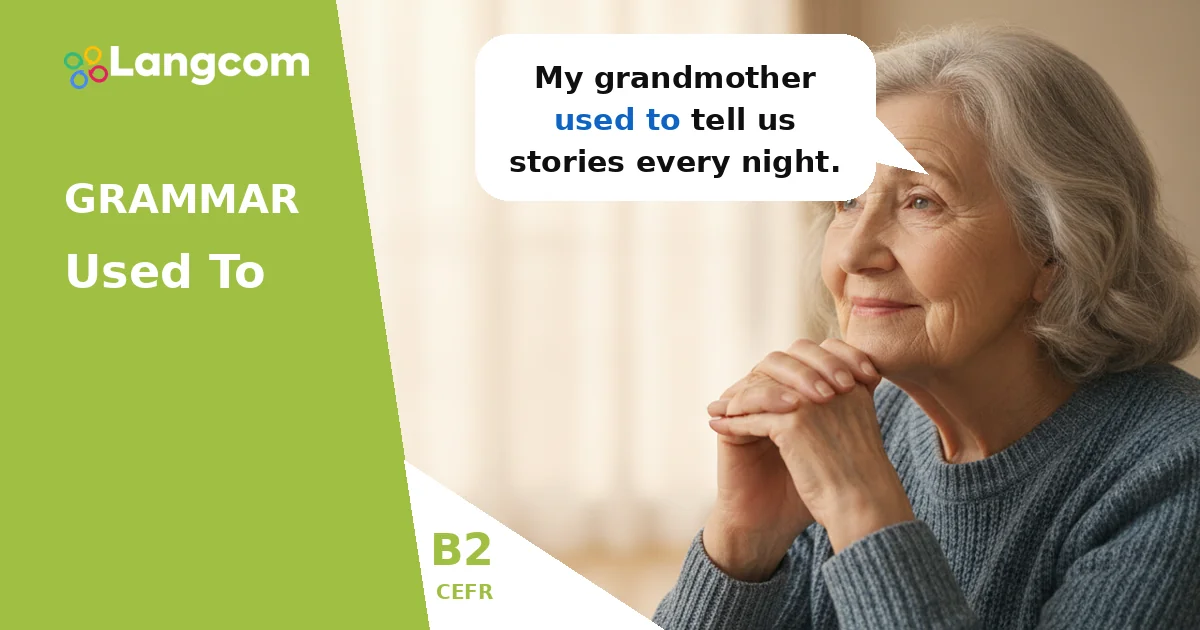
- My grandmother used to tell us stories every night.
- There used to be a cinema on this street, but it closed last year.
- When I was a child, I didn't use to like broccoli.
- Did you use to have long hair?
- On weekends, my friends and I would meet at the park.
- Every morning, he would drink a cup of coffee and read the newspaper.
- I am used to the noise of the city now.
- You will get used to the new system quickly.
Übung
Bist du bereit, dein Zertifikat zu erwerben?
Der Kurs Langcom bereitet die Teilnehmer auf die Prüfungen von Cambridge, IELTS, TOEFL, DELE, SIELE und Michigan vor.
Erste Schritte mit LangcomHäufige Fehler bei Spanischsprechern
- Verwendung von would for past states: Many learners incorrectly use would for situations that were true in the past but are not repeated actions.
Falsch: I would be shy when I was younger.
Richtig: I used to be shy when I was younger. (Being shy is a state, not a repeated action.) - Verwirrend used to mit be used to: These structures look similar but have different meanings and grammar.
Falsch: I am used to study hard. (Meaning 'I usually studied hard in the past' or 'I am accustomed to studying hard now'?)
Correct (past habit): I used to study hard.
Correct (present custom): I am used to studying hard. - Verwendung von did used to in questions/negatives: Remember to change used zu use when did is present.
Falsch: Did you used to play football?
Richtig: Did you use to play football?
Häufig gestellte Fragen
Can I always use 'used to' instead of 'would' for past habits?
Yes, you can always use used to for past repeated actions. However, you cannot always use would statt used to, especially for past states.
Is 'used to' or 'would' more formal?
Beides used to und would are common in both formal and informal English. Would is often preferred in narrative or storytelling contexts to add a sense of nostalgia or vividness to past repeated actions.
How is 'used to' tested in the B2 First (FCE) exam?
You might encounter questions about used to oder would in the Use of English Part 2 (Open Cloze) or Part 4 (Key Word Transformation). You may need to correctly form past habits or states, or distinguish between used to und be/get used to. It's also useful for writing tasks to describe past experiences.




0 Kommentare