

What is the Present Simple in English?
We use the Present Simple for things that happen regularly, often, or are always true. Think about your daily routine or facts about the world.
- Gewohnheiten und Routinen: Actions you do many times. For example, I wake up at 7 AM every day.
- General Truths and Facts: Things that are always true. For example, The sun rises in the east.
- Schedules: Fixed times for events. For example, The train leaves at 8 o’clock.
The form is simple: use the base verb. For he, she, it, hinzufügen -s oder -es to the verb.
🎓 Englisch lernen mit der Blended-Methode
Kleingruppen · KI-Tutor rund um die Uhr · Vorbereitung auf die Cambridge-Prüfungen
Pläne von $39 $79 pro Monat
When do we use the Present Continuous?
We use the Present Continuous for actions happening right now, at this moment. It describes something in progress.
- Actions Happening Now: Things you are doing at the time of speaking. For example, I am studying English now.
- Temporary Situations: Actions that are happening for a short time. For example, She is living with her sister this month.
The form for the Present Continuous is be (am/is/are) + verb + -ing. Zum Beispiel:, I am reading, He is working, They are playing.
How are Present Simple and Present Continuous different?
The main difference is about time. The Present Simple is for general time or repeated actions. The Present Continuous is for a specific time: now.
- Present Simple: Use words like always, often, usually, sometimes, never, every day/week.
- Present Continuous: Use words like now, right now, at the moment, today.
Think of it this way: Present Simple is like a photograph of a general truth. Present Continuous is like a video of an action happening.
| Feature | Present Simple | Present Continuous |
|---|---|---|
| Use | Habits, routines, facts | Actions happening now, temporary actions |
| Form | Base verb (verb + -s/-es for he/she/it) | be (am/is/are) + verb + -ing |
| Keywords | Always, often, every day | Now, right now, at the moment |
| Example | I drink water. | I am drinking water. |
Beispiele
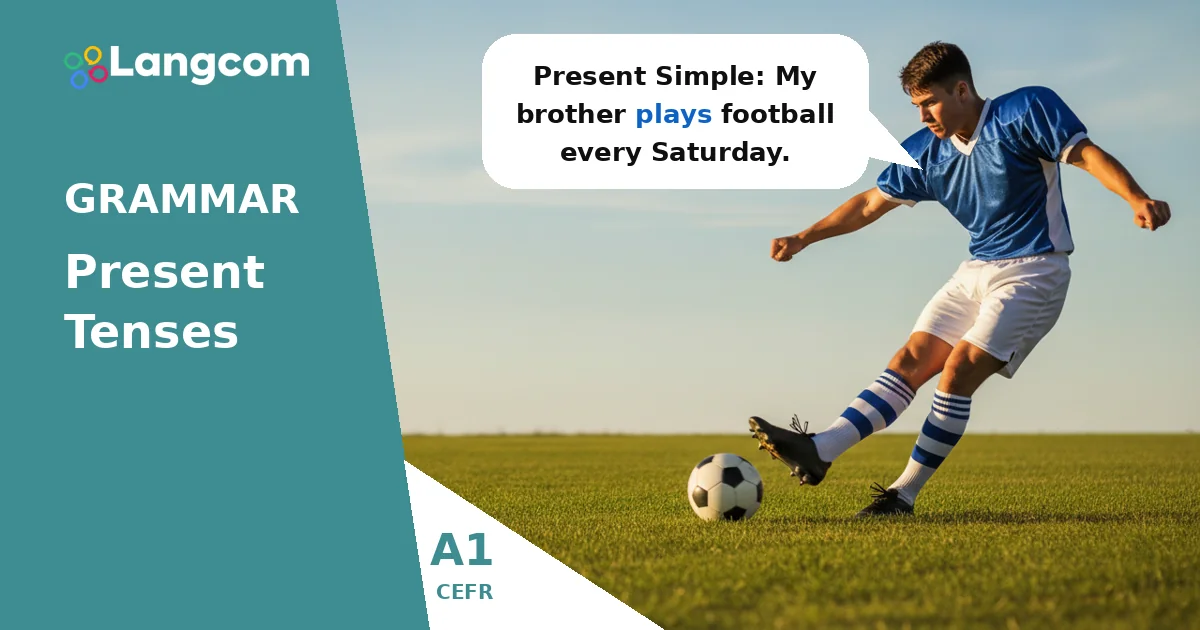
- Present Simple: My brother plays football every Saturday.
- Present Continuous: My brother is playing football right now.
- Present Simple: We live in Madrid.
- Present Continuous: We are visiting London this week.
- Present Simple: She drinks coffee in the morning.
- Present Continuous: She is drinking tea at the moment.
Übung
💬 Benötigen Sie eine individuelle Beratung?
Als autorisiertes Cambridge-Vorbereitungszentrum können wir Ihnen helfen, den richtigen Kurs und die passende Zertifizierung zu finden. Chatten Sie noch heute mit unseren Beratern.
Chatten Sie mit einem Berater auf WhatsAppHäufige Fehler bei Spanischsprechern
Häufige Fehler bei Spanischsprechern
Spanish speakers sometimes make specific mistakes when using these tenses:
- Using Present Simple for actions happening now: In Spanish, you might say "Yo como ahora." But in English, for an action happening at this moment, you must use the Present Continuous.
Falsch: I eat now.
Rechts: I am eating now. - Forgetting 'do/does' in Present Simple questions/negatives: In Spanish, you just add 'no' or change the word order. In English, you need do oder does.
Falsch: You not work here.
Rechts: You don't work here.
Falsch: He works here?
Rechts: Does he work here? - Forgetting the 'be' verb in Present Continuous: You need am, is, oder are before the -ing verb.
Falsch: She watching TV.
Rechts: She is watching TV.
Häufig gestellte Fragen
Wozu wird das Präsens hauptsächlich verwendet?
The Present Simple is mainly for habits, routines, and general facts. It describes things that happen regularly or are always true, like I go to school every day.
When should I use the Present Continuous?
You should use the Present Continuous for actions that are happening right now, at the moment of speaking, or for temporary situations. For example, She is reading a book now.
Can I use 'now' with the Present Simple?
No, generally you do not use now with the Present Simple. Now is a signal word for the Present Continuous, indicating an action in progress. For example, I am working now.




0 Kommentare