
When do we use the Present Simple Affirmative?
We use the Present Simple Affirmative to talk about things that are true all the time or happen regularly.
- Daily routines and habits: Things you do every day or often. I get up at seven o’clock.
- Facts and general truths: Things that are always true. The sun rises in the east.
- Schedules and timetables: Fixed events. The train leaves at 9 AM.
🎓 Englisch lernen mit der Blended-Methode
Kleingruppen · KI-Tutor rund um die Uhr · Vorbereitung auf die Cambridge-Prüfungen
Pläne von $39 $79 pro Monat
How do we form the Present Simple Affirmative?
The form of the verb changes for He, She, und It.
- For I, You, We, They, we use the base form of the verb. I watch TV.
- For He, She, It, we add -s oder -es to the base form of the verb. She watches TV.
Here are some rules for adding -s oder -es:
- Most verbs: Add -s. work → works, eat → eats
- Verbs ending in -s, -ss, -sh, -ch, -x, -o: Add -es. watch → watches, go → goes
- Verbs ending in a consonant + -y: Change -y to -ies. study → studies (but play → plays because it’s a vowel + -y)
Special verb: ‘have’
The verb have is special in the Present Simple Affirmative.
- For I, You, We, They, we use have. I have breakfast.
- For He, She, It, we use has. He has breakfast.
We often use have to talk about meals, like have breakfast, have lunch, oder have dinner. You can also use eat for meals, but have is very common.
| Subject | Verb: <span data-no-translation>WORK</span> | Verb: <span data-no-translation>WATCH</span> | Verb: <span data-no-translation>STUDY</span> | Verb: <span data-no-translation>HAVE</span> |
|---|---|---|---|---|
| I | work | watch | study | have |
| You | work | watch | study | have |
| He | works | watches | studies | has |
| She | works | watches | studies | has |
| It | works | watches | studies | has |
| We | work | watch | study | have |
| They | work | watch | study | have |
Examples
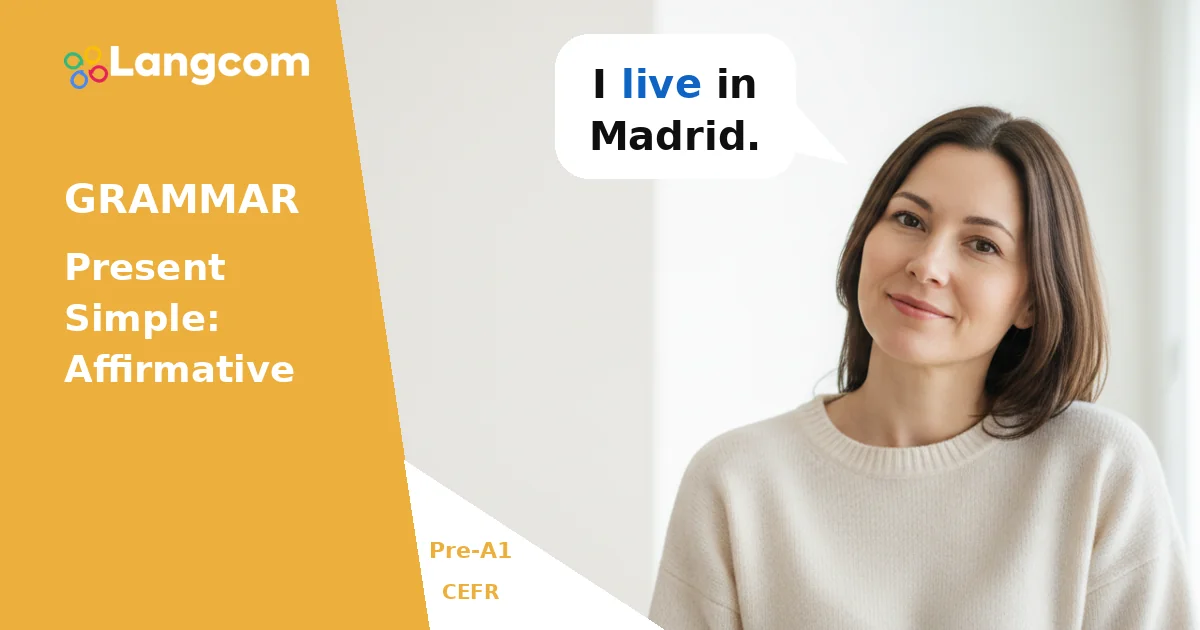
- I live in Madrid.
- You study English at Langcom.
- He works in an office.
- She watches TV every evening.
- It rains a lot in winter.
- We get up early on weekdays.
- They have two children.
Practice
💬 Benötigen Sie eine individuelle Beratung?
Als autorisiertes Cambridge-Vorbereitungszentrum können wir Ihnen helfen, den richtigen Kurs und die passende Zertifizierung zu finden. Chatten Sie noch heute mit unseren Beratern.
Chatten Sie mit einem Berater auf WhatsAppCommon mistakes for Spanish speakers
Forgetting the -s for He/She/It
A common mistake for Spanish speakers is to forget to add -s oder -es to the verb when the subject is He, She, oder It. In Spanish, verb endings change for all subjects, but in English, the change is mostly for the third person singular.
- Incorrect: She live in London.
- Correct: She lives in London.
- Incorrect: He watch TV.
- Correct: He watches TV.
Using ‘have’ instead of ‘has’ for He/She/It
Remember that have changes to has for He, She, und It.
- Incorrect: He have breakfast at 8 AM.
- Correct: He has breakfast at 8 AM.
Häufig gestellte Fragen
What is the main use of the Present Simple Affirmative?
The main use is to talk about daily routines, habits, and facts that are generally true. For example, I drink water every day.
Do all verbs add -s for He/She/It?
Most verbs add -s. However, some verbs add -es (like watch → watches) or change -y to -ies (like study → studies). The verb have changes to has.
Why is the Present Simple important for Pre-A1 learners?
It is fundamental because it allows you to describe basic information about yourself, your family, and your daily life, which is essential for early communication in English. It’s a building block for more complex sentences.
Can I use ‘eat’ instead of ‘have’ for meals?
Yes, you can use eat for meals (e.g., I eat breakfast). However, have (e.g., I have breakfast) is also very common and natural in English.



0 Kommentare