

What is No and How Do We Use It?
No is a determiner (like ‘a’, ‘the’, ‘some’). It means ‘not any’ or ‘not a single one’.
You always use no directly before a noun. It can be used with both countable and uncountable nouns.
- When you use no, the verb in the sentence is positive. For example, I have no money (nicht I don’t have no money).
- It can also be used with comparative adjectives or adverbs to show a lack of difference or degree.
- We can also use no with the word different.
✍️ Du bist dir nicht sicher, auf welchem Niveau du bist?
Machen Sie unseren kostenlosen Einstufungstest und erhalten Sie individuelles Feedback von zertifizierten Cambridge-Prüfern.
Machen Sie unseren KOSTENLOSEN EinstufungstestWhen Should You Use None?
None is a pronoun. It means 'not one' or 'not any'.
Weil none is a pronoun, it can stand alone or be followed by of + a plural noun, of + an uncountable noun, oder of + a pronoun.
- When none is followed by of + a plural noun, the verb can be singular or plural.
- In formal written English, a singular verb is often preferred: None of my colleagues speaks Japanese.
- However, in everyday speech, a plural verb is very common and acceptable: None of this morning's flights have been delayed.
- When none refers to an uncountable noun, the verb is always singular: None of the information is correct.
Understanding Not: The Negative Adverb
Not is an adverb. Its main job is to make verbs negative.
It often appears as a contraction (n't) with auxiliary verbs (don't, isn't, haven't).
- Not can also make other words or phrases negative, such as adjectives, adverbs, or quantifiers like many oder all.
- It is used in short answers to questions.
- Wir verwenden not to negate infinitives (not to go) and participles (not knowing).
| Wort | Typ | Function | Beispiel |
|---|---|---|---|
| No | Determiner | Before a noun; means 'not any' or 'not a single' | I have no patience. |
| None | Pronoun | Stands alone or with of + noun/pronoun; means 'not one' or 'not any' | None of them knew. |
| Not | Adverb | Negates verbs, adjectives, adverbs, phrases | She is not ready. |
Beispiele
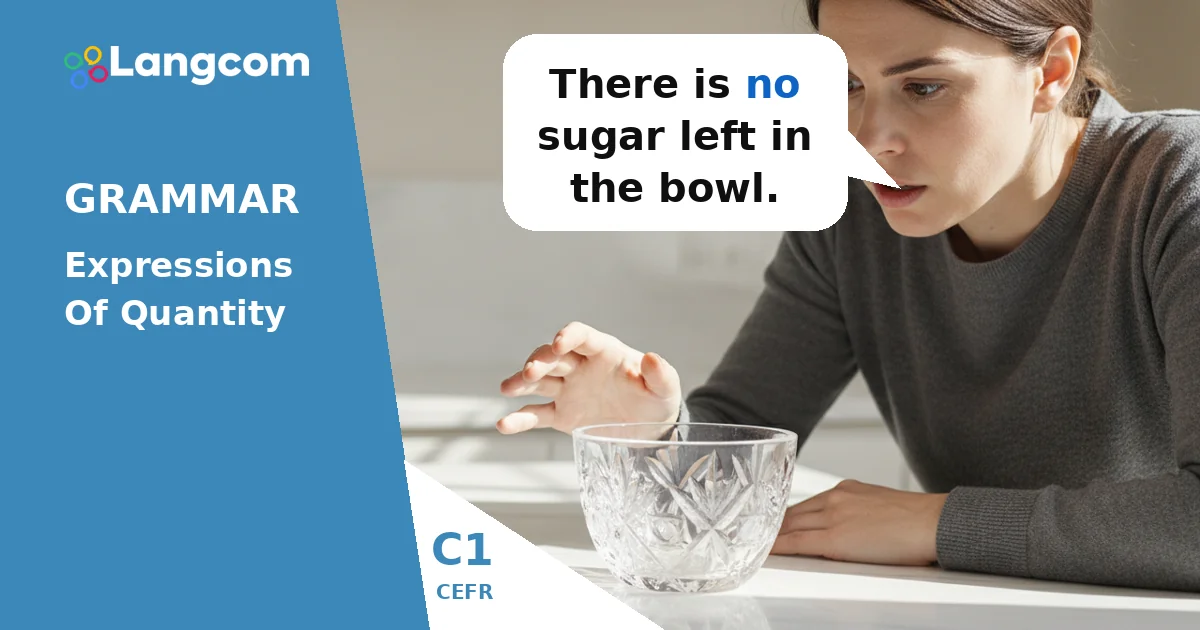
- There is no sugar left in the bowl.
- None of the students completed the extra credit assignment.
- I am not going to the party tonight.
- She had no idea how difficult the exam would be.
- How many mistakes did you make? None at all.
- Not many people understand quantum physics.
- The new policy is no different from the old one.
- He decided not to accept the job offer.
Übung
Bist du bereit, dein Zertifikat zu erwerben?
Der Kurs Langcom bereitet die Teilnehmer auf die Prüfungen von Cambridge, IELTS, TOEFL, DELE, SIELE und Michigan vor.
Erste Schritte mit LangcomHäufige Fehler bei Spanischsprechern
Double Negatives
A common mistake for Spanish speakers is using double negatives, which are incorrect in English. In Spanish, it's common to say 'No tengo nada' (literally 'I don't have nothing'), but in English, you must use only one negative word.
- Falsch: I don't have no money.
- Richtig: I don't have any money. ODER I have no money.
Verwirrend No mit Not a/an
Sometimes learners use no wobei not a/an is more appropriate, especially with singular countable nouns.
- Falsch: She is no doctor. (While grammatically possible, it sounds unnatural or poetic.)
- Richtig: She is not a doctor.
Verwendung von None Instead of No Before a Noun
None is a pronoun and cannot directly precede a noun.
- Falsch: None cars were in the parking lot.
- Richtig: No cars were in the parking lot. ODER None of the cars were in the parking lot.
Häufig gestellte Fragen
Can I use none with singular verbs?
Ja, none can be used with a singular verb, especially in formal English, when it means 'not one'. For example, None of the solutions was satisfactory. However, a plural verb is also very common in informal speech, for example, None of the students have arrived yet.
Was ist der Unterschied zwischen no one und none?
No one refers exclusively to people and means 'not a single person'. None can refer to people or things, and means 'not one' or 'not any'. For example, No one came to the party (only people). None of the books were interesting (things). None of my friends could help (people).
How does understanding no, none, not help with the C1 Advanced exam?
Mastering these distinctions is vital for the C1 Advanced (CAE) exam, particularly in the Use of English paper. You might encounter questions testing these differences in Part 1 (Multiple-choice cloze) or Part 2 (Open cloze), where precise word choice is key. Correct usage also improves your overall accuracy and coherence in the Writing and Speaking papers, demonstrating a high level of grammatical control.



0 Kommentare