

What Are Hobbies and Free Time Activities?
Hobbies are things you enjoy doing regularly when you are not working or studying. They help you relax and learn new skills.
Free time activities are similar, but they can be less regular. For example, watching a movie is a free time activity, but it might not be a hobby unless you do it very often and have a special interest in films.
✍️ Du bist dir nicht sicher, auf welchem Niveau du bist?
Machen Sie unseren kostenlosen Einstufungstest und erhalten Sie individuelles Feedback von zertifizierten Cambridge-Prüfern.
Machen Sie unseren KOSTENLOSEN EinstufungstestCommon Hobbies and Their Verbs
Here are some popular hobbies and the verbs we use with them:
- Chess: You play chess.
- Cycling: You go cycling oder ride a bike.
- Painting: You paint a picture oder do some painting.
- Cooking: You cook a meal oder do some cooking.
- Music: You play an instrument (like a guitar) or listen to music.
- Photography: You take photos oder do photography.
- Volunteering: You do volunteer work oder volunteer.
- Camping: You go camping.
How Do We Talk About Hobbies?
Use these phrases to talk about your hobbies and ask others about theirs:
- To state your hobby: My hobby is cycling. oder I like cycling.
- To express enjoyment: I love cooking., I enjoy painting.
- To show interest: I'm interested in photography.
- To describe how you spend time: I spend my free time playing chess.
- To ask someone: What do you do in your free time? oder Do you have any hobbies?
Vocabulary for Hobby Equipment and People
Many hobbies need special equipment or have specific names for the people who do them:
- Für Chess: You need a board und pieces. A person who plays is a chess player.
- Für Cycling: You need a bike und eine helmet for safety. A person who cycles is a cyclist.
- Für Painting: You use a brush und paint. The artist is a painter.
- Für Cooking: You might use a cooker or an oven. The person is a cook.
- Für Music: You might play an instrument. A person who plays music is a musician.
- Für Photography: You need a camera. The person is a photographer.
- Für Camping: You need a tent und eine backpack. A person who camps is a camper.
| Hobby | Common Verb Phrase | Related Nouns / People |
|---|---|---|
| Chess | play chess | board, pieces, chess player |
| Cycling | go cycling | bike, helmet, cyclist |
| Painting | paint a picture | brush, paint, painter |
| Cooking | cook a meal | cooker, oven, cook |
| Music | play an instrument | instrument, musician |
| Photography | take photos | camera, photographer |
| Volunteering | do volunteer work | volunteer |
| Camping | go camping | tent, backpack, camper |
Beispiele
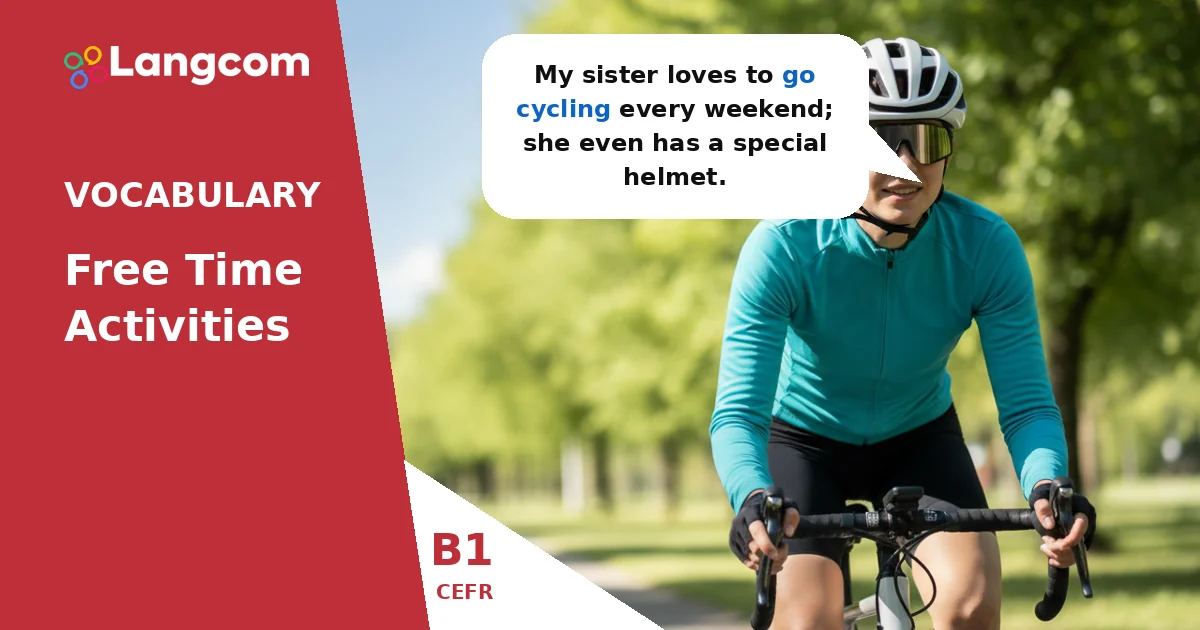
- My sister loves to go cycling every weekend; she even has a special helmet.
- For my birthday, I received a new camera because I'm very interested in photography.
- My dad is a great cook, and his hobby is trying new recipes in the kitchen.
- We are going camping next month, so I need to buy a new tent and a backpack.
- He spends his free time playing chess with his friends online.
Übung
Bist du bereit, dein Zertifikat zu erwerben?
Der Kurs Langcom bereitet die Teilnehmer auf die Prüfungen von Cambridge, IELTS, TOEFL, DELE, SIELE und Michigan vor.
Erste Schritte mit LangcomHäufige Fehler bei Spanischsprechern
Common Mistakes with Hobbies Vocabulary
Spanish speakers sometimes make mistakes with verbs like do, play, und go:
- Using 'do' instead of 'play' or 'go': You might say I do cycling. The correct phrase is I go cycling. Similarly, for chess, it's I play chess, nicht I do chess.
- Direct translation of 'my hobby is to...': In English, we usually say My hobby is painting (using the -ing form) or I like to paint, nicht My hobby is to paint.
- Forgetting the -ing form: After verbs like enjoy, like, love, we use the -ing form for activities: I enjoy cooking, nicht I enjoy cook.
Häufig gestellte Fragen
What is the difference between a hobby and a sport?
A hobby is any activity done for pleasure in free time. A sport is a type of hobby that involves physical activity and often competition, like cycling oder football. Not all hobbies are sports, but all sports can be hobbies.
How can I ask someone about their hobbies in English?
You can ask, What do you like to do in your free time? oder Do you have any hobbies? You can also say, What are your interests?
Why is it important to learn hobby vocabulary for the B1 Preliminary exam?
In the B1 Preliminary (PET) exam, you might need to talk about your personal life, including your hobbies und free time activities, in the Speaking Part 1. Knowing this vocabulary helps you answer questions confidently and naturally.
Can I use 'do' with any hobby?
Nein, do is typically used with non-team sports or individual activities like do yoga, do gymnastics, oder do volunteer work. For hobbies like chess oder music, you use play. For activities that involve movement and often end in -ing, like cycling oder camping, you use go.

0 Kommentare