

What Are Gradable Adjectives?
Gradable adjectives describe qualities that can exist in different degrees or levels. Think of them like a scale: something can be a little bit, quite, or very much of that quality.
- You can make gradable adjectives stronger or weaker.
- Common intensifiers for gradable adjectives include very, quite, really, extremely, und a bit.
- Examples of gradable adjectives are good, bad, hot, cold, tired, hungry, und big.
🎓 Englisch lernen mit der Blended-Methode
Kleingruppen · KI-Tutor rund um die Uhr · Vorbereitung auf die Cambridge-Prüfungen
Pläne von $39 $79 pro Monat
What Are Extreme Adjectives?
Extreme adjectives describe qualities that are already at their highest or lowest point. They express an absolute or maximum degree of a quality, so they do not need to be made stronger with words like very.
- These adjectives already have a strong meaning built into them.
- Common intensifiers for extreme adjectives include absolutely, completely, utterly, und totally.
- Examples of extreme adjectives are fantastic (for good), terrible (for bad), boiling (for hot), freezing (for cold), exhausted (for tired), starving (for hungry), und enormous (for big).
Why Is This Important for Your English?
Understanding gradable and extreme adjectives helps you speak more accurately and express your feelings more powerfully. It makes your English sound more natural and fluent.
- Using the correct intensifier shows a good command of English vocabulary.
- It helps you avoid common mistakes that can make your speech sound less natural.
- You can express a wider range of emotions and descriptions, from quite good zu absolutely fantastic.
| Gradable Adjective | Extreme Adjective |
|---|---|
| good | fantastic / amazing |
| bad | terrible / awful |
| tired | exhausted |
| hungry | starving |
| big | enormous / gigantic |
| small | tiny |
| hot | boiling |
| cold | freezing |
| dirty | filthy |
| funny | hilarious |
Beispiele
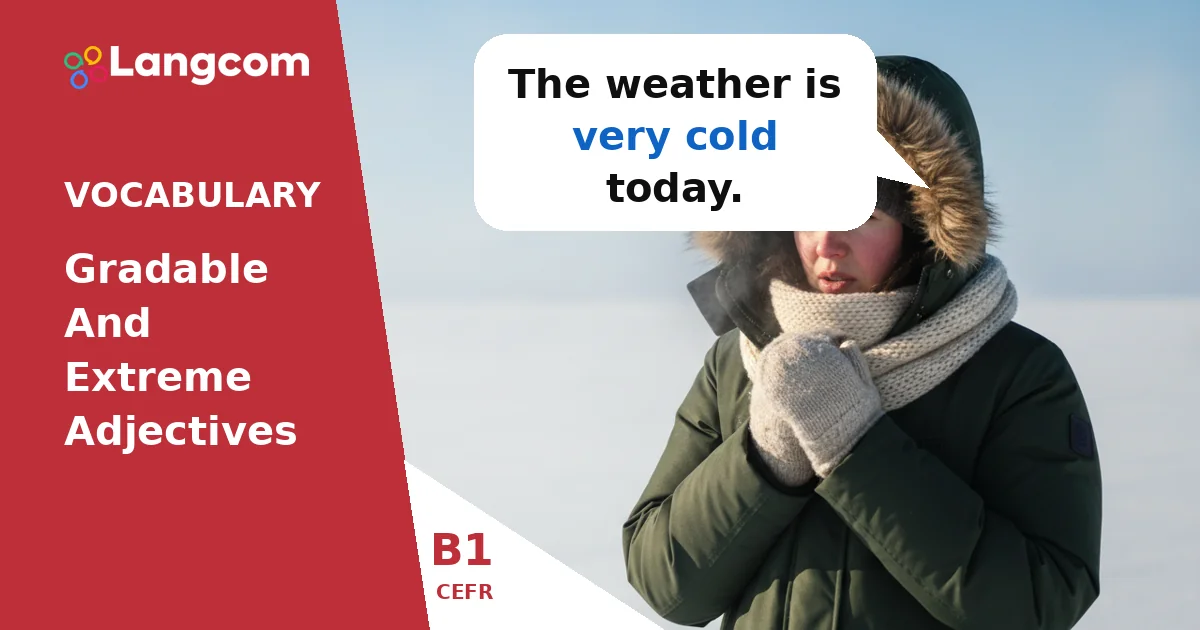
- The weather is very cold today.
- I am absolutely freezing!
- The movie was quite good.
- That film was absolutely amazing!
- She felt a bit tired after work.
- He was completely exhausted after running the marathon.
- The food was really delicious.
- This cake is utterly perfect.
Übung
✍️ Du bist dir nicht sicher, auf welchem Niveau du bist?
Machen Sie unseren kostenlosen Einstufungstest und erhalten Sie individuelles Feedback von zertifizierten Cambridge-Prüfern.
Machen Sie unseren KOSTENLOSEN EinstufungstestHäufige Fehler bei Spanischsprechern
A common mistake for Spanish speakers is using very with extreme adjectives, similar to how 'muy' might be used with strong adjectives in Spanish. However, this is incorrect in English.
- Falsch: The movie was very amazing.
- Richtig: The movie was absolutely amazing.
- Falsch: I am very exhausted.
- Richtig: I am completely exhausted.
Remember, extreme adjectives already mean 'very + gradable adjective'. So, amazing bedeutet very good, und exhausted bedeutet very tired.
Häufig gestellte Fragen
Can I use 'very' with an extreme adjective?
Nein, das geht nicht. very with extreme adjectives. Extreme adjectives already have a strong meaning. Instead, use intensifiers like absolutely oder completely. For example, say absolutely fantastic, nicht very fantastic.
What is an intensifier?
An intensifier is a word that strengthens or weakens the meaning of an adjective or adverb. For example, very is an intensifier for gradable adjectives (very hot), und absolutely is an intensifier for extreme adjectives (absolutely boiling).
How can I remember which adjectives are extreme?
The best way is to learn them in pairs or groups. For instance, learn good (gradable) with fantastic (extreme), or tired (gradable) with exhausted (extreme). Pay attention to context and practice using them. You can often feel if an adjective already expresses a maximum degree.
Is this grammar point important for B1 English exams?
Yes, understanding gradable and extreme adjectives is important for B1 level. It helps you express yourself more precisely in speaking and writing tasks, making your language sound more sophisticated and natural. Using the correct intensifiers can improve your score in vocabulary and fluency criteria.


0 Kommentare