

What are the main sounds of ‘S’ in English?
The letter ‘s’ in English can sound different depending on the word. It has three main pronunciations:
- Die /s/ sound, like in sun. This is a voiceless sound.
- Die /z/ sound, like in zoo. This is a voiced sound.
- Die /ɪz/ sound, like in boxes. This sound is also voiced.
A voiceless sound means your vocal cords do not vibrate when you make the sound. A voiced sound means your vocal cords vibrate.
🎓 Englisch lernen mit der Blended-Methode
Kleingruppen · KI-Tutor rund um die Uhr · Vorbereitung auf die Cambridge-Prüfungen
Pläne von $39 $79 pro Monat
When does 'S' sound like /s/ (as in "snake")?
You use the /s/ sound when the letter 's' comes after a voiceless consonant sound. Think of it as a 'hissing' sound.
- At the beginning of many words: sit, stop, see.
- After voiceless sounds like /p/, /t/, /k/, /f/, /θ/. This is common for plural nouns and verbs in the third person singular.
When does 'S' sound like /z/ (as in "zoo")?
You use the /z/ sound when the letter 's' comes after a voiced sound or a vowel. This sound is like a 'buzzing' sound.
- At the beginning of some words: zoo, zero.
- Between two vowels: easy, music.
- After voiced sounds like /b/, /d/, /g/, /v/, /m/, /n/, /l/, /r/, and all vowel sounds. This is also common for plural nouns and verbs in the third person singular.
When does 'S' sound like /ɪz/ (as in "boxes")?
You use the /ɪz/ sound when the letter 's' (or 'es') comes after a 'sibilant' sound. Sibilant sounds are sounds that have a 'hissing' or 'shushing' quality.
- After sounds like /s/, /z/, /ʃ/ (like in she), /ʒ/ (like in measure), /tʃ/ (like in church), or /dʒ/ (like in judge).
- This sound adds an extra syllable to the word.
| Ending Sound Before -s/-es | Pronunciation of -s/-es | Example Words |
|---|---|---|
| Voiceless sounds (/p/, /t/, /k/, /f/, /θ/) | /s/ | cats, stops, books |
| Voiced sounds (/b/, /d/, /g/, /v/, /m/, /n/, /l/, /r/, and all vowels) | /z/ | dogs, reads, plays |
| Sibilant sounds (/s/, /z/, /ʃ/, /ʒ/, /tʃ/, /dʒ/) | /ɪz/ | boxes, washes, watches |
Beispiele
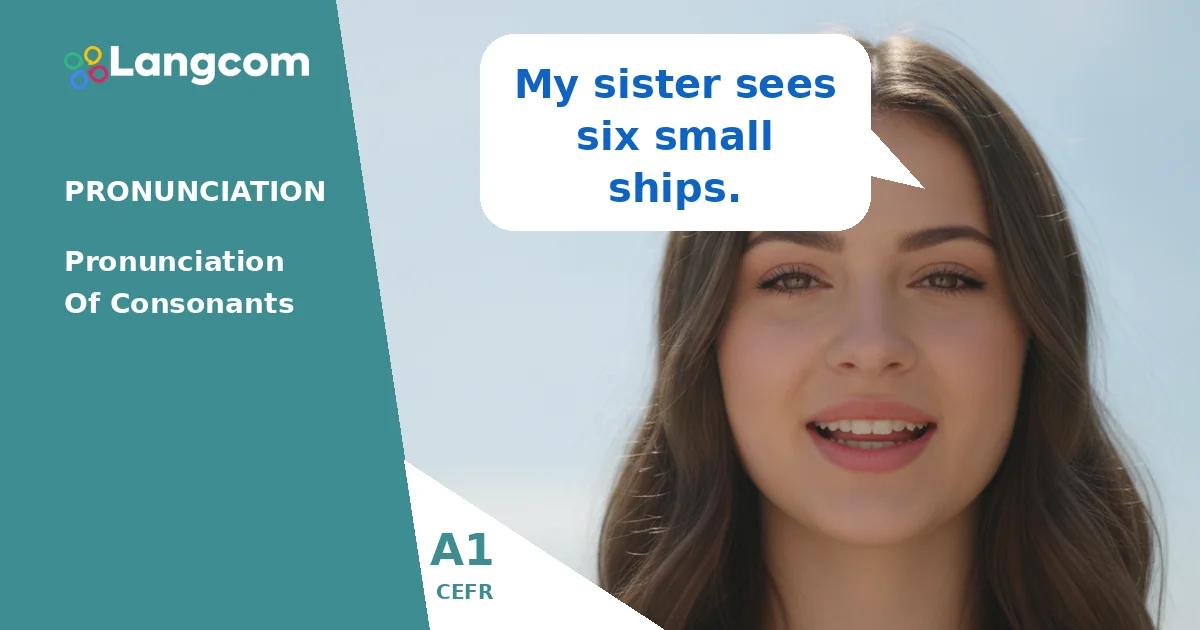
- My sister sees six small ships.
- The cats sleep on the sofa.
- He always plays games with his friends.
- She washes the dishes every day.
- The buses stop here.
Übung
💬 Benötigen Sie eine individuelle Beratung?
Als autorisiertes Cambridge-Vorbereitungszentrum können wir Ihnen helfen, den richtigen Kurs und die passende Zertifizierung zu finden. Chatten Sie noch heute mit unseren Beratern.
Chatten Sie mit einem Berater auf WhatsAppHäufige Fehler bei Spanischsprechern
Many Spanish speakers often make two common mistakes with the 's' sound:
- Adding an 'e' sound: Sometimes, words starting with s followed by another consonant (like school, street, speak) are pronounced with an extra 'e' sound at the beginning, like eschool oder espeak. Remember, in English, these words start directly with the /s/ sound, without an initial vowel sound.
- Using only the /s/ sound: It's common to pronounce all -s endings (for plurals or verbs) as /s/, even when they should be /z/ oder /ɪz/. For example, saying dog-s with an /s/ sound instead of dog-z with a /z/ sound. Pay attention to the sound before the 's' to choose the correct pronunciation.
Häufig gestellte Fragen
Why does the 's' sound change in English?
The 's' sound changes to make words easier to say. It depends on the sound that comes right before it. Your mouth naturally prepares for the next sound, which affects how the 's' is pronounced.
How can I practice these different 's' sounds?
Listen carefully to native speakers. Repeat words and sentences that have different 's' sounds. Tongue twisters, like She sells seashells by the seashore, are great for practice. Focus on feeling if your vocal cords vibrate or not.
Is the 's' in 'sugar' pronounced the same way?
No, the 's' in sugar is pronounced as /ʃ/, which is a 'sh' sound, like in shoe. This is different from the /s/, /z/, oder /ɪz/ sounds we discussed.

0 Kommentare