

What are “This” and “That” in English?
This und that are special words. They help us show where something is.
- They tell us if something is close to us.
- They tell us if something is far from us.
- They are only for one thing (singular).
🎓 Englisch lernen mit der Blended-Methode
Kleingruppen · KI-Tutor rund um die Uhr · Vorbereitung auf die Cambridge-Prüfungen
Pläne von $39 $79 pro Monat
When do we use "This"?
Wir verwenden this for one thing that is near you.
- The item is close. You can touch it.
- It is singular (only one).
- Think: "Here, close to me."
When do we use "That"?
Wir verwenden that for one thing that is far from you.
- The item is not close. You cannot touch it easily.
- It is singular (only one).
- Think: "Over there, far from me."
How do "This" and "That" work with nouns?
This und that can be used in two main ways:
- Vor einem Substantiv: They describe the noun. For example, this book oder that car.
- Alone: They replace the noun. For example, This is my book. oder That is a car.
| Wort | Distance | Zahl |
|---|---|---|
| This | Near (close to you) | One (Singular) |
| That | Far (not close to you) | One (Singular) |
Beispiele
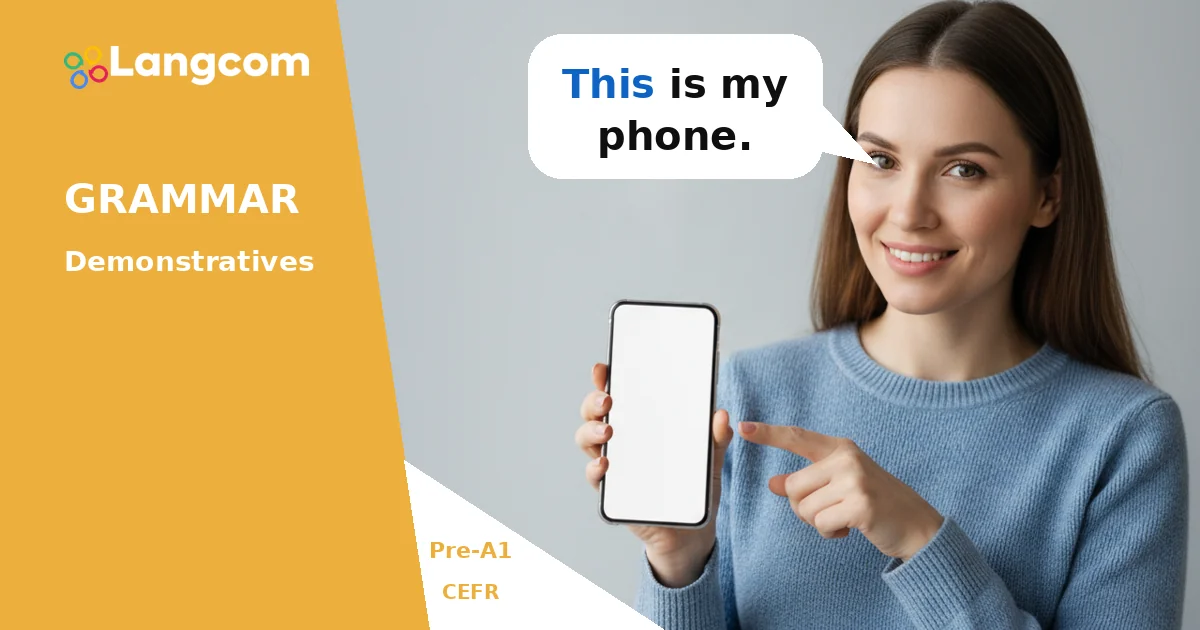
- This is my phone. (The phone is in my hand.)
- This apple is red. (The apple is on the table next to me.)
- That is a big tree. (The tree is across the street.)
- That dog is cute. (The dog is playing far away in the park.)
- Is this your bag? (The bag is right here.)
- Look at that bird! (The bird is flying high in the sky.)
Übung
💬 Benötigen Sie eine individuelle Beratung?
Als autorisiertes Cambridge-Vorbereitungszentrum können wir Ihnen helfen, den richtigen Kurs und die passende Zertifizierung zu finden. Chatten Sie noch heute mit unseren Beratern.
Chatten Sie mit einem Berater auf WhatsAppHäufige Fehler bei Spanischsprechern
Spanish speakers sometimes confuse this und that mit it.
- Fehler: You point to a pen in your hand and say, It is a pen.
- Korrektur: When you point to something new or show its location, use this oder that. So, This is a pen.
Remember:
- Verwendung this oder that when you are pointing to something for the first time or showing its position.
- Verwendung it when you are talking about something you already mentioned.
Häufig gestellte Fragen
What is the main difference between "this" and "that"?
The main difference is distance. We use this for one thing that is near you, and that for one thing that is far from you.
Can I use "this" or "that" for people?
Ja, du kannst this und that for people, especially when introducing someone or pointing them out. For example, This is my friend, Maria. oder Who is that man?
Are "this" and "that" for singular or plural nouns?
Beides this und that are only for singular nouns (one item). For plural nouns (more than one item), we use these (near) and those (far), but that is a lesson for another time!
What is the Spanish equivalent for "this" and "that"?
In Spanish, this can be like "este" or "esta." That can be like "ese," "esa," "aquel," or "aquella." The English system is simpler with just this (near) and that (far) for singular items.


0 Kommentare