
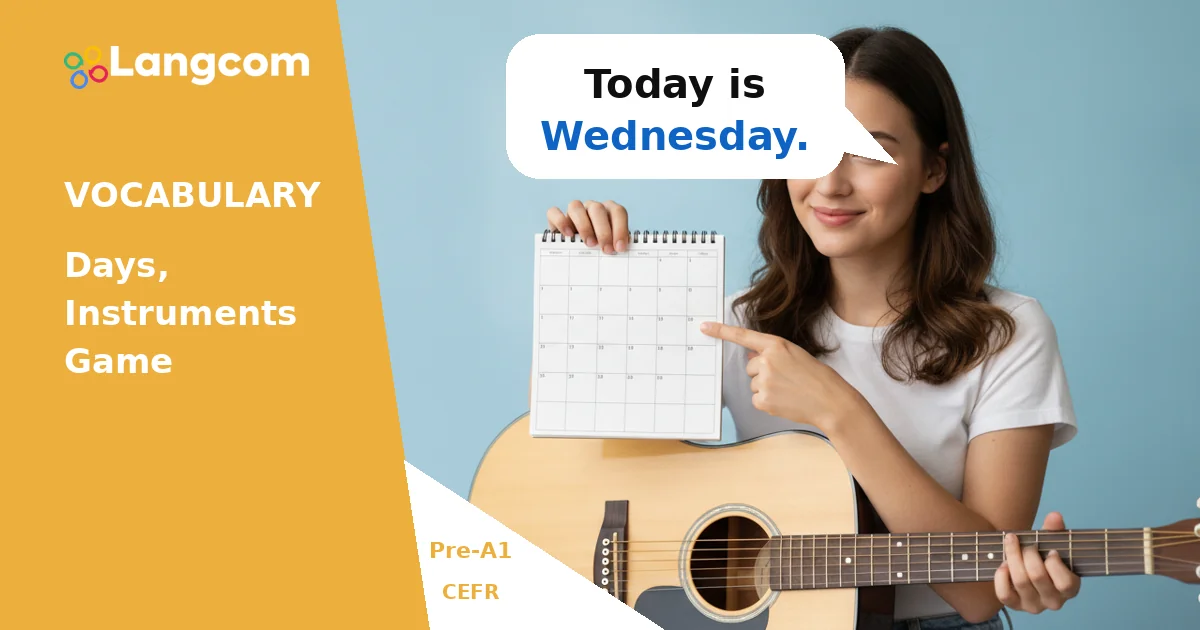

Learning instrument names allows you to discuss hobbies, music, and interests with others. You can tell someone I play the guitar oder I like the piano. This vocabulary is essential for building simple sentences and having basic conversations in English. Mastering these words will give you confidence to talk about your daily life and personal interests.
Why Learn Days of the Week in English?
The days of the week are fundamental for talking about time and planning. They help you understand schedules, appointments, and events.
- Monday
- Tuesday
- Wednesday
- Thursday
- Friday
- Saturday
- Sunday
🎓 Englisch lernen mit der Blended-Methode
Kleingruppen · KI-Tutor rund um die Uhr · Vorbereitung auf die Cambridge-Prüfungen
Pläne von $39 $79 pro Monat
How Do We Use English Days?
In English, we always capitalize the first letter of each day. This is a very important rule.
We use the preposition on before a day when we talk about something happening on that day. For example, I have a meeting on Monday.
What Are Some Common Musical Instruments in English?
Music is a universal language, and knowing the names of instruments helps you talk about your favorite songs or hobbies. Here are some common ones:
- Piano
- Guitar
- Saxophone
- Drums
- Violin
- Clarinet
Talking About Music: Instruments in Sentences
When you talk about playing a musical instrument, you usually use the word the before the instrument's name. This is a common pattern in English.
For example, you say I play the guitar, nicht I play guitar.
| Category | Englisches Wort |
|---|---|
| Days of the Week | Monday |
| Days of the Week | Tuesday |
| Days of the Week | Wednesday |
| Days of the Week | Thursday |
| Days of the Week | Friday |
| Days of the Week | Saturday |
| Days of the Week | Sunday |
| Musical Instrument | Piano |
| Musical Instrument | Guitar |
| Musical Instrument | Saxophone |
| Musical Instrument | Drums |
| Musical Instrument | Violin |
| Musical Instrument | Clarinet |
Beispiele
- Today is Wednesday.
- My English class is on Friday.
- I like to relax on Sunday.
- She plays the piano very well.
- Do you play the guitar?
- The drums are loud.
Übung
💬 Benötigen Sie eine individuelle Beratung?
Als autorisiertes Cambridge-Vorbereitungszentrum können wir Ihnen helfen, den richtigen Kurs und die passende Zertifizierung zu finden. Chatten Sie noch heute mit unseren Beratern.
Chatten Sie mit einem Berater auf WhatsAppHäufige Fehler bei Spanischsprechern
Days of the Week:
- Not capitalizing: A common mistake is writing days without a capital letter, like monday. Remember, it must always be Monday.
- Wrong preposition: Learners sometimes say in Monday. The correct preposition is on, so it's on Monday.
Musical Instruments:
- Missing 'the': Many learners forget to use the when talking about playing an instrument. For example, I play guitar is incorrect. The correct way is I play the guitar.
Häufig gestellte Fragen
How do I say 'Monday' in English?
The word for the first day of the week is Monday.
Do I always capitalize days of the week in English?
Yes, always. For example, you write Tuesday, not 'tuesday'.
What is a common musical instrument?
Die guitar is a very popular musical instrument around the world.
Do I use 'the' before instrument names?
Yes, when you talk about playing an instrument, you usually use the. Zum Beispiel:, I play the piano.


0 Kommentare