

What Are Countries and Nationalities?
Countries are names of places. They are geographical areas with their own governments.
- Examples: Brazil, China, Spain.
Nationalities are words that describe people from those countries. They tell us where a person is from.
- Examples: Brazilian, Chinese, Spanish.
🎓 Englisch lernen mit der Blended-Methode
Kleingruppen · KI-Tutor rund um die Uhr · Vorbereitung auf die Cambridge-Prüfungen
Pläne von $39 $79 pro Monat
How Do We Use Countries and Nationalities in Sentences?
We use countries and nationalities to talk about origin. This is very useful when you meet new people.
- Verwendung "I am from + Country" to say your origin.
- Beispiel: I am from Colombia.
- Verwendung "I am + Nationality" to state your nationality.
- Beispiel: I am Colombian.
You can also ask others:
- Where are you from?
- What is your nationality?
Why Are Countries and Nationalities Important?
Knowing these words helps you introduce yourself and understand others. It is a basic part of conversation.
- You can tell people about yourself: I am from Mexico. I am Mexican.
- You can understand where other people live or were born.
- This vocabulary is essential for travel and making new friends.
| Country | Nationality |
|---|---|
| Spain | Spanish |
| Mexico | Mexican |
| United States | American |
| United Kingdom | British |
| Brazil | Brazilian |
| China | Chinese |
| Japan | Japanese |
| Russia | Russian |
| Colombia | Colombian |
Beispiele
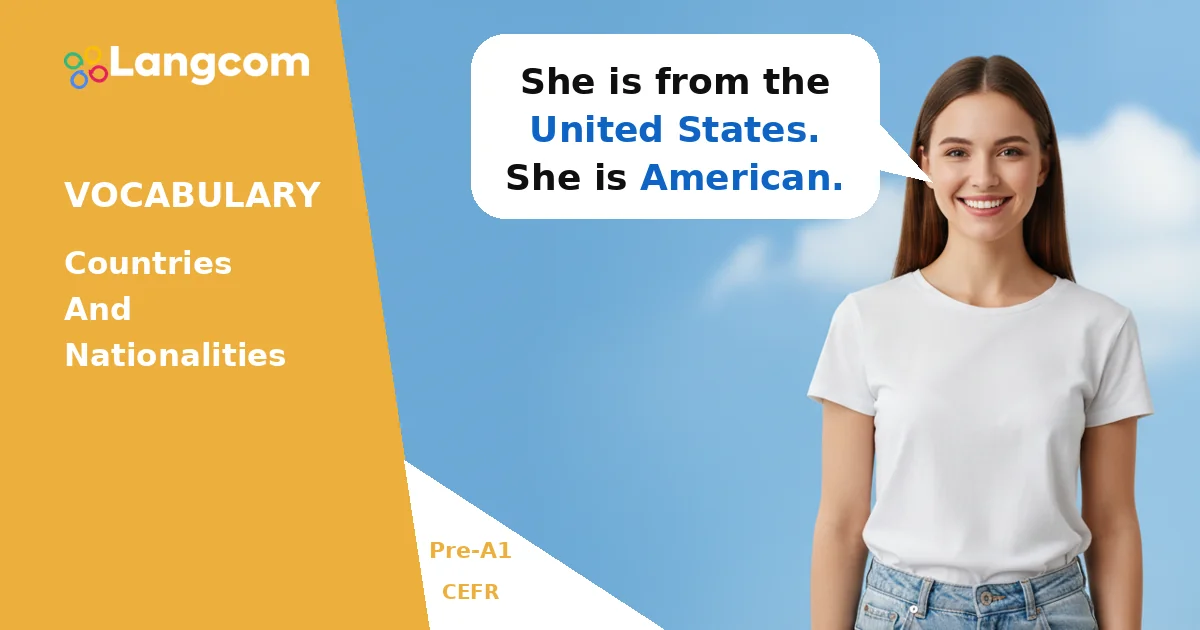
- She is from the United States. She is American.
- He is from Japan. He is Japanese.
- They are from Brazil. They are Brazilian.
- Are you from China? Are you Chinese?
- I am from Mexico. I am Mexican.
- We are from the United Kingdom. We are British.
Übung
💬 Benötigen Sie eine individuelle Beratung?
Als autorisiertes Cambridge-Vorbereitungszentrum können wir Ihnen helfen, den richtigen Kurs und die passende Zertifizierung zu finden. Chatten Sie noch heute mit unseren Beratern.
Chatten Sie mit einem Berater auf WhatsAppHäufige Fehler bei Spanischsprechern
Spanish speakers sometimes make these mistakes:
- Not capitalizing country names and nationalities: In English, these words are always capitalized.
- WRONG: i am spanish.
- RIGHT: I am Spanish.
- WRONG: she is from mexico.
- RIGHT: She is from Mexico.
- Using "the" before a nationality when talking about one person: We do not use "the" with a single person's nationality.
- WRONG: I am the Spanish.
- RIGHT: I am Spanish.
- (We use "the" for groups, like "the Spanish people" oder "the British", but not for a single person's nationality.)
Häufig gestellte Fragen
What is the difference between a country and a nationality?
A country is a place, like Spain. A nationality is a word that describes a person from that country, like Spanish.
Do I always capitalize countries and nationalities?
Yes, always capitalize both country names (e.g., Colombia) and nationality words (e.g., Colombian) in English.
How do I ask someone where they are from?
Du kannst fragen: "Where are you from?" oder "What is your nationality?"



0 Kommentare