

What are Countable Nouns?
Countable nouns are for things we can count. We can use numbers with them.
- They have a singular form (one thing) and a plural form (more than one thing).
- Examples: a book, two books; one car, three cars.
- We can use a oder an with singular countable nouns.
✍️ Du bist dir nicht sicher, auf welchem Niveau du bist?
Machen Sie unseren kostenlosen Einstufungstest und erhalten Sie individuelles Feedback von zertifizierten Cambridge-Prüfern.
Machen Sie unseren KOSTENLOSEN EinstufungstestWhat are Uncountable Nouns?
Uncountable nouns are for things we cannot count individually. They often represent ideas, substances, or collections.
- They usually have only one form (singular).
- Examples: water, sugar, information, advice.
- We cannot use a oder an with uncountable nouns.
- To talk about quantity, we use words like some, much, or phrases like a glass of water.
How Do We Make Plural Nouns?
Most countable nouns become plural by following simple rules. Here are the main ways:
- Hinzufügen -s: This is the most common rule.
Beispiel: cat → cats, book → books. - Hinzufügen -es for nouns ending in -s, -ss, -sh, -ch, -x, -z:
Beispiel: bus → buses, watch → watches, box → boxes. - Hinzufügen -es for nouns ending in -o after a consonant:
Beispiel: tomato → tomatoes, potato → potatoes. (But note exceptions like photo → photos). - Ändern -y zu -ies for nouns ending in -y after a consonant:
Beispiel: baby → babies, story → stories. - Hinzufügen -s for nouns ending in -y after a vowel:
Beispiel: toy → toys, key → keys.
Are There Any Irregular Plural Nouns?
Yes, some nouns have special, irregular plural forms that do not follow the usual rules. You need to learn these by heart.
- Common irregular plurals:
man → men
woman → women
child → children
foot → feet
tooth → teeth
mouse → mice - Nouns that stay the same in plural:
fish → fish
sheep → sheep
deer → deer
Beispiele
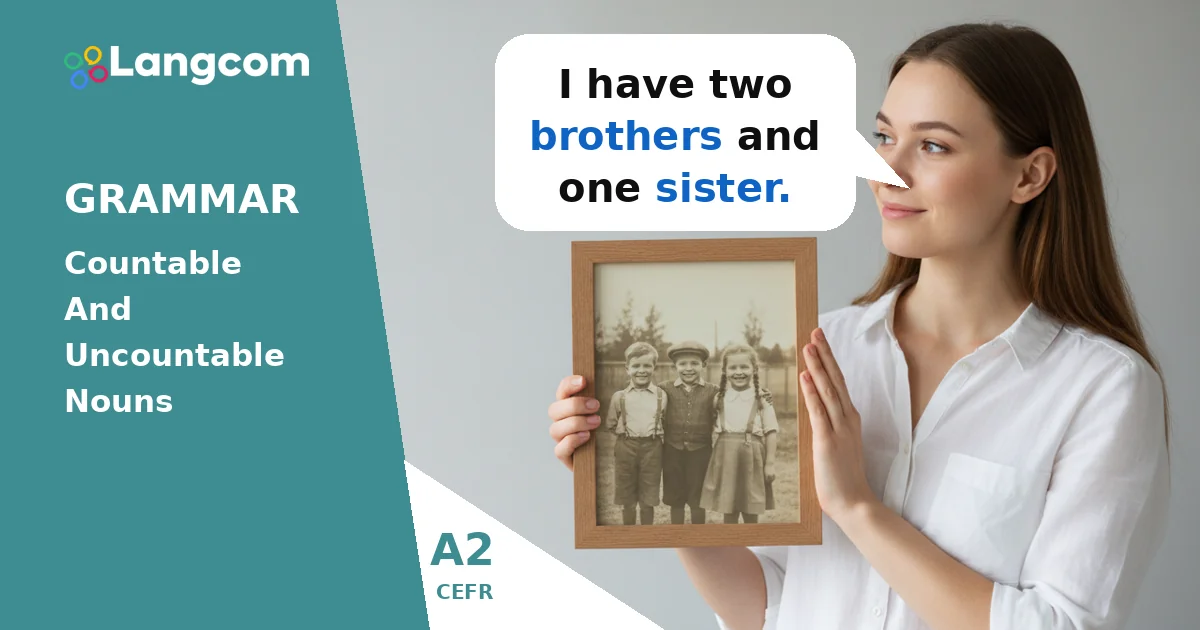
- I have two brothers and one sister.
- There are many books on the shelf.
- Can I have some water, please?
- She gave me good advice.
- The children are playing in the park.
- My feet are tired after walking.
- We saw many fish in the ocean.
- I need some new information for my project.
Übung
Bist du bereit, dein Zertifikat zu erwerben?
Der Kurs Langcom bereitet die Teilnehmer auf die Prüfungen von Cambridge, IELTS, TOEFL, DELE, SIELE und Michigan vor.
Erste Schritte mit LangcomHäufige Fehler bei Spanischsprechern
Häufige Fehler bei Spanischsprechern
Spanish speakers sometimes make mistakes with uncountable nouns because many nouns that are uncountable in English are countable in Spanish.
- Trying to pluralize uncountable nouns:
Falsch: I need some informations.
Richtig: I need some information. (oder some pieces of information) - Verwendung von a/an with uncountable nouns:
Falsch: I want an advice.
Richtig: I want some advice. (oder a piece of advice) - Forgetting irregular plurals:
Falsch: There are three mans.
Richtig: There are three men.
Häufig gestellte Fragen
What is the main difference between countable and uncountable nouns?
The main difference is that countable nouns can be counted and have plural forms (e.g., apple, apples), while uncountable nouns cannot be counted individually and usually have only one form (e.g., rice, milk).
Can I use 'many' with uncountable nouns?
Nein, das geht nicht. many with uncountable nouns. Use much instead for uncountable nouns (e.g., much water), und many for countable nouns (e.g., many books).
Why is it important to learn plural rules for the A2 Key exam?
Learning plural rules is important for the A2 Key exam because you need to correctly identify and use singular and plural forms in reading and writing tasks. For example, in Part 6 of the Reading and Writing paper, you might need to complete sentences with the correct noun form.
Are there any nouns that can be both countable and uncountable?
Yes, some nouns can be both, depending on the meaning. For example, coffee can be uncountable (the drink: I like coffee) or countable (a cup of coffee: Two coffees, please).




0 Kommentare