

What Are Countable Nouns?
Countable nouns are for things we can count. They have a singular form and a plural form.
- You can use numbers with them: one apple, two apples.
- In the singular, you can use a oder an: a book, an orange.
- In the plural, you can use quantifiers like many, a few, some, any: many friends, a few ideas.
✍️ Du bist dir nicht sicher, auf welchem Niveau du bist?
Machen Sie unseren kostenlosen Einstufungstest und erhalten Sie individuelles Feedback von zertifizierten Cambridge-Prüfern.
Machen Sie unseren KOSTENLOSEN EinstufungstestWhat Are Uncountable Nouns?
Uncountable nouns are for things we cannot count individually. These often include:
- Liquids: water, coffee, milk
- Materials: wood, metal, plastic
- Abstract ideas: information, advice, happiness
- Gases: air, oxygen
- Small particles: rice, sand, sugar
They usually only have a singular form and do not take a oder an. We cannot use numbers directly with them. Instead, we use quantifiers like much, a little, some, any, a lot of.
How Do We Use Quantifiers with These Nouns?
Choosing the correct quantifier depends on whether the noun is countable or uncountable. Here are the main ones:
- Many: Used with countable nouns in plural. How many books do you have?
- Much: Used with uncountable nouns. How much money do you need?
- A lot of / Lots of: Can be used with both countable (plural) and uncountable nouns. This is very common in informal English. She has a lot of friends. / We have lots of work.
- Few / A few: Used with countable nouns in plural. Few people came. / I have a few questions.
- Little / A little: Used with uncountable nouns. There is little hope. / Can I have a little sugar?
- Some / Any: Used with both countable (plural) and uncountable nouns. Some is for positive statements and offers. Any is for questions and negative statements. I have some ideas. / Do you have any water? / I don't have any money.
When Can Uncountable Nouns Become Countable?
Sometimes, an uncountable noun can be used in a countable way, but its meaning changes slightly. This is important for B2 learners.
- General vs. Specific Types: Coffee (uncountable, the drink) vs. two coffees (countable, two cups/orders of coffee).
- Abstract vs. Concrete Instance: Experience (uncountable, general knowledge) vs. an experience (countable, a specific event).
- Using Measuring Words: We can count uncountable nouns by using specific units or containers. For example, instead of two waters, we say two bottles of water oder two glasses of water. Other examples include a slice of bread, a piece of advice, a carton of milk.
| Quantifier | Countable Nouns (Plural) | Uncountable Nouns |
|---|---|---|
| Many | many books | ❌ |
| Much | ❌ | much time |
| A lot of / Lots of | a lot of friends | a lot of advice |
| Few / A few | a few ideas | ❌ |
| Little / A little | ❌ | a little sugar |
| Some / Any | some questions | some water |
Beispiele
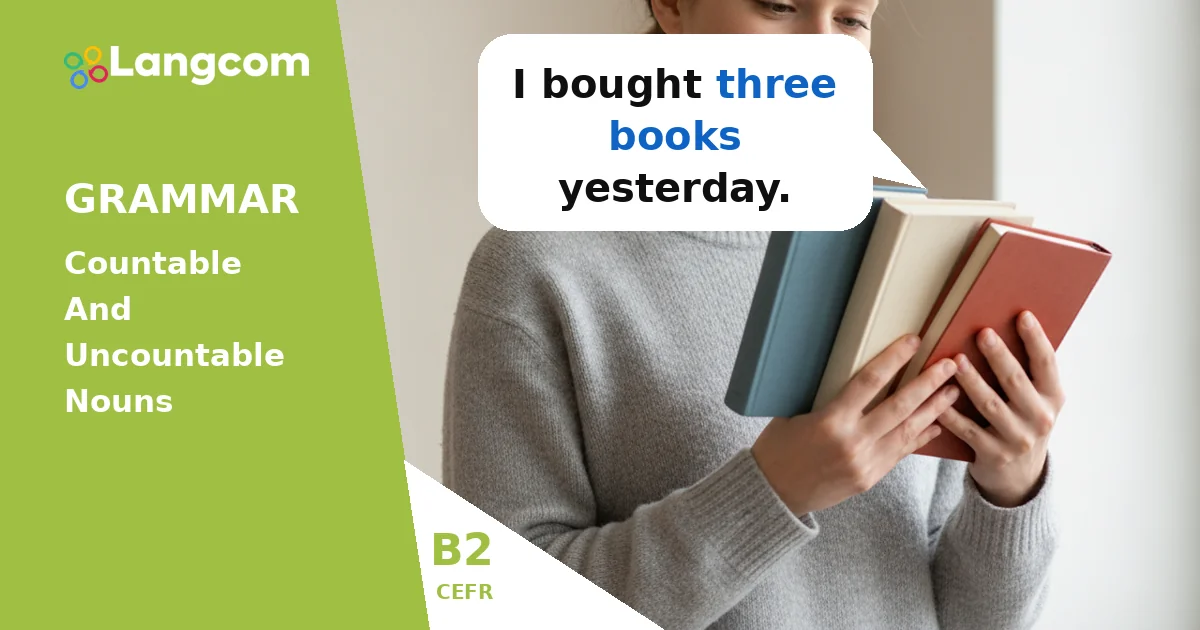
- I bought three books yesterday.
- She needs some information for her project.
- There isn't much traffic on the roads today.
- How many students are in your class?
- Could I have a glass of water, please?
- We had a wonderful experience at the concert.
Übung
Bist du bereit, dein Zertifikat zu erwerben?
Der Kurs Langcom bereitet die Teilnehmer auf die Prüfungen von Cambridge, IELTS, TOEFL, DELE, SIELE und Michigan vor.
Erste Schritte mit LangcomHäufige Fehler bei Spanischsprechern
Spanish speakers often make mistakes with countable and uncountable nouns because some nouns are treated differently in English and Spanish.
- Adding -s to uncountable nouns: In Spanish, nouns like 'información' or 'consejo' can sometimes be pluralized in a way that doesn't directly translate to English. For example, you cannot say
informationsoderadvices. The correct forms are information und advice. - Verwendung von many with uncountable nouns: It's incorrect to say
many moneyodermany furniture. The correct forms are much money und much furniture (oder a lot of furniture). - Verwendung von a/an with uncountable nouns: You cannot say
an adviceodera bread. Instead, use a piece of advice oder a slice of bread.
Häufig gestellte Fragen
What is the main difference between countable and uncountable nouns?
The main difference is that countable nouns refer to individual items you can count and pluralize (e.g., three apples), while uncountable nouns refer to things you cannot count individually and usually only have a singular form (e.g., some water).
Is 'fruit' countable or uncountable?
Generally, fruit is used as an uncountable noun in English when referring to fruit in general (e.g., Fruit is good for you.). However, when talking about different types of fruit, it can be countable (e.g., There are many exotic fruits in this market.).
How do I know if a noun is countable or uncountable?
A good test is to try to put a number in front of it or add an -s to make it plural. If it sounds natural (e.g., two chairs), it's countable. If it doesn't (e.g., two waters), it's uncountable. For uncountable nouns, think about whether you need a measuring word like a piece of oder a glass of.
Is understanding countable and uncountable nouns important for the B2 First exam?
Yes, it is very important. Correctly using countable and uncountable nouns, along with their appropriate quantifiers, is tested in various parts of the B2 First exam, especially in the Use of English paper (e.g., Part 1 Multiple-choice cloze, Part 2 Open cloze) and in your written tasks to ensure grammatical accuracy.



0 Kommentare