
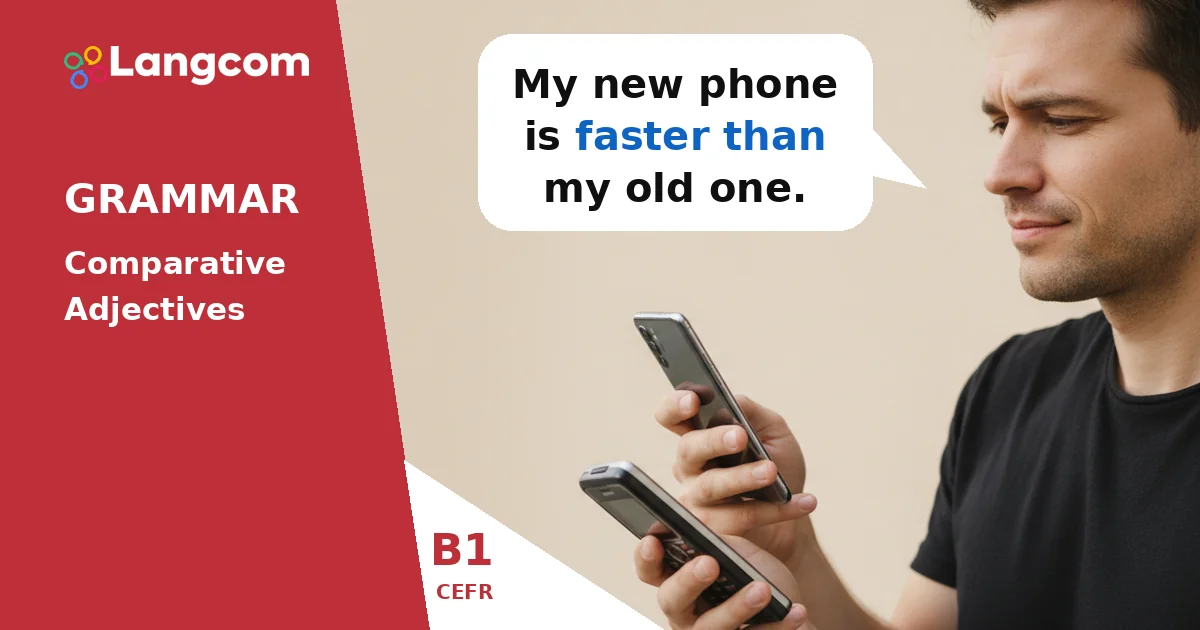

What Are Comparative Adjectives?
Comparative adjectives help us compare two nouns (people, places, or things). They show which one has more of a specific quality.
Wir verwenden comparative adjectives to say that one thing is different from another. We often use the word than after the adjective.
- For short adjectives (one syllable), we usually add -er. Zum Beispiel:, tall wird zu taller.
- For longer adjectives (two or more syllables), we use more before the adjective. For example, expensive wird zu more expensive.
✍️ Du bist dir nicht sicher, auf welchem Niveau du bist?
Machen Sie unseren kostenlosen Einstufungstest und erhalten Sie individuelles Feedback von zertifizierten Cambridge-Prüfern.
Machen Sie unseren KOSTENLOSEN EinstufungstestWhat Are Superlative Adjectives?
Superlative adjectives describe one noun that has the highest or lowest degree of a quality within a group of three or more.
They tell us which item is “the most” or “the least” of something. We always use the before a superlative adjective.
- For short adjectives, we usually add -est. Zum Beispiel:, tall wird zu the tallest.
- For longer adjectives, we use most before the adjective. For example, expensive wird zu the most expensive.
How Do We Form Comparative and Superlative Adjectives?
The way we form comparative und superlative adjectives depends on the number of syllables in the base adjective.
There are some general rules to follow, but also a few irregular forms you need to learn.
- One-syllable adjectives: Hinzufügen -er for comparative and -est for superlative.
- cold → colder → coldest
- One-syllable adjectives ending in -e: Hinzufügen -r for comparative and -st for superlative.
- large → larger → largest
- One-syllable adjectives ending in consonant + vowel + consonant: Double the final consonant, then add -er oder -est.
- hot → hotter → hottest
- Two-syllable adjectives ending in -y: Ändern y zu i, then add -er oder -est.
- happy → happier → happiest
- Adjectives with two or more syllables (not ending in -y): Verwendung more for comparative and most for superlative.
- beautiful → more beautiful → most beautiful
- Irregular adjectives: These do not follow the rules and must be memorized.
- good → better → best
- bad → worse → worst
- far → farther/further → farthest/furthest
| Adjective Type | Base Form | Vergleichsform | Superlative Form |
|---|---|---|---|
| One-syllable | small | smaller | smallest |
| One-syllable ending in -e | nice | nicer | nicest |
| One-syllable CVC (consonant-vowel-consonant) | big | bigger | biggest |
| Two-syllables ending in -y | easy | easier | easiest |
| Two or more syllables | important | more important | most important |
| Irregular | good | better | best |
| Irregular | bad | worse | worst |
Beispiele
- My new phone is faster than my old one.
- This book is more interesting than the movie.
- She is the happiest person I know.
- Mount Everest is the highest mountain in the world.
- Learning English is more difficult than learning Spanish for some people.
- That was the worst meal I've ever had!
- He is the most intelligent student in the class.
- Today's weather is better than yesterday's.
Übung
Bist du bereit, dein Zertifikat zu erwerben?
Der Kurs Langcom bereitet die Teilnehmer auf die Prüfungen von Cambridge, IELTS, TOEFL, DELE, SIELE und Michigan vor.
Erste Schritte mit LangcomHäufige Fehler bei Spanischsprechern
Spanish speakers sometimes make specific mistakes with comparative und superlative adjectives:
- Verwendung von more mit -er: In Spanish, you might say "más rápido". In English, do not combine more mit -er.
- INCORRECT: My car is more faster than yours.
- CORRECT: My car is faster than yours.
- Forgetting than oder the: These small words are essential for correct comparisons.
- INCORRECT: This book is more interesting that movie. (Missing than)
- CORRECT: This book is more interesting than that movie.
- INCORRECT: She is happiest person I know. (Missing the)
- CORRECT: She is the happiest person I know.
- Applying -er/-est to long adjectives: Remember to use more/most for adjectives with two or more syllables (unless they end in -y).
- INCORRECT: This is the beautifulest painting.
- CORRECT: This is the most beautiful painting.
Häufig gestellte Fragen
What is the main difference between comparative and superlative adjectives?
Comparative adjectives compare two things (taller than, more interesting than). Superlative adjectives compare one thing to a group of three or more, showing it has the most of a quality (the tallest, the most interesting).
Can I use "more" with short adjectives like "big"?
No, you should not use more with short adjectives. For big, the comparative is bigger, nicht more big.
How are comparative and superlative adjectives tested in the B1 Preliminary exam?
In the B1 Preliminary exam, you might find questions about comparative und superlative adjectives in the Reading and Writing parts, especially in tasks like "Open Cloze" or "Word Formation" where you need to choose the correct form of an adjective to complete a sentence.
Are there any adjectives that can use both -er/-est and more/most?
Yes, some two-syllable adjectives, especially those ending in -ow, -le, oder -er, can sometimes use both forms. For example, clever can be cleverer oder more clever, und cleverest oder most clever. However, the -er/-est forms are often more common for these.


0 Kommentare