
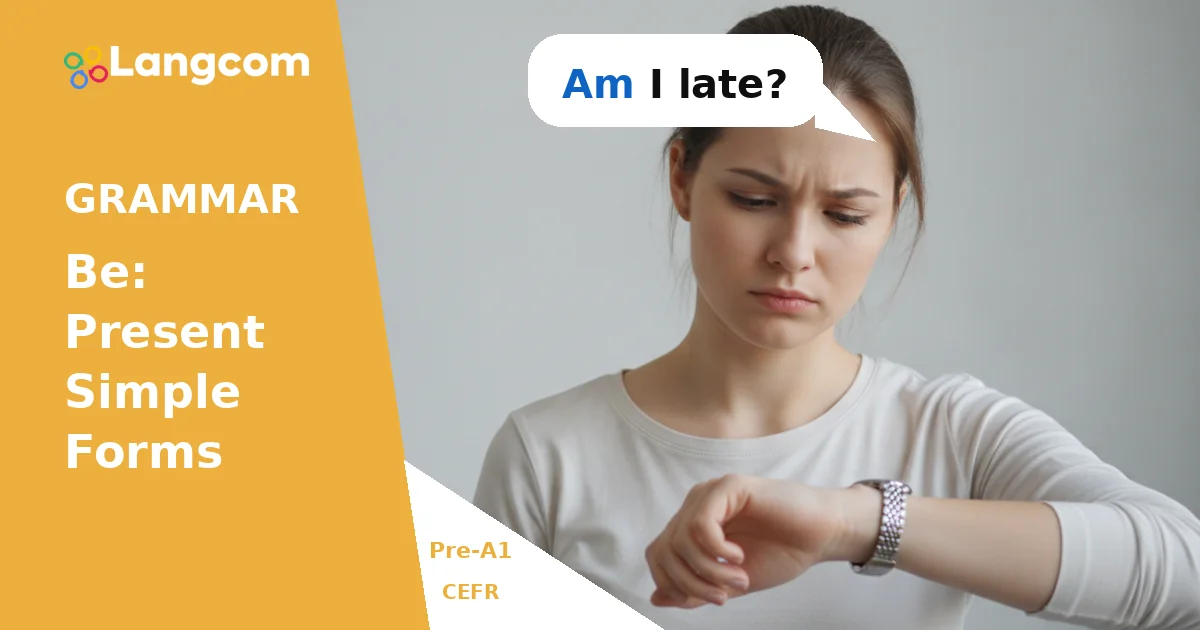

How Do We Form Yes/No Questions with ‘Be’?
Yes/No questions are simple. They ask for a ‘yes’ or ‘no’ answer.
- Beginnen Sie mit Am, Is, oder Are.
- Then add the subject (who or what).
- Finish with the rest of the sentence.
- Beispiel: Are you happy?
🎓 Englisch lernen mit der Blended-Methode
Kleingruppen · KI-Tutor rund um die Uhr · Vorbereitung auf die Cambridge-Prüfungen
Pläne von $39 $79 pro Monat
What Are Short Answers to 'Be' Questions?
When someone asks a Yes/No question with be, we often use short answers.
- They are positive (e.g., Yes, I am) or negative (e.g., No, I'm not).
- Remember to use the correct form of be for the subject.
- Important: Do not use contractions in positive short answers. For example, say Yes, I am, nicht Yes, I'm.
How Do We Form Wh-Questions with 'Be'?
Wh-questions ask for specific information, not just 'yes' or 'no'.
- Start with a question word: What, Where, Who, When, Why, How.
- Dann füge hinzu am, is, oder are.
- Finally, add the subject and the rest of the sentence.
- Beispiel: Where are you from?
| Verb Be | Betreff | Rest of Sentence? | Positive Short Answer | Negative Short Answer |
|---|---|---|---|---|
| Am | I | ready? | Yes, you are. | No, you aren't. |
| Is | he/she/it | cold? | Yes, he/she/it is. | No, he/she/it isn't. |
| Are | you | a teacher? | Yes, I am. | No, I'm not. |
| Are | we/they | here? | Yes, we/they are. | No, we/they aren't. |
Beispiele
- Am I late?
- Is she a student?
- Are they friends?
- What is your name?
- Where are you from?
- How old is he?
- Who is that?
Übung
💬 Benötigen Sie eine individuelle Beratung?
Als autorisiertes Cambridge-Vorbereitungszentrum können wir Ihnen helfen, den richtigen Kurs und die passende Zertifizierung zu finden. Chatten Sie noch heute mit unseren Beratern.
Chatten Sie mit einem Berater auf WhatsAppHäufige Fehler bei Spanischsprechern
Spanish speakers sometimes put the subject before the verb in questions, like in Spanish. This is incorrect in English.
- Falsch: You are happy?
- Richtig: Are you happy?
Another common mistake is forgetting to use the verb to be when asking about age. This is often a direct translation from Spanish.
- Falsch: How old you have?
- Richtig: How old are you?
Also, remember not to use contractions in positive short answers.
- Falsch: Yes, I'm.
- Richtig: Yes, I am.
Häufig gestellte Fragen
What is the basic rule for 'be' questions?
The basic rule is to put the verb be (am, is, are) before the subject. For example, Is he happy?
Can I use contractions in 'be' questions?
Yes, you can use contractions in negative questions, like Isn't she here? oder Aren't you ready? However, we usually do not contract am not in questions.
How do I answer a Yes/No question with 'be'?
Use short answers. For example, if someone asks Are you a student?, you can say Yes, I am oder No, I'm not. Remember, no contractions in positive short answers.
What are some common question words with 'be'?
Common question words include What (for things), Where (for places), Who (for people), When (for time), and How (for manner or age).

0 Kommentare