

Why are Verbs with Prepositions Important?
Verbs followed by prepositions are very common in English. They help you express ideas clearly and naturally.
- They are essential for everyday conversations.
- They make your English sound more fluent and correct.
- They are often fixed expressions, so you need to learn them as a pair.
🎓 Englisch lernen mit der Blended-Methode
Kleingruppen · KI-Tutor rund um die Uhr · Vorbereitung auf die Cambridge-Prüfungen
Pläne von $39 $79 pro Monat
How Do Verbs and Prepositions Work Together?
A preposition connects the verb to the noun or pronoun that follows it. This noun or pronoun is the object of the preposition.
For example, in the sentence She is thinking about her holiday, the verb is thinking, the preposition is about, and the object is her holiday.
- The preposition often tells us more about the relationship between the verb and its object.
- Sometimes, the same verb can take different prepositions, and the meaning changes. For example, talk about (discuss a topic) is different from talk to (speak to a person).
Common B1 Verbs and Their Prepositions
Here are some important verbs and their common prepositions that B1 learners should know:
- Listen to: To pay attention to sounds. I always listen to music when I study.
- Wait for: To stay in a place until someone or something arrives. Are you waiting for a friend?
- Talk about: To discuss a topic. We talked about our plans for the weekend.
- Agree with: To have the same opinion as someone. I agree with you; it's a good idea.
- Think about/of: To consider or have an idea. What are you thinking about? / I often think of my family.
- Depend on: To rely on someone or something. Our picnic depends on the weather.
- Apologize for: To say sorry for something. He apologized for being late.
- Believe in: To have faith or trust in something/someone. Do you believe in ghosts?
- Look at: To direct your eyes towards something. Look at that beautiful painting!
Tips for Learning Verbs with Prepositions
Learning these combinations can take time, but these tips can help:
- Learn them as chunks: Always learn the verb and its preposition together, e.g., listen to, wait for.
- Use example sentences: Create or find example sentences for each pair. This helps you see them in context.
- Read and listen: Pay attention to how native speakers use these combinations in books, movies, and conversations.
- Keep a vocabulary notebook: Write down new verb + preposition pairs with an example sentence for each.
| Verb | Preposition | Beispielsatz |
|---|---|---|
| listen | to | I always listen to the radio in the morning. |
| wait | for | Please wait for me outside the cinema. |
| talk | about | Let's talk about your ideas. |
| agree | with | I don't agree with his decision. |
| depend | on | You can depend on me for help. |
| apologize | for | She apologized for her rude behavior. |
Beispiele
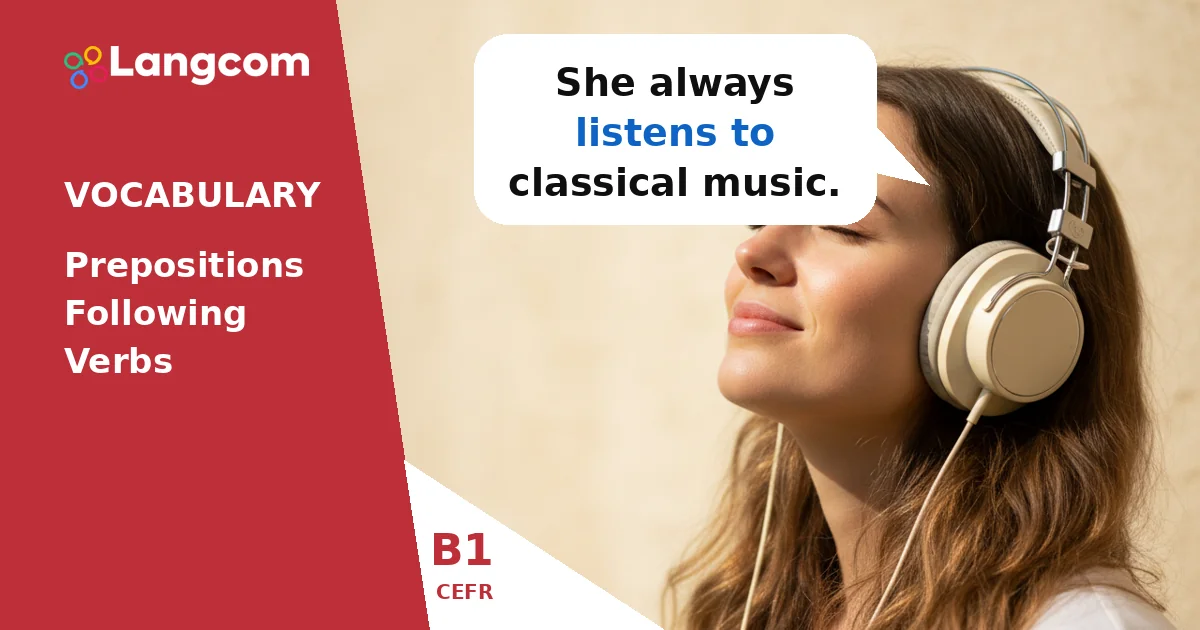
- She always listens to classical music.
- I'm waiting for the train to arrive.
- We need to talk about your project.
- Do you agree with my opinion?
- He is thinking about his future.
- Everything depends on your decision.
- Please apologize for your mistake.
- Many people believe in luck.
- Don't look at your phone while driving.
Übung
✍️ Du bist dir nicht sicher, auf welchem Niveau du bist?
Machen Sie unseren kostenlosen Einstufungstest und erhalten Sie individuelles Feedback von zertifizierten Cambridge-Prüfern.
Machen Sie unseren KOSTENLOSEN EinstufungstestHäufige Fehler bei Spanischsprechern
A common mistake for Spanish speakers is to translate directly from Spanish, where prepositions might be different or not used at all.
- Falsch: I listen music.
Richtig: I listen to music. (In Spanish, you might say 'escucho música' without a preposition.) - Falsch: She waits her friend.
Richtig: She waits for her friend. (In Spanish, 'espera a su amigo/a' uses 'a'.) - Falsch: We talked our plans.
Richtig: We talked about our plans. (In Spanish, 'hablamos de nuestros planes' uses 'de'.)
Remember that English prepositions do not always match Spanish ones. It's best to learn the verb and its preposition as a fixed pair.
Häufig gestellte Fragen
What is the difference between a phrasal verb and a verb + preposition?
A phrasal verb (e.g., turn off) has a particle that changes the verb's meaning significantly, and the particle can sometimes be separated from the verb. With a verb + preposition (e.g., listen to), the preposition is always followed by an object and cannot be separated from the verb. The preposition often clarifies the verb's action rather than changing its core meaning entirely.
Are there rules for which preposition to use with a verb?
Unfortunately, there are very few strict rules. Most verb + preposition combinations must be learned as fixed expressions. While some prepositions have general meanings (e.g., for often indicates purpose), their use with specific verbs is often idiomatic. The best way is to learn them through practice and exposure.
How can I remember all these verb + preposition combinations?
The best way is through consistent practice and exposure. Try to use new combinations in your own sentences, read English texts, and listen to English speakers. Keep a vocabulary notebook and review it regularly. Don't try to learn too many at once; focus on a few common ones each week.

0 Kommentare