


What are basic time expressions?
Basic time expressions tell us how often something happens. They are important for talking about your routine and habits.
- We use them with the simple present tense.
- They help answer questions like How often do you…?
🎓 Englisch lernen mit der Blended-Methode
Kleingruppen · KI-Tutor rund um die Uhr · Vorbereitung auf die Cambridge-Prüfungen
Pläne von $39 $79 pro Monat
How do we say 'one time' or 'two times'?
For one and two times, we use special words:
- For 'one time', we say once. Zum Beispiel:, I go to the gym once a week.
- For 'two times', we say twice. Zum Beispiel:, She calls her mother twice a day.
What about 'three times' or more?
For three times or more, we use the number plus times.
- three times: He eats pizza three times a month.
- four times: They visit their grandparents four times a year.
- You can use any number with times.
How do we use 'every'?
Das Wort every means 'all' or 'each'. We use it with time words like day, week, month, oder year.
- every day: I drink water every day.
- every week: We have an English lesson every week.
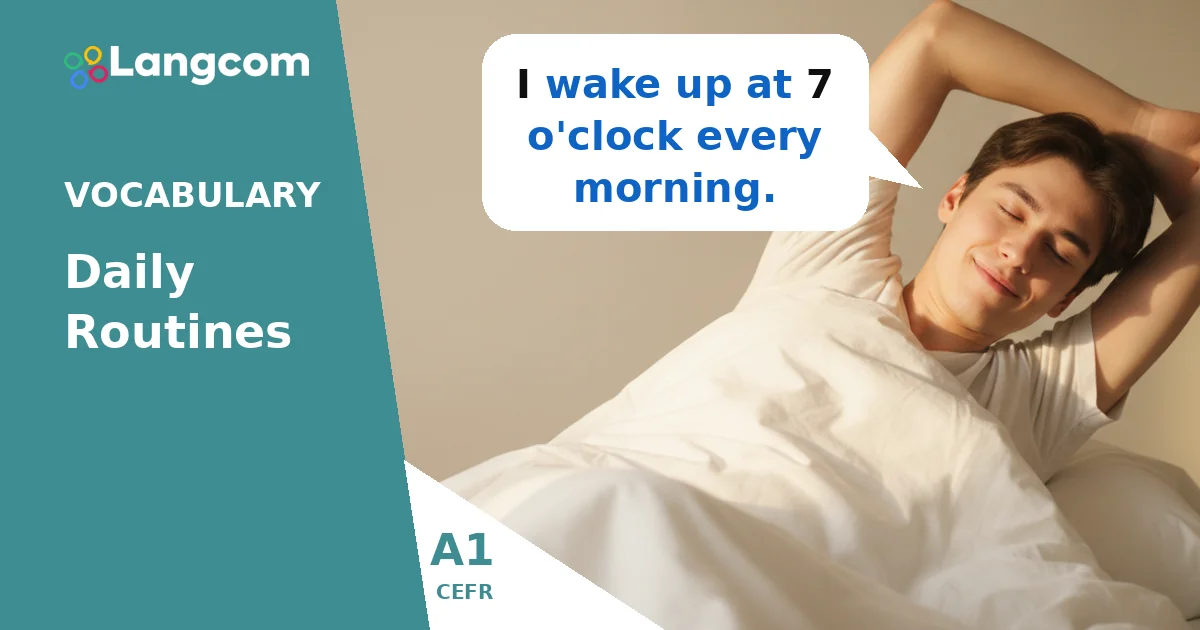
- every morning: She wakes up early every morning.
- every Monday: They play tennis every Monday.
Where do time expressions go in a sentence?
Usually, these time expressions go at the end of the sentence.
- I watch TV every night.
- She goes swimming twice a week.
- We have a meeting once a month.
| How often? | Beispielsatz |
|---|---|
| once a day | I eat fruit once a day. |
| twice a week | She studies English twice a week. |
| three times a month | He visits the library three times a month. |
| every day | We check our emails every day. |
| every weekend | They relax every weekend. |
| every year | The festival happens every year. |
Beispiele
- I brush my teeth twice a day.
- She goes to school every morning.
- They visit their family once a year.
- He plays video games three times a week.
- We eat dinner together every evening.
Übung
💬 Benötigen Sie eine individuelle Beratung?
Als autorisiertes Cambridge-Vorbereitungszentrum können wir Ihnen helfen, den richtigen Kurs und die passende Zertifizierung zu finden. Chatten Sie noch heute mit unseren Beratern.
Chatten Sie mit einem Berater auf WhatsAppHäufige Fehler bei Spanischsprechern
Spanish speakers sometimes make mistakes with 'once' and 'twice' or the position of the expression.
- Falsch: I go to the gym one time a week.
Richtig: I go to the gym once a week. (Use once for 'one time'.) - Falsch: I every day drink coffee.
Richtig: I drink coffee every day. (Time expressions usually go at the end.) - Falsch: She goes to the park two times a week.
Richtig: She goes to the park twice a week. (Use twice for 'two times'.)
Häufig gestellte Fragen
What is the difference between 'once' and 'one time'?
In English, we usually say once for 'one time' when talking about frequency. One time is not wrong, but once is more natural and common.
Can I say 'every' with specific days?
Yes, you can say every Monday, every Tuesday, etc. This means 'on all Mondays' or 'on each Tuesday'.
Do these expressions work with all tenses?
For A1 English, these expressions are mostly used with the simple present tense to talk about routines and habits. For example, I eat breakfast every morning.



0 Kommentare