

Why Is Health Vocabulary Important?
Talking about health is a common part of daily life. You might need to describe how you feel, ask for help, or understand advice from a doctor.
Knowing the right words helps you communicate clearly and feel more confident in English, especially when you are not feeling well.
🎓 Englisch lernen mit der Blended-Methode
Kleingruppen · KI-Tutor rund um die Uhr · Vorbereitung auf die Cambridge-Prüfungen
Pläne von $39 $79 pro Monat
Describing Illnesses and Symptoms
When you feel bad, you need words to explain your problem. Here are some common terms:
-
Sick / Ill / Unwell: These words mean you are not feeling healthy. Sick can also mean you want to vomit.
-
Temperature / Fever: If your body is too hot, you have a temperature or a fever.
-
Headache: Pain in your head.
-
Stomach ache: Pain in your stomach.
-
Sore throat: When your throat hurts, often when you swallow.
-
Cough: When you push air from your lungs with a sudden, loud sound.
-
Cold: A common illness that makes your nose run and you might cough.
-
Flu: A more serious cold mit fever and body aches.
People and Places That Help You
When you are sick, certain people and places can help:
-
Doctor: A person trained to treat illnesses. You visit a doctor when you are unwell.
-
Nurse: A person who helps doctors and cares for sick people, often in a hospital.
-
Hospital: A place where sick or injured people receive medical treatment.
-
Chemist / Pharmacy: A shop where you can buy medicine. In British English, it's often a chemist; in American English, it's a pharmacy.
-
Ambulance: A special vehicle that takes sick or injured people to the hospital quickly.
Treatments and Getting Better
After seeing a doctor, you might need treatment:
-
Medicine: Drugs or pills you take to get better.
-
Prescription: A written order from a doctor für medicine.
-
Get better / Recover: To become healthy again after being sick.
| Category | Englisches Wort |
|---|---|
| Illnesses/Symptoms | Sick, Ill, Unwell, Temperature, Fever, Headache, Stomach ache, Sore throat, Cough, Cold, Flu |
| People/Places | Doctor, Nurse, Hospital, Chemist, Pharmacy, Ambulance |
| Treatments/Actions | Medicine, Prescription, Get better, Recover |
Beispiele
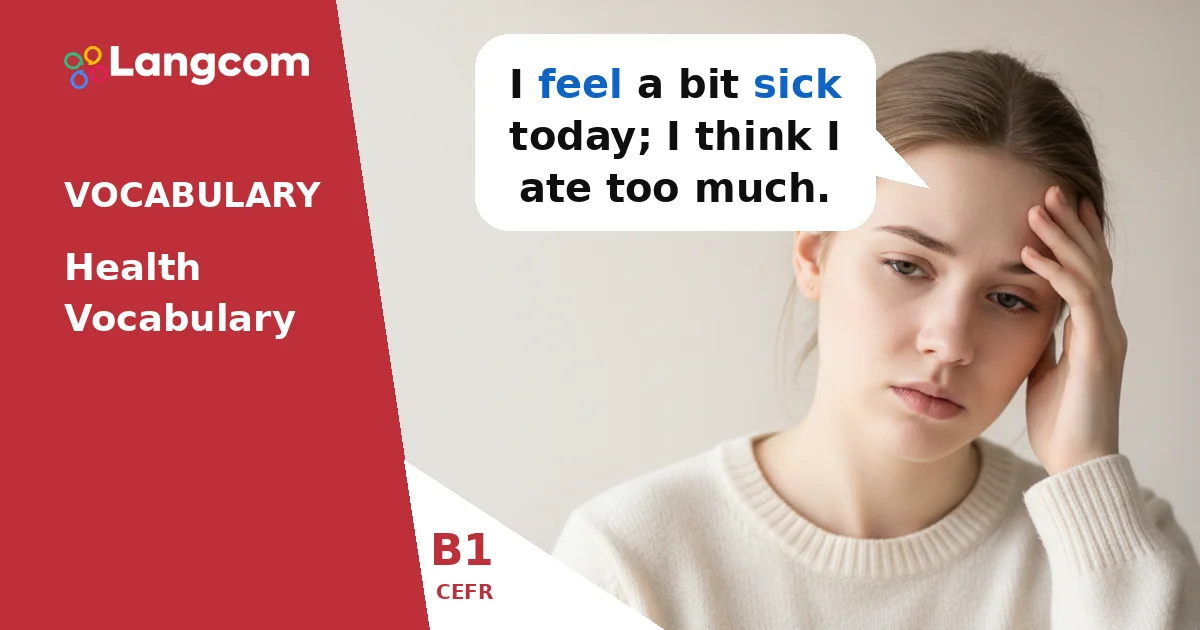
- I feel a bit sick today; I think I ate too much.
- The nurse gave me some medicine for my headache.
- If it's an emergency, call an ambulance immediately.
- You should take this medicine twice a day.
- My temperature is high, so I have a fever.
- I need to go to the chemist to pick up my prescription.
- She has a bad cold and a sore throat.
- The doctor told me to rest and drink a lot of water to get better.
Übung
✍️ Du bist dir nicht sicher, auf welchem Niveau du bist?
Machen Sie unseren kostenlosen Einstufungstest und erhalten Sie individuelles Feedback von zertifizierten Cambridge-Prüfern.
Machen Sie unseren KOSTENLOSEN EinstufungstestHäufige Fehler bei Spanischsprechern
Many Spanish speakers make small errors with health vocabulary. Here are some common ones:
-
Sick vs. Ill: Both mean 'enfermo'. However, sick can also mean 'nauseous' or 'vomiting'. So, I feel sick often means 'tengo náuseas'. If you just mean 'enfermo', ill is always safe. Example: I am ill with the flu. (Richtig) I feel sick, I might vomit. (Richtig)
-
Have temperature: Im Englischen sagen wir have a temperature oder have a fever. We don't say 'have temperature' without 'a'. Example: I have a high temperature. (Correct) Not: I have high temperature.
-
Chemist vs. Pharmacy: Both are correct, but chemist kommt im britischen Englisch häufiger vor, und pharmacy in American English. You can use either, but be aware of the difference.
Häufig gestellte Fragen
What is the difference between 'sick' and 'ill'?
Sick und ill both mean 'not healthy'. However, sick can also mean 'feeling like you want to vomit'. For example, I feel ill means 'I am not well', but I feel sick can mean 'I feel nauseous'.
What is a 'chemist'?
A chemist is a shop where you can buy medicine and other health products. It is the British English word for what is often called a pharmacy in American English.
How do I say 'I have a cold' in English?
Man kann sagen, I have a cold. You can also say I've caught a cold. If it's more serious, you might say I have the flu.
What should I do if I have a high temperature?
If you have a high temperature (oder fever), you should rest, drink plenty of water, and consider taking medicine like paracetamol. If you feel very unwell, you should see a doctor.
How can I practice this vocabulary for exams like Cambridge A2 Key?
To practice, try describing common illnesses or talking about a time you visited a doctor. You can also use flashcards or label pictures of health-related items. For exams like the Cambridge A2 Key, you might find tasks where you match words to definitions or complete sentences about health, similar to the exercise in this lesson.




0 Kommentare