

What Are Dependent Prepositions?
In English, many verbs are not complete by themselves. They need a specific preposition to follow them. This preposition is called a dependent preposition.
It “depends” on the verb and always goes with that particular verb to create a correct and natural phrase.
🎓 Englisch lernen mit der Blended-Methode
Kleingruppen · KI-Tutor rund um die Uhr · Vorbereitung auf die Cambridge-Prüfungen
Pläne von $39 $79 pro Monat
Why Are Dependent Prepositions Important for B1 English?
Using the correct dependent preposition is key for clear communication.
If you use the wrong preposition, your sentence might sound unnatural or even have a different meaning.
- Speak more fluently and confidently.
- Understand native speakers better.
- Avoid common mistakes in exams and daily conversations.
Common B1 Verbs with Their Dependent Prepositions
Here are some common verbs that B1 learners often use, along with their dependent prepositions and example sentences. Remember, these pairs are fixed, so it's best to learn them together.
- Agree with (a person/idea): I agree with you.
- Apologize for (an action): He apologized for being late.
- Apologize to (a person): She apologized to her friend.
- Belong to (ownership): This book belongs to me.
- Concentrate on (focus): Please concentrate on your work.
- Depend on (rely on): We depend on good weather for our picnic.
- Dream about/of (think about while sleeping or wish for): I often dream about flying. / She dreams of becoming a doctor.
- Listen to (hear something): Do you like to listen to music?
- Look at (direct your eyes): Look at that beautiful painting!
- Pay for (buy something): I will pay for dinner tonight.
- Talk about (discuss a topic): Let's talk about your plans.
- Talk to (speak with someone): Can I talk to you for a moment?
- Think about/of (consider/have an opinion): What are you thinking about? / I think of her as a good friend.
- Wait for (expect someone/something): We are waiting for the bus.
- Worry about (feel anxious): Don't worry about the exam.
How Can I Learn Dependent Prepositions Effectively?
Learning dependent prepositions takes practice. Here are some tips:
- Learn in chunks: Always learn the verb and its preposition together, like listen to, not just listen.
- Use flashcards: Write the verb on one side and the preposition with an example sentence on the other.
- Read and listen: Pay attention to how native speakers use these verbs in books, movies, and conversations.
- Practice speaking and writing: Try to use new verb-preposition pairs in your own sentences.
| Verb + Preposition | Bedeutung | Example Sentence |
|---|---|---|
| Agree with | To have the same opinion as someone | I agree with your idea. |
| Apologize for | To say sorry for something | He apologized for his mistake. |
| Belong to | To be owned by someone | This car belongs to my uncle. |
| Concentrate on | To give all your attention to something | Try to concentrate on your breathing. |
| Depend on | To need someone or something | Our success depends on teamwork. |
| Listen to | To pay attention to sounds | She loves to listen to classical music. |
| Worry about | To feel anxious or unhappy about something | Don't worry about the future. |
Beispiele
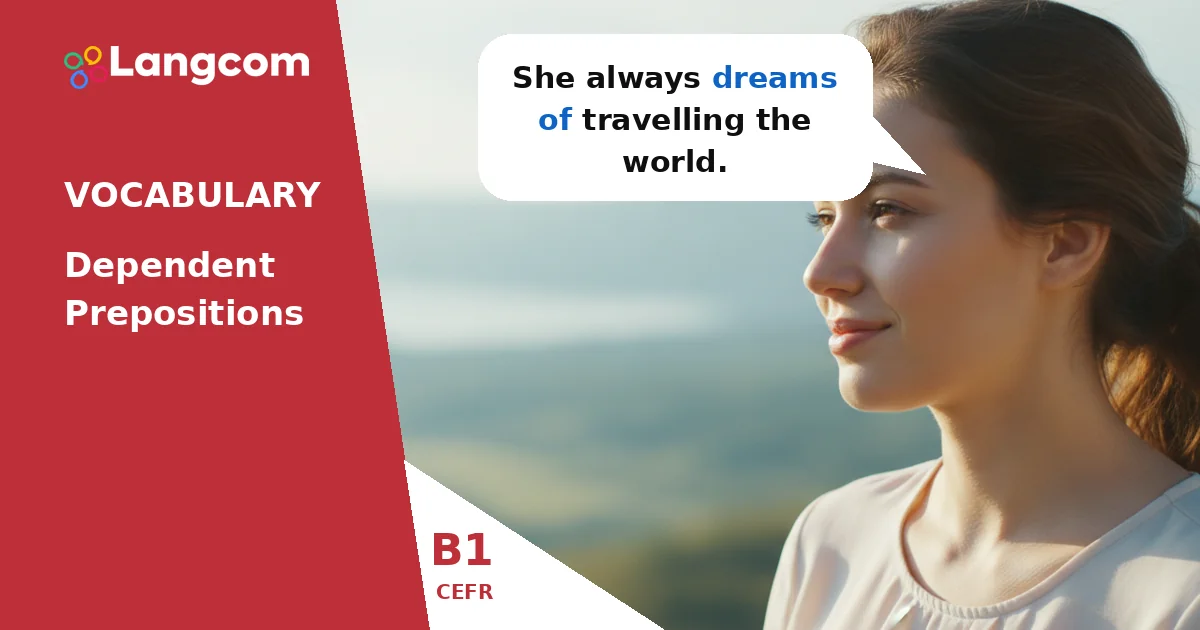
- She always dreams of travelling the world.
- I need to concentrate on my studies this week.
- Who does this pen belong to?
- We must apologize for the delay.
- Can you wait for me outside the cinema?
- Don't worry about the small details.
- He agreed with my suggestion.
- Let's talk about the new project.
Übung
✍️ Du bist dir nicht sicher, auf welchem Niveau du bist?
Machen Sie unseren kostenlosen Einstufungstest und erhalten Sie individuelles Feedback von zertifizierten Cambridge-Prüfern.
Machen Sie unseren KOSTENLOSEN EinstufungstestHäufige Fehler bei Spanischsprechern
Spanish speakers often make mistakes with dependent prepositions because the rules are different.
- Falsch: I depend of you. (Influenced by "depender de")
Richtig: I depend on you. - Falsch: She listened the music. (Influenced by "escuchar la música" without 'a')
Richtig: She listened to the music. - Falsch: I will pay the dinner. (Influenced by "pagar la cena" without 'por')
Richtig: I will pay for the dinner. - Falsch: What are you thinking in? (Influenced by "pensar en")
Richtig: What are you thinking about? - Falsch: Wait me! (Influenced by "esperar a alguien" or "esperarme")
Richtig: Wait for me!
Always remember that English verbs often need a specific preposition, even if your native language doesn't use one in the same situation.
Häufig gestellte Fragen
Do all verbs have dependent prepositions?
No, not all verbs have dependent prepositions. Many verbs, like eat, run, oder sleep, do not need a specific preposition to complete their meaning. Dependent prepositions are only for certain verbs.
Is there a rule to know which preposition goes with which verb?
Unfortunately, there is no simple rule. Dependent prepositions are often idiomatic, meaning their use is fixed and must be learned. The best way is to memorize the verb and its preposition together, like apologize for oder agree with.
What is the difference between dependent prepositions and phrasal verbs?
This is a good question! With dependent prepositions, the verb usually keeps its main meaning, and the preposition just completes it (e.g., look at means 'direct eyes towards'). With phrasal verbs, the verb and preposition (or adverb) together create a new meaning that is often very different from the original verb (e.g., look up can mean 'search for information').

0 Kommentare