

Was sind Adjektive?
Adjectives are words that describe nouns. They tell us more about the quality, size, color, or feeling of a person, place, or thing.
- A noun is a person, place, or thing (e.g., film, book, friend).
- An adjective describes that noun (e.g., an interesting film, a boring book, an amazing friend).
Adjectives usually come vor the noun they describe, or after verbs like be, seem, oder feel.
✍️ Du bist dir nicht sicher, auf welchem Niveau du bist?
Machen Sie unseren kostenlosen Einstufungstest und erhalten Sie individuelles Feedback von zertifizierten Cambridge-Prüfern.
Machen Sie unseren KOSTENLOSEN EinstufungstestDescribing Good Things: Positive Adjectives
Here are some adjectives to describe things you like or find positive:
- Amazing: This means very surprising and wonderful. It's stronger than 'good'.
Beispiel: The view from the mountain was amazing. - Awesome: This means extremely good or impressive. It's often used for things that are very exciting.
Beispiel: The band played an awesome song. - Interesting: This means holding your attention; not boring. You want to know more about it.
Beispiel: I read an interesting article about space.
Describing Bad Things: Negative Adjectives
These adjectives help you talk about things you don't like or find negative:
- Boring: This means not interesting; it makes you feel tired or annoyed.
Beispiel: The lesson was boring, so I almost fell asleep. - Horrible: This means very bad or unpleasant. It can describe feelings, tastes, or experiences.
Beispiel: The weather was horrible yesterday. - Terrible: This also means very bad or of very poor quality. It's similar to 'horrible'.
Beispiel: The food at the restaurant was terrible.
Learning Opposites for A2 Key
Knowing opposites (antonyms) is very useful for your A2 Key exam. It helps you understand different meanings and express yourself more clearly. For example, in Part 2 of the A2 Key Speaking exam, you might need to describe two different pictures.
- Amazing is the opposite of terrible oder horrible.
- Awesome is also the opposite of terrible oder horrible.
- Interesting is the opposite of boring.
| Adjektiv | Opposite |
|---|---|
| amazing | terrible / boring |
| awesome | horrible / boring |
| interesting | boring |
| boring | interesting / amazing |
| horrible | amazing / awesome |
| terrible | amazing / awesome |
Beispiele
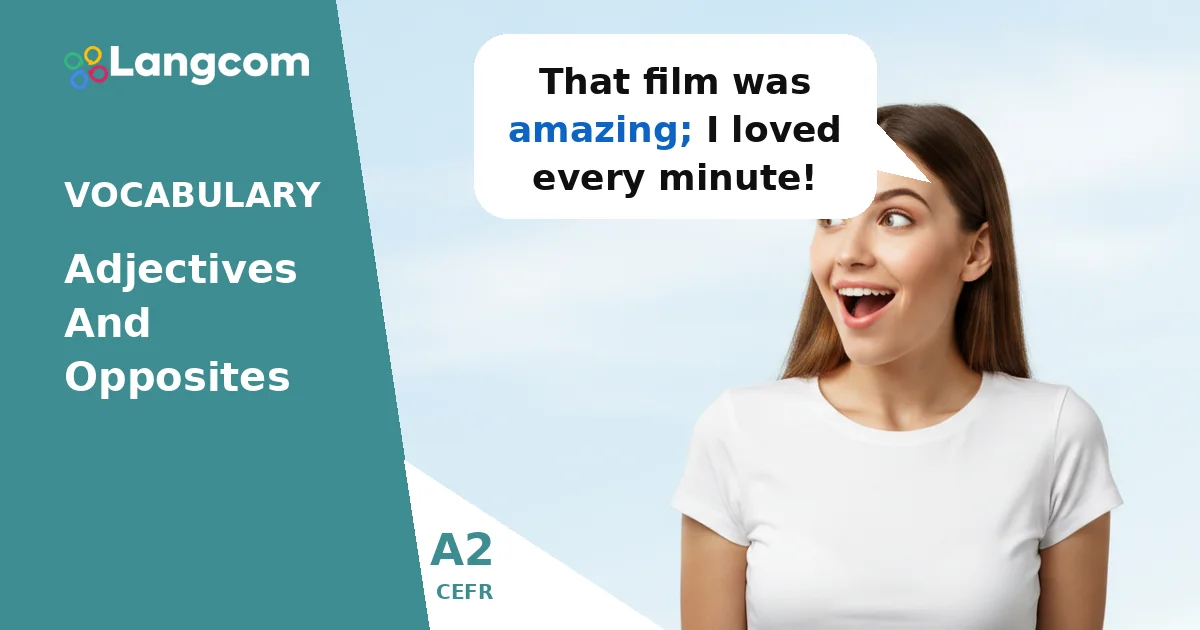
- That film was amazing; I loved every minute!
- We had an awesome time at the concert last night.
- The museum exhibition was very interesting.
- I found the book quite boring, so I didn't finish it.
- The traffic was horrible this morning.
- My internet connection is terrible today.
Übung
Bist du bereit, dein Zertifikat zu erwerben?
Der Kurs Langcom bereitet die Teilnehmer auf die Prüfungen von Cambridge, IELTS, TOEFL, DELE, SIELE und Michigan vor.
Erste Schritte mit LangcomHäufige Fehler bei Spanischsprechern
Spanish speakers sometimes make these mistakes with English adjectives:
- Word Order: In English, adjectives usually come vor the noun. In Spanish, they often come after.
Falsch: a film interesting
Rechts: an interesting film - Agreement: English adjectives do not change for plural or gender.
Falsch: two amazings films
Rechts: two amazing films - Verwendung von very with strong adjectives: Adjectives like amazing, awesome, horrible, und terrible are already very strong. Do not use very with them. Instead, use words like really oder absolutely.
Falsch: The food was very terrible.
Rechts: The food was really terrible. oder The food was absolutely terrible.
Häufig gestellte Fragen
Was ist ein Adjektiv?
An adjective is a word that describes a noun or pronoun. It tells you more about its qualities, like big, small, happy, oder boring.
Where do I put adjectives in a sentence?
Most often, adjectives go before the noun they describe, like an amazing book. They can also come after verbs like be, seem, oder feel, for example: The film was interesting.
Why are opposites important for the A2 Key exam?
Knowing opposites helps you understand a wider range of vocabulary and express contrasts. For example, in A2 Key Reading Part 2, you might need to match descriptions with different opinions, where understanding opposites like amazing vs. terrible is key.
Can I use 'very' with all adjectives?
No. You can use very with normal adjectives like good oder bad. But for strong adjectives like amazing, awesome, horrible, oder terrible, use words like really oder absolutely instead.

0 Kommentare