

What are Adverbs?
Adverbs are words that give more information about an action. They describe verbs.
Think of adverbs as words that answer questions like “How?”, “When?”, or “Where?”. At A1, we focus on “How?”.
- He runs. (This is a simple sentence.)
- He runs quickly. (The adverb quickly tells us how he runs.)
🎓 Englisch lernen mit der Blended-Methode
Kleingruppen · KI-Tutor rund um die Uhr · Vorbereitung auf die Cambridge-Prüfungen
Pläne von $39 $79 pro Monat
How Do We Form Adverbs?
Many adverbs are formed by adding -ly to an adjective.
- Adjective: slow → Adverb: slowly
- Adjective: quick → Adverb: quickly
- Adjective: beautiful → Adverb: beautifully
Some adverbs are irregular. They do not follow the -ly rule. You need to learn these words.
- Adjective: good → Adverb: well
- Adjective: hard → Adverb: hard (It stays the same!)
Where Do Adverbs Go in a Sentence?
For A1 adverbs of manner, the most common place is after the verb.
- She speaks loudly. (loudly comes after the verb speaks)
- They work hard. (hard comes after the verb work)
If there is an object, the adverb usually goes after the object.
- He drives his car carefully. (carefully comes after his car)
- I speak English well. (well comes after English)
Common A1 Adverbs to Know
Here are some adverbs you will use often at A1 level:
- quickly: The rabbit runs quickly.
- slowly: The turtle walks slowly.
- happily: She smiled happily.
- sadly: He spoke sadly about his lost dog.
- loudly: The baby cried loudly.
- quietly: Please speak quietly in the library.
- well: She sings well.
- badly: He plays tennis badly.
- hard: They study hard for the exam.
Beispiele
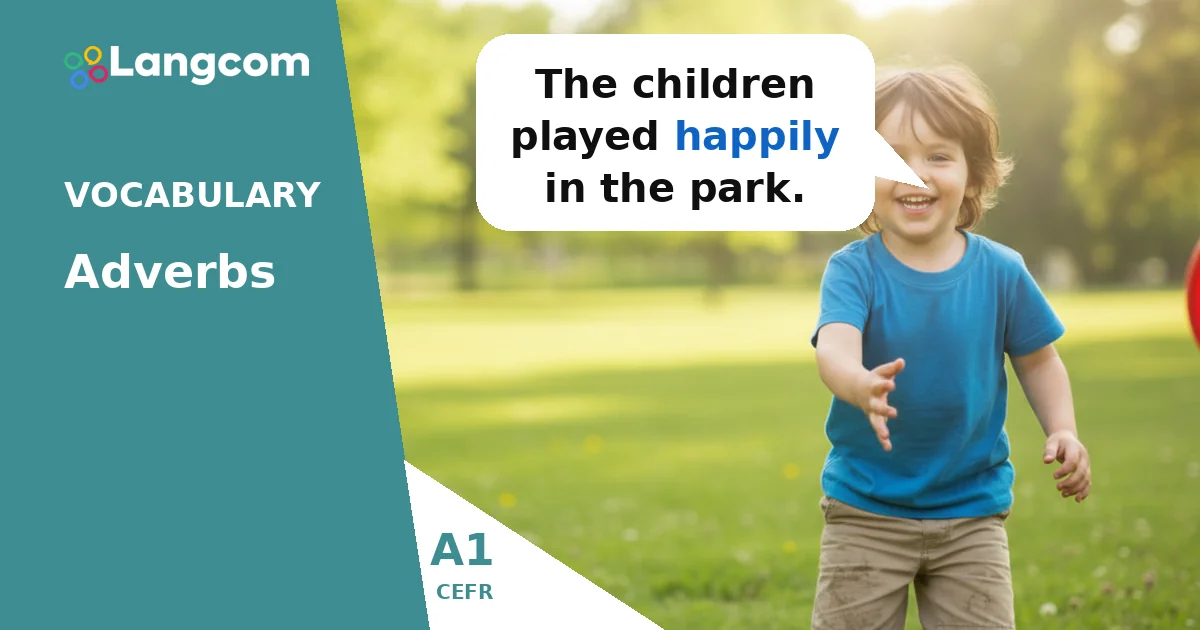
- The children played happily in the park.
- He drives his old car very slowly.
- She always speaks English well.
- My brother works hard every day.
- The teacher explained the lesson clearly.
Übung
💬 Benötigen Sie eine individuelle Beratung?
Als autorisiertes Cambridge-Vorbereitungszentrum können wir Ihnen helfen, den richtigen Kurs und die passende Zertifizierung zu finden. Chatten Sie noch heute mit unseren Beratern.
Chatten Sie mit einem Berater auf WhatsAppHäufige Fehler bei Spanischsprechern
Using Adjectives Instead of Adverbs
A common mistake for Spanish speakers is to use an adjective when an adverb is needed. Remember, adjectives describe nouns, and adverbs describe verbs.
- Falsch: He speaks good. (Hier, good is an adjective.)
- Richtig: He speaks well. (Hier, well is the adverb for good.)
- Falsch: She runs quick. (Hier, quick is an adjective.)
- Richtig: She runs quickly. (Hier, quickly is the adverb.)
Always check if you are describing a noun or a verb. If you are describing an action (a verb), you need an adverb!
Häufig gestellte Fragen
What is the main job of an adverb at A1 level?
At A1 level, the main job of an adverb is to tell us how an action happens. For example, She walks slowly.
Do all adverbs end in -ly?
No, many adverbs end in -ly, wie quickly oder happily. But some are irregular, like well (aus good) or hard (which stays the same).
Where should I put an adverb in a sentence?
Usually, you put the adverb after the verb. For example, He sings loudly. If there is an object, the adverb goes after the object: She plays the piano beautifully.

0 Kommentare