

What are Countable Nouns?
Countable nouns are things we can count. They have a singular form and a plural form.
You can use numbers with them.
- one book, two books
- one chair, three chairs
- one student, many students
We use specific words to talk about the quantity of countable nouns:
- a / an (for one item): a pen, an apple
- Numbers: two pencils, five friends
- many: How many books do you have?
- a few: I have a few questions.
- some (for positive sentences): I have some friends.
- any (for questions and negative sentences): Do you have any questions?, I don’t have any pens.
With countable nouns, we use the verb are (oder were in the past) for plural forms.
🎓 Englisch lernen mit der Blended-Methode
Kleingruppen · KI-Tutor rund um die Uhr · Vorbereitung auf die Cambridge-Prüfungen
Pläne von $39 $79 pro Monat
What are Uncountable Nouns?
Uncountable nouns are things we cannot count individually. They usually do not have a plural form.
These nouns often refer to:
- Liquids: water, milk, coffee
- Materials: wood, paper, gold
- Abstract ideas: information, advice, love
- Food items (often in bulk): rice, sugar, bread
We use specific words to talk about the quantity of uncountable nouns:
- much: How much water do you need?
- a little: I need a little sugar.
- some (for positive sentences): I have some money.
- any (for questions and negative sentences): Do you have any information?, I don't have any advice.
With uncountable nouns, we always use the verb is (oder was in the past).
How to Ask About Quantity: 'How many?' vs. 'How much?'
Choosing between how many und how much depends on the type of noun.
- Verwendung How many...? with countable nouns (things you can count).
How many students are in the class?
How many apples do you want? - Verwendung How much...? with uncountable nouns (things you cannot count individually).
How much money do you have?
How much sugar do you need?
| Countable Nouns | Uncountable Nouns |
|---|---|
| apple / apples | water |
| book / books | money |
| chair / chairs | information |
| friend / friends | rice |
| idea / ideas | advice |
| car / cars | sugar |
Beispiele
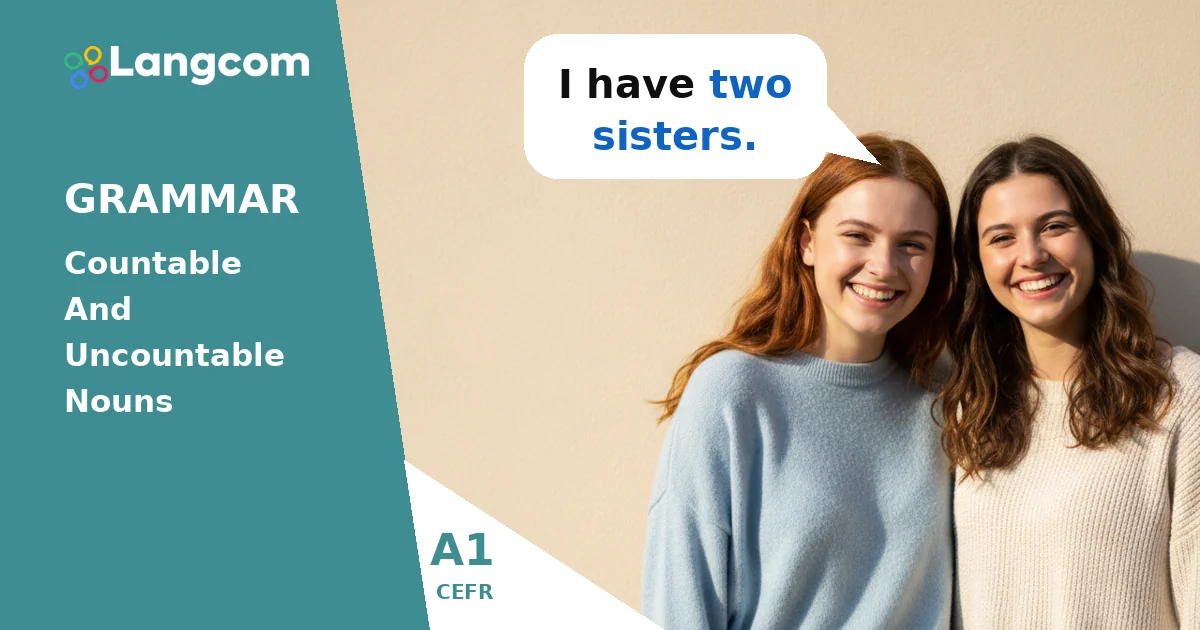
- I have two sisters.
- There are many cars on the road.
- She needs some advice.
- How much milk is in the fridge?
- I don't have any information about that.
- He bought a new book.
Übung
💬 Benötigen Sie eine individuelle Beratung?
Als autorisiertes Cambridge-Vorbereitungszentrum können wir Ihnen helfen, den richtigen Kurs und die passende Zertifizierung zu finden. Chatten Sie noch heute mit unseren Beratern.
Chatten Sie mit einem Berater auf WhatsAppHäufige Fehler bei Spanischsprechern
Spanischsprachige machen manchmal folgende häufige Fehler:
- Verwendung von many with uncountable nouns: In Spanish, words like 'dinero' (money) or 'información' (information) can feel like they should be plural, but in English, they are uncountable.
❌ I have many money.
✅ I have much money. oder I have a lot of money. - Verwendung von a/an with uncountable nouns: You cannot say 'a water' or 'an advice'.
❌ I need an advice.
✅ I need some advice. oder I need a piece of advice. - Making uncountable nouns plural: Uncountable nouns do not usually have a plural form.
❌ I need informations.
✅ I need information.
Häufig gestellte Fragen
What is the main difference between countable and uncountable nouns?
The main difference is that countable nouns can be counted as separate items (e.g., one apple, two apples), while uncountable nouns cannot be counted individually (e.g., water, information).
Can I use 'some' and 'any' with both countable and uncountable nouns?
Ja, du kannst some und any with both types of nouns. Some is for positive sentences, and any is for questions and negative sentences.
How do I know if a noun is countable or uncountable?
Think if you can put a number in front of it and make it plural. If you can say one book, two books, it's countable. If you can't say one water, two waters, it's uncountable. For uncountable nouns, you often need 'containers' or 'units' like a glass of water.




0 Kommentare