

Why is Crime Vocabulary Important for B2 English?
Learning specific words for crimes helps you understand and talk about important topics. You can read news articles, watch documentaries, and discuss current events more easily.
For B2 First (FCE) exams, you might need this vocabulary for reading tasks, listening comprehension, or even in the speaking part when discussing social issues.
[langcom_cta variant=”placement”]
What Are Some Common Crime Categories?
Crimes can be grouped into different categories based on their nature. This helps to organize and understand the many types of illegal acts.
- Crimes Against Property: These involve damaging or stealing property.
- Burglary: Entering a building illegally to steal.
- Shoplifting: Stealing goods from a shop.
- Vandalism: Deliberately damaging public or private property.
- Arson: Illegally setting fire to property.
- Joyriding: Taking a car without the owner’s permission and driving it recklessly.
- Crimes Against People (Violent Crimes): These involve harming individuals.
- Mugging: Attacking someone in a public place to steal from them.
- Kidnapping: Taking someone away illegally and holding them captive.
- Manslaughter: Killing a person unlawfully but without intent.
- Pickpocketing: Stealing from someone’s pocket, especially in a crowd.
- Financial Crimes (Fraud): These involve deception for money or gain.
- Fraud: Deceiving someone to gain money or property illegally.
- Con tricks: Clever, dishonest plans to trick people into giving money.
- Blackmail: Demanding money or favors by threatening to reveal embarrassing information.
- Other Serious Crimes:
- Drug pushing: Illegally selling drugs.
- Hijacking: Taking control of a vehicle (plane, bus, ship) by force.
- Bank robbery: Stealing money from a bank, usually by force or threat.
- Speeding: Driving faster than the legal speed limit.
Crime vs. Criminal: Who Does What?
It is important to know both the name of the crime and the name of the person who commits it. Often, these words are related but different.
For example, someone who commits burglary is a burglar. Someone who commits fraud is a fraudster.
| Crime (Action) | Criminal (Person) |
|---|---|
| Burglary | Burglar |
| Shoplifting | Shoplifter |
| Vandalism | Vandal |
| Arson | Arsonist |
| Fraud | Fraudster / Con artist |
| Mugging | Mugger |
| Kidnapping | Kidnapper |
| Pickpocketing | Pickpocket |
| Blackmail | Blackmailer |
| Drug pushing | Drug pusher |
| Hijacking | Hijacker |
| Bank robbery | Bank robber |
| Speeding | Speeder |
Beispiele
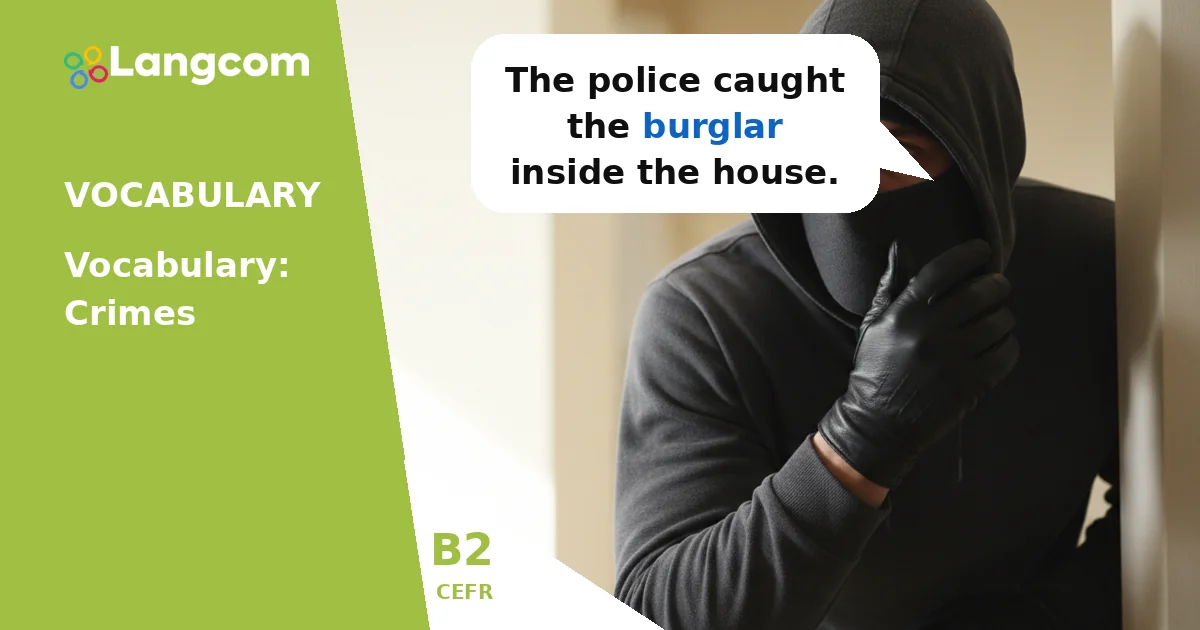
- The police caught the burglar inside the house.
- She was arrested for shoplifting a jacket.
- Graffiti on the wall is a form of vandalism.
- The old factory was destroyed by arson.
- Teenagers were caught joyriding in a stolen car.
- He was mugged on his way home last night.
- The child was kidnapped for ransom.
- The driver was charged with manslaughter after the accident.
- Be careful of pickpocketing in busy tourist areas.
- He committed fraud by faking documents.
- Many elderly people fall victim to con tricks.
- The criminal tried to blackmail the politician.
- The police arrested several people for drug pushing.
- The terrorists attempted to hijack the plane.
- The bank robbery was carried out by masked men.
- He got a ticket for speeding on the highway.
Übung
[langcom_cta variant=”exam”]
Häufige Fehler bei Spanischsprechern
Spanish speakers sometimes confuse similar English words related to stealing. It’s important to know the difference between steal und rob, and between theft und robbery.
- Steal (verb) / Theft (noun): To take something belonging to someone else without permission. Focus is on the item taken.
- Richtig: Someone stole my wallet. (Not: Someone robbed my wallet.)
- Richtig: The theft of the painting was reported.
- Rob (verb) / Robbery (noun): To take money or property illegally from a person or place, often using force or threats. Focus is on the person or place from which something is taken.
- Richtig: They robbed the bank. (Not: They stole the bank.)
- Richtig: A man was robbed in the street. (Not: A man was stolen in the street.)
Another common point of confusion is between murder und manslaughter. Murder is the unlawful killing of another human being with malice aforethought (intent). Manslaughter is also unlawful killing, but without prior intent, often due to recklessness or during a sudden quarrel.
Häufig gestellte Fragen
What is the difference between a crime and a criminal?
A crime is the illegal act itself, like burglary. A criminal is the person who commits the crime, for example, a burglar.
Why do I need to know these words for the B2 First exam?
In the B2 First (FCE) exam, you might encounter crime-related vocabulary in reading passages, listening tasks about news reports, or even in the speaking part when discussing social issues or laws. Knowing these words helps you understand the context and express your ideas clearly.
Are all these crimes equally serious?
No, crimes vary greatly in seriousness. Speeding is a minor offense, while manslaughter oder kidnapping are very serious felonies with severe penalties.
What is the difference between ‘theft’ and ‘robbery’?
Theft is generally taking something without permission. Robbery involves taking something from a person or place using force or threats. For example, shoplifting is a type of theft, aber bank robbery is a robbery.
[langcom_related]




0 Kommentare