
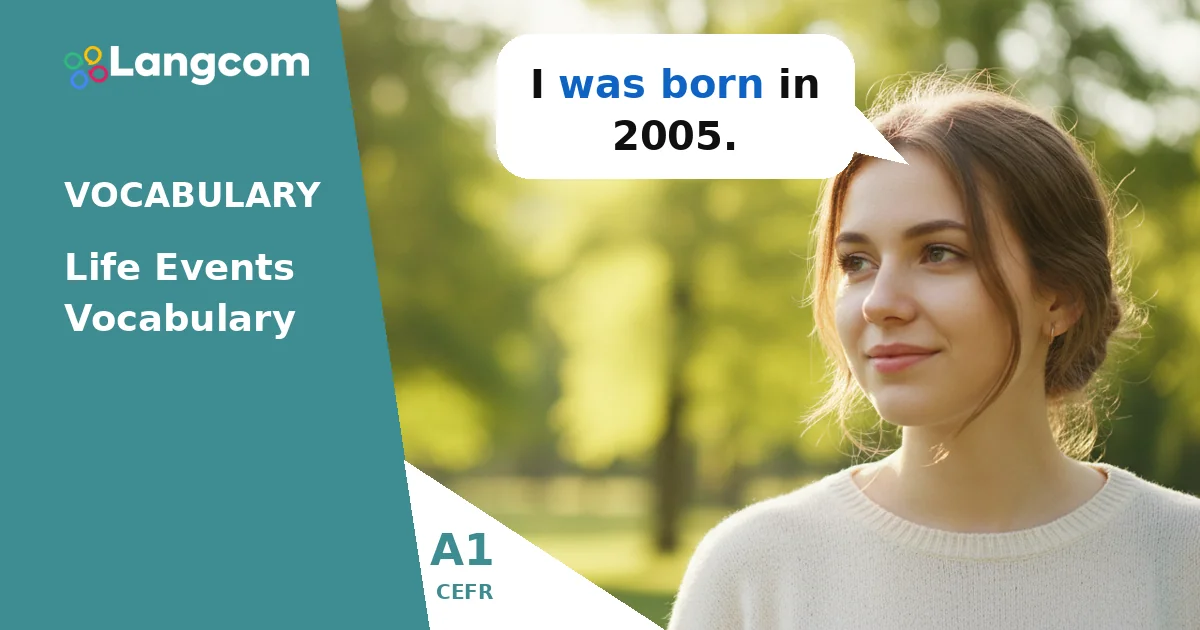

What Are Life Events?
Life events are the big moments that mark a person’s journey. They are special times that change our lives.
These events can be happy, like getting married, or sad, like when someone dies. They help us tell our personal stories.
🎓 Englisch lernen mit der Blended-Methode
Kleingruppen · KI-Tutor rund um die Uhr · Vorbereitung auf die Cambridge-Prüfungen
Pläne von $39 $79 pro Monat
Essential Life Event Vocabulary
Here are some common English words and phrases to talk about life events. Remember to use the past simple tense when talking about events that happened in the past.
- be born: This means to come into the world as a baby. We always use was born oder were born for past events.
- grow up: This means to become an adult.
- go to school: This means to attend classes and learn.
- finish school / finish university: This means to complete your studies at a school or university.
- get married: This means to become husband and wife, or partners, in a ceremony.
- have a baby: This means to become a parent to a new child.
- stop working: This means to finish your job, often when you are older.
- die: This means to stop living.
Using Life Event Verbs in Sentences
Let's look at more examples of how to use these words in sentences. These examples show how to talk about different stages of life.
- Wir verwenden be born to say when and where someone started their life.
- Grow up describes the place where a person spent their childhood.
- Go to school und finish university talk about education.
- Get married und have a baby are about starting a family.
| Life Event (Base Form) | Past Simple Form |
|---|---|
| be born | was/were born |
| grow up | grew up |
| go to school | went to school |
| finish school/university | finished school/university |
| get married | got married |
| have a baby | had a baby |
| stop working | stopped working |
| die | died |
Beispiele
- I was born in 2005.
- She grew up in a small town.
- We go to school for many years.
- He finished university last year.
- They got married in July.
- My sister had a baby last month.
- My grandfather stopped working at 65.
- He died peacefully.
- My brother was born in Argentina.
- Did you grow up in this city?
- Many people finish school at 18.
- My parents got married in 1995.
Übung
💬 Benötigen Sie eine individuelle Beratung?
Als autorisiertes Cambridge-Vorbereitungszentrum können wir Ihnen helfen, den richtigen Kurs und die passende Zertifizierung zu finden. Chatten Sie noch heute mit unseren Beratern.
Chatten Sie mit einem Berater auf WhatsAppHäufige Fehler bei Spanischsprechern
Spanish speakers sometimes make mistakes with 'to be born' and 'to have a baby':
- Falsch: I born in 1990.
- Richtig: I was born in 1990. (Remember to use the verb 'to be' in the past simple: was oder were).
- Falsch: She made a baby.
- Richtig: She had a baby. (Use have a baby, nicht make a baby).
Häufig gestellte Fragen
What is the most common way to say where you started your life?
The most common way is to say I was born in [city/country]. Zum Beispiel:, I was born in Mexico.
How do I talk about my education?
You can use phrases like I went to school, I finished school, oder I went to university. Zum Beispiel:, I went to school in Barcelona.
Can I use 'get married' for both men and women?
Ja, get married is used for both men and women. For example, He got married last year und She got married last year are both correct.

0 Kommentare