
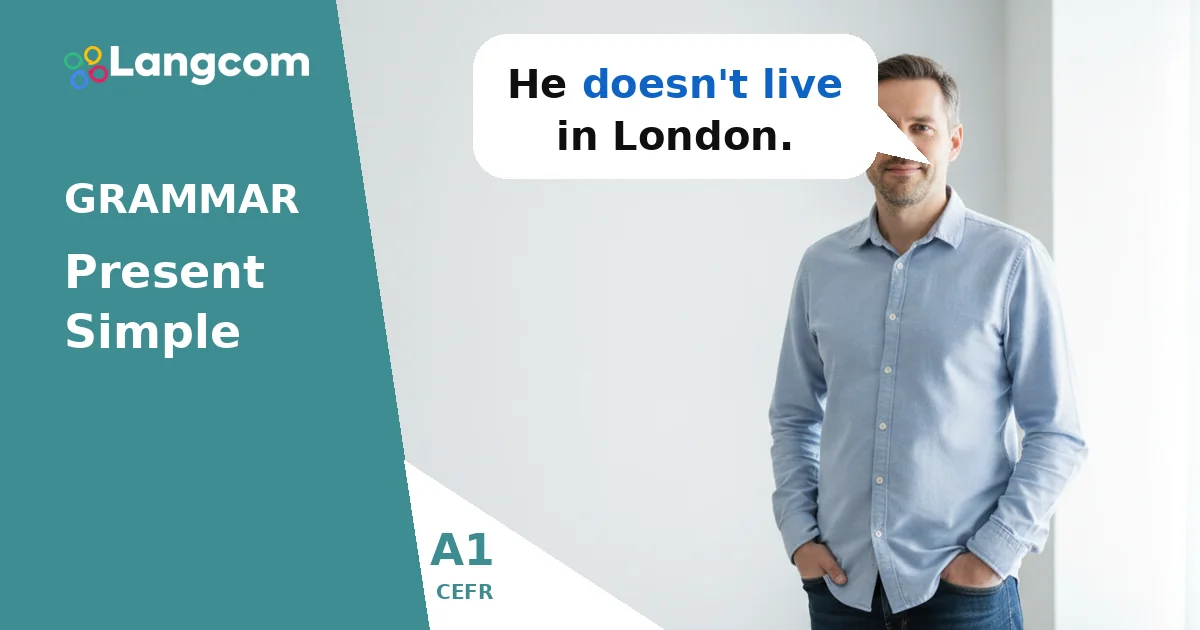

To make negative sentences in the Present Simple for ‘he’, ‘she’, and ‘it’, you always use doesn’t followed by the base form of the verb. This means you do not add ‘-s’ to the main verb. For example, you say He doesn’t work here, ، وليس He doesn’t works here. The word doesn’t is a short form of does not. It helps us show that the action is not happening or is not true for a singular third-person subject. Remember this simple structure to speak and write correctly about what ‘he’, ‘she’, or ‘it’ does not do.
What is the Present Simple Negative for He, She, It?
The Present Simple is for actions that happen regularly or for facts. When we want to say that something is NOT true or NOT happening for ‘he’, ‘she’, or ‘it’, we use the negative form.
- نحن نستخدم doesn’t to make the verb negative.
- Doesn’t is the short form of does not.
- بعد doesn’t, the main verb always stays in its base form (the infinitive without ‘to’).
🎓 تعلم اللغة الإنجليزية باستخدام الطريقة المختلطة
مجموعات صغيرة · مدرس ذكاء اصطناعي متاح على مدار الساعة · التحضير لامتحانات كامبريدج
خطط من $39 $79 في الشهر
How Do We Form Negative Sentences?
The structure for negative sentences with 'he', 'she', and 'it' is very simple:
- Subject + doesn't + Base Form of the Verb
For example, if you want to say that a person does not like coffee, you would say:
- She doesn't like coffee.
It is important to remember that doesn't is only for 'he', 'she', and 'it'. For 'I', 'you', 'we', and 'they', we use don't.
Remember: No '-s' on the Main Verb!
This is a very common mistake for learners. When you use doesn't, the main verb does NOT get an '-s' at the end.
الكلمة does already shows that the subject is 'he', 'she', or 'it'. So, you do not need to add '-s' to the next verb.
- الصحيح: He doesn't play football.
- خطأ: He doesn't plays football.
أمثلة
- He doesn't live in London.
- She doesn't speak French.
- It doesn't rain much in summer here.
- My brother doesn't work on Sundays.
- The cat doesn't eat fish.
- He doesn't like fast food.
التدريب
💬 هل تحتاج إلى إرشادات مخصصة؟
بصفتنا مركزًا معتمدًا للتحضير لاختبارات كامبريدج، يمكننا توجيهك نحو الدورة والشهادة المناسبتين لك. تحدث مع مستشارينا اليوم.
دردش مع مستشار على واتسابالأخطاء الشائعة لدى المتحدثين باللغة الإسبانية
Many Spanish speakers make two common mistakes when forming negative sentences with 'he', 'she', 'it' in the Present Simple:
- Using 'no' directly before the verb: In Spanish, you might say Él no trabaja. But in English, you cannot say He no works. You must use doesn't. The correct form is He doesn't work.
- Adding '-s' to the main verb after 'doesn't': This is a very common error. You might think, 'It's 'he', so the verb needs an '-s'.' But does already has the '-s' form. So, you should say She doesn't like, ، وليس She doesn't likes.
الأسئلة الشائعة
What is the short form of 'does not'?
الصيغة المختصرة لـ does not هو doesn't. Both mean the same thing, but doesn't is more common in everyday speaking.
Why don't we add '-s' to the verb after 'doesn't'?
We do not add -s to the main verb after doesn't because the -s ending is already in the word does. The auxiliary verb does carries the third-person singular marker, so the main verb stays in its base form.
Can I use 'does not' instead of 'doesn't'?
نعم، يمكنك استخدام does not بدلاً من doesn't. Does not is typically used for more formal writing or when you want to emphasize the negative, for example: He does NOT want to go.
Is this grammar point important for English exams?
Yes, understanding how to form negative sentences in the Present Simple for 'he', 'she', and 'it' is fundamental for A1 level English. It is essential for basic communication and will appear in many speaking and writing tasks on exams.


0 تعليق