
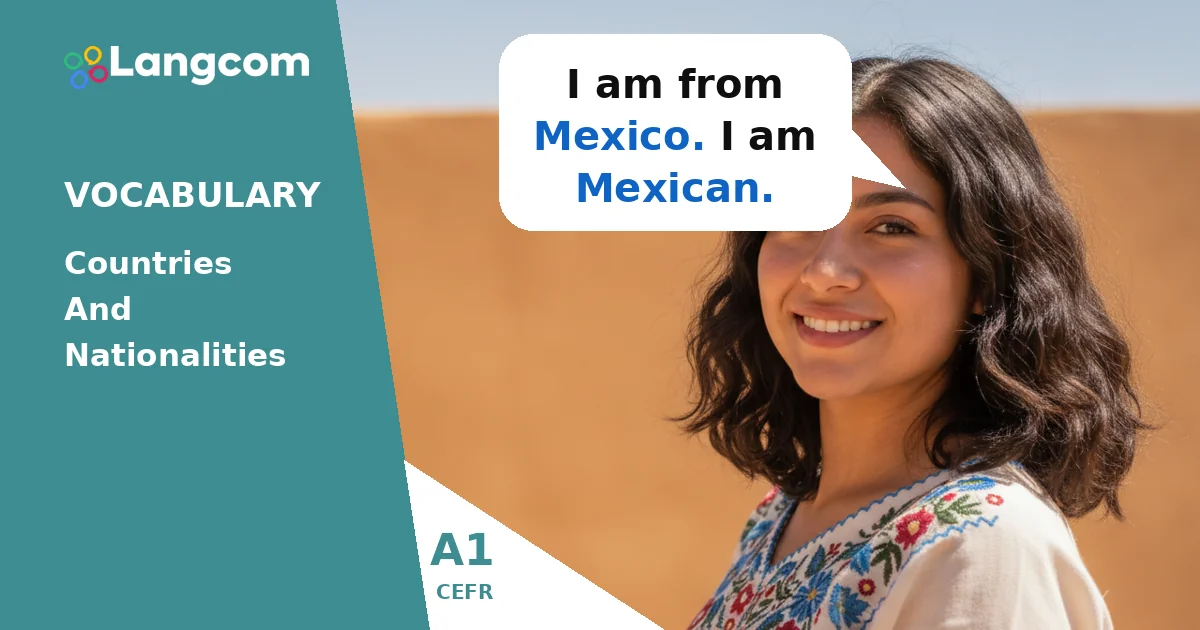

What are Countries and Nationalities?
A country is a nation or a land. It has its own government and borders. For example, Brazil is a country.
A nationality describes where a person is from. It is an adjective. For example, someone from Brazil هو Brazilian.
- We always write countries and nationalities with a capital letter.
- This is different from some other languages, like Spanish.
🎓 تعلم اللغة الإنجليزية باستخدام الطريقة المختلطة
مجموعات صغيرة · مدرس ذكاء اصطناعي متاح على مدار الساعة · التحضير لامتحانات كامبريدج
خطط من $39 $79 في الشهر
How Do We Use Countries and Nationalities?
You can use two main phrases to talk about where you or someone else is from:
- الاستخدام "I am from [Country]." This tells us your origin.
- الاستخدام "I am [Nationality]." This tells us your nationality.
These phrases work for other people too. For example, "She is from Japan" أو "He is Japanese."
Common Endings for Nationalities
Many nationalities follow common patterns. Learning these patterns can help you guess new nationalities.
- -an: Many countries use this ending. Mexico → Mexican, America → American, Brazil → Brazilian.
- -ish: This ending is common for some European countries. Britain → British, Spain → Spanish.
- -ese: This ending is often for countries in Asia. Japan → Japanese, China → Chinese.
- -ian: Similar to -an, but for specific countries. Russia → Russian.
Remember, some nationalities are irregular and do not follow these patterns. For example, France → French.
| البلد | Nationality |
|---|---|
| Mexico | Mexican |
| Japan | Japanese |
| Russia | Russian |
| China | Chinese |
| Brazil | Brazilian |
| Britain | British |
| America | American |
| Spain | Spanish |
| France | French |
| Germany | German |
أمثلة
- I am from Mexico. I am Mexican.
- She is from Japan. She is Japanese.
- He is from Russia. He is Russian.
- We are from China. We are Chinese.
- They are from Brazil. They are Brazilian.
- You are from Britain. You are British.
- Is she from America? Yes, she is American.
- Are you from Spain? Yes, I am Spanish.
التدريب
💬 هل تحتاج إلى إرشادات مخصصة؟
بصفتنا مركزًا معتمدًا للتحضير لاختبارات كامبريدج، يمكننا توجيهك نحو الدورة والشهادة المناسبتين لك. تحدث مع مستشارينا اليوم.
دردش مع مستشار على واتسابالأخطاء الشائعة لدى المتحدثين باللغة الإسبانية
Spanish speakers often make these mistakes:
- Not capitalizing nationalities: In Spanish, nationalities are not capitalized (e.g., español). In English, they always are.
✗ I am spanish.
✓ I am Spanish. - Using "the" before a nationality as a personal description: In English, we don't say "I am the Spanish." نقول "I am Spanish."
✗ He is the Mexican.
✓ He is Mexican. - Using "of" instead of "from": To talk about your country of origin, use "from."
✗ I am of China.
✓ I am from China.
الأسئلة الشائعة
Why do I need to capitalize nationalities in English?
In English, all proper nouns, including names of countries and the adjectives derived from them (nationalities), are always capitalized. This is a basic rule of English grammar.
Is 'American' only for people from the USA?
Yes, in everyday English, American almost always refers to someone or something from the United States of America. While geographically North and South America are continents, the term American is specifically linked to the USA.
Can I use 'the' with nationalities?
You can use the with a nationality to refer to the people of that country as a group (e.g., the Spanish are friendly). But you do not use the when describing an individual's nationality (e.g., I am Spanish, ، وليس I am the Spanish).



0 تعليق