

Why is Cause and Result Vocabulary Important?
When you communicate in English, you often need to explain why something happened or what the consequences were. At B2 level, you need more than just because أو so.
Using a variety of cause and result words makes your English sound more natural, sophisticated, and precise. It is especially useful for academic writing, formal discussions, and professional contexts.
✍️ لست متأكدًا من مستواك؟
خُذ اختبار تحديد المستوى المجاني الخاص بنا واحصل على تعليقات مخصصة من ممتحنين معتمدين من كامبريدج.
قم بإجراء اختبار تحديد المستوى المجانيWhat is the Difference Between Affect و Effect?
This is one of the most common confusions in English! Remember that affect is usually a verb, and effect is usually a noun.
-
Affect (verb): To influence or produce a change in something.
-
Effect (noun): The result or consequence of an action or cause.
How Can We Talk About Causes?
There are several ways to introduce the reason or origin of something.
-
Cause (verb and noun):
-
As a verb, cause means to make something happen.
-
As a noun, cause refers to the person or thing that makes something happen.
-
-
Lead to (verb phrase):
-
This phrase means to result in or to bring about a particular outcome. It often implies a process or a chain of events.
-
How Can We Talk About Results?
When you want to describe what happened as a consequence, you have several options.
-
Result in (verb phrase):
-
This means to have something as a consequence or outcome. The subject of result in is the cause.
-
-
As a result of (prepositional phrase):
-
This phrase introduces the cause, explaining why something happened. It is followed by a noun or a gerund.
-
-
Have an effect on (verb phrase):
-
This is another way to use the noun effect. It means to influence something or someone.
-
When Should I Use These Words?
Many of these expressions are more formal than simple conjunctions like so أو because. Using them correctly can significantly improve the formality and sophistication of your English.
-
Use them in academic essays, reports, and presentations.
-
They are suitable for professional emails and formal discussions.
-
In everyday casual conversation, simpler words might be more common, but these expressions are still understood and can add clarity.
| Word/Phrase | Part of Speech | Meaning/Usage |
|---|---|---|
| affect | Verb | To influence or change something. |
| effect | Noun | The result or consequence of an action. |
| cause | Verb | To make something happen. |
| cause | Noun | The reason or origin of something. |
| lead to | Verb phrase | To result in; to bring about an outcome (often a process). |
| result in | Verb phrase | To have something as a consequence or outcome. |
| as a result of | Prepositional phrase | Because of; introducing the cause. |
| have an effect on | Verb phrase | To influence something or someone. |
أمثلة
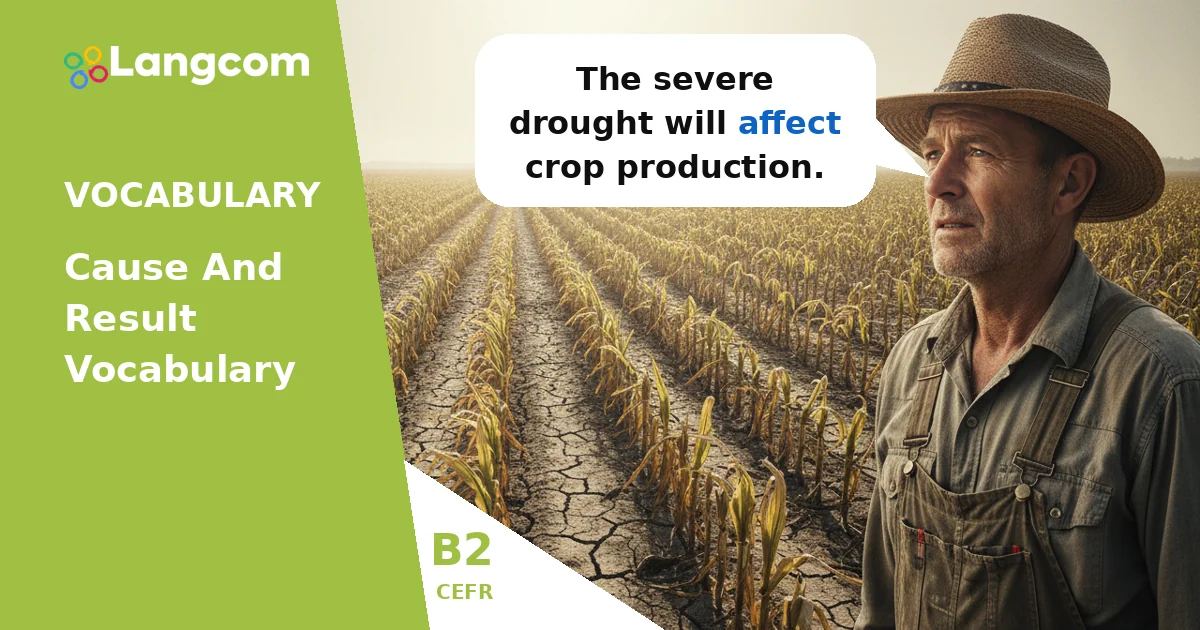
- The severe drought will affect crop production.
- Lack of sleep can affect your concentration.
- The new law had a positive effect on the economy.
- What was the effect of the storm on the coastal towns?
- Smoking can cause serious health problems.
- The main cause of the accident was driver fatigue.
- Stress can lead to various health issues.
- His hard work led to a promotion.
- The new policy resulted in a decrease in unemployment.
- Poor communication often results in misunderstandings.
- As a result of the heavy rain, the river flooded.
- She got the job as a result of her excellent interview.
- The government's decision had a significant effect on public opinion.
- Exercise has a positive effect on mental health.
التدريب
هل أنت مستعد للحصول على شهادتك؟
يُعد برنامج Langcom الطلاب لامتحانات كامبريدج وIELTS وTOEFL وDELE وSIELE وMichigan.
ابدأ مع Langcomالأخطاء الشائعة لدى المتحدثين باللغة الإسبانية
Spanish speakers often make these mistakes:
-
مربك affect و effect: تذكر affect (verb) and effect (noun). You might incorrectly say The drought will effect crop production (wrong) instead of The drought will affect crop production (صحيح).
-
Incorrect prepositions with result: It's result in (verb) or as a result of (prepositional phrase). Avoid saying result of as a verb, for example, The problem resulted of a mistake (wrong). Instead, say The problem resulted from a mistake أو The problem was a result of a mistake (صحيح).
-
Overusing simple conjunctions: في حين أن because و so are correct, B2 learners should aim to use more varied and formal expressions like those taught here to enhance their English.
الأسئلة الشائعة
Can 'effect' ever be a verb?
Yes, but it is rare and formal. As a verb, effect means 'to bring about' or 'to accomplish,' as in The committee will effect change. For B2 learners, it's best to focus on affect as the verb and effect as the noun.
Are these words suitable for IELTS or Cambridge exams?
Absolutely! Using a range of cause and result vocabulary, such as lead to, result in, ، و as a result of, demonstrates a higher level of lexical resource, which is crucial for achieving a good score in writing and speaking tasks for exams like IELTS, FCE, or CAE.
Is there a difference between 'lead to' and 'cause'?
While similar, cause often implies a direct and immediate action, while lead to can suggest a process or a series of events that eventually bring about a result. For example, The spark caused the fire (direct), but Poor management led to the company's decline (process).



0 تعليق