

What are Conditionals in English?
Conditionals are sentence structures that show a cause-and-effect relationship. They tell us what might happen, what could happen, or what we wish would happen.
In English, we use different conditional types to express different levels of certainty or possibility. Today, we will focus on the first and second conditionals.
✍️ لست متأكدًا من مستواك؟
خُذ اختبار تحديد المستوى المجاني الخاص بنا واحصل على تعليقات مخصصة من ممتحنين معتمدين من كامبريدج.
قم بإجراء اختبار تحديد المستوى المجانيWhen do we use the First Conditional?
We use the First Conditional to talk about possible or likely future events and their expected results. These are situations that we believe are realistic and have a good chance of happening.
- Form: If + present simple, will + infinitive
- Function: Describes a real possibility in the future.
For example, if you study hard, it's likely you will pass your exam.
When do we use the Second Conditional?
We use the Second Conditional to talk about imagined events or states and their consequences. These situations are either unreal in the present or very unlikely to happen in the future.
- Form: If + past simple, would + infinitive
- Function: Describes an unreal present situation or an unlikely future event.
We often use the phrase if I were you to give advice. Even if the subject is I, he, she, ، أو it, we typically use were بدلاً من was in the if clause of the second conditional, especially in formal English.
Can I use other verbs with Conditionals?
Yes, you can use other verbs in conditional sentences to express different meanings:
- Other Modals: In the main clause, you can use other modal verbs like might, could, ، أو can بدلاً من will أو would to show different degrees of certainty or ability.
- Going to: In the first conditional, you can use going to بدلاً من will to talk about plans or intentions.
- Imperatives: You can use an imperative (a command) in the main clause of a first conditional sentence.
- Other Tenses in the if-clause: Sometimes, you might see other tenses in the if-clause, especially if they logically fit the situation.
First vs. Second Conditional: What's the Key Difference?
The main difference is about likelihood and reality:
- First Conditional: For situations that are real or very probable in the future. You believe it can happen.
- Second Conditional: For situations that are hypothetical, imagined, or very unlikely to happen. You don't expect it to happen, or it's simply not true now.
Think about how realistic the situation is. If it's a genuine possibility, use the first conditional. If it's a dream, a wish, or something that won't happen, use the second conditional.
| ميزة | First Conditional | Second Conditional |
|---|---|---|
| Likelihood | Real or very likely future events | Imagined, unreal, or very unlikely events |
| Form (if-clause) | If + present simple | If + past simple |
| Form (main clause) | will + infinitive | would + infinitive |
| Example | If I find her number, I will call her. | If I found her number, I would call her. |
| Meaning | I think it's possible I'll find her number. | I don't expect to find her number. |
أمثلة
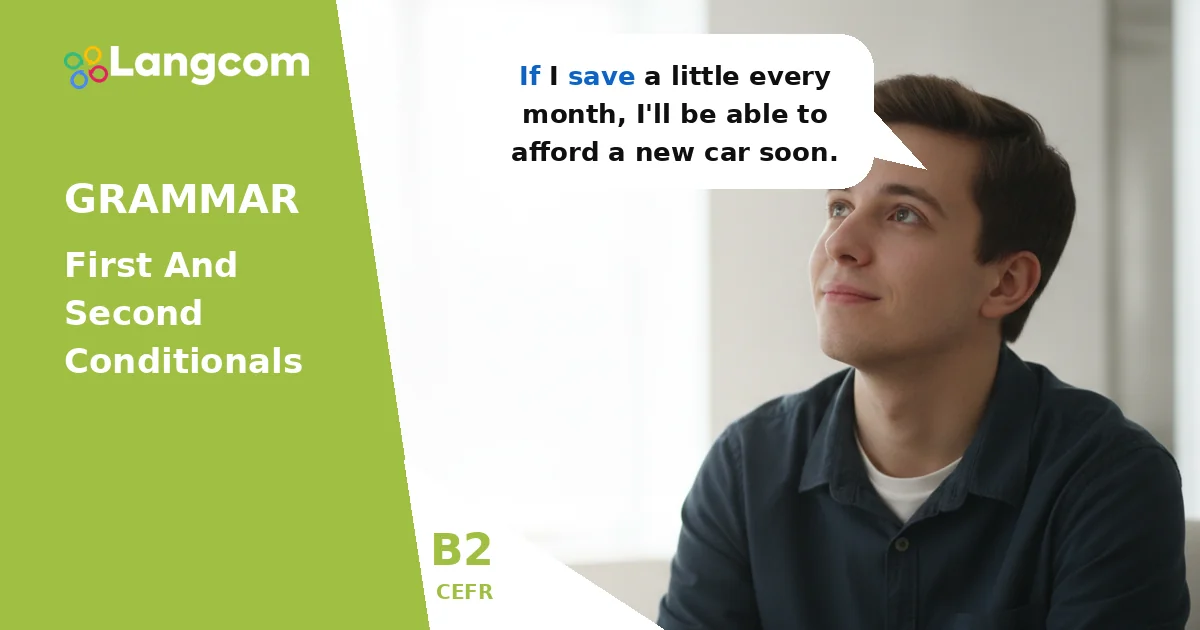
- If I save a little every month, I'll be able to afford a new car soon.
- If it rains tomorrow, we will stay at home.
- If you study hard, you will pass the exam.
- If I had $1 for every time I've heard that, I'd be a millionaire.
- If I saved 50 cents every month, I'd have enough for a new computer by the end of the year.
- If I were you, I wouldn't borrow so much money.
- If I saw her tomorrow, I would tell her my news.
- If I see her tomorrow, I'm going to tell her my news.
- If you've finished your test and you're waiting to leave, you should come to my desk.
- If you've finished your test and you're waiting to leave, please come to my desk.
- If I weren't feeling so tired, I might go for a run.
- If I won the lottery, I would travel the world.
التدريب
هل أنت مستعد للحصول على شهادتك؟
يُعد برنامج Langcom الطلاب لامتحانات كامبريدج وIELTS وTOEFL وDELE وSIELE وMichigan.
ابدأ مع Langcomالأخطاء الشائعة لدى المتحدثين باللغة الإسبانية
Spanish speakers sometimes make mistakes with conditionals due to direct translation from Spanish. Here are common errors:
- استخدام would in the if-clause: In Spanish, you might use a conditional tense in both parts of the sentence. In English, you only use would in the main clause of the second conditional.
❌ If I would have money, I would buy a car.
✅ If I had money, I would buy a car. - استخدام will in the if-clause: Similar to the above, will is not used in the if-clause of the first conditional.
❌ If it will rain, we will stay home.
✅ If it rains, we will stay home. - Confusing likelihood: Using the first conditional for very unlikely situations or the second conditional for very likely ones. Always consider the probability.
الأسئلة الشائعة
What is the main difference between the first and second conditional?
The main difference is the likelihood of the situation. The first conditional is for real or very likely future events, while the second conditional is for imagined, hypothetical, or very unlikely situations in the present or future.
Can I reverse the order of the clauses in conditional sentences?
Yes, you can put the if-clause after the main clause. If the if-clause comes first, you usually need a comma before the main clause. If the main clause comes first, no comma is needed. For example: If I had more time, I would learn French. أو I would learn French if I had more time.
Why do we use 'were' instead of 'was' in the second conditional with 'I' or 'he/she/it'?
استخدام were for all subjects in the if-clause of the second conditional (e.g., if I were, if he were) is called the subjunctive mood. It emphasizes the hypothetical or unreal nature of the situation. While was is sometimes used informally, were is considered more grammatically correct and is common in formal English.
Are there other types of conditionals?
Yes, besides the first and second conditionals, there is also the zero conditional (for general truths and facts) and the third conditional (for hypothetical situations in the past). There are also mixed conditionals.

0 تعليق