
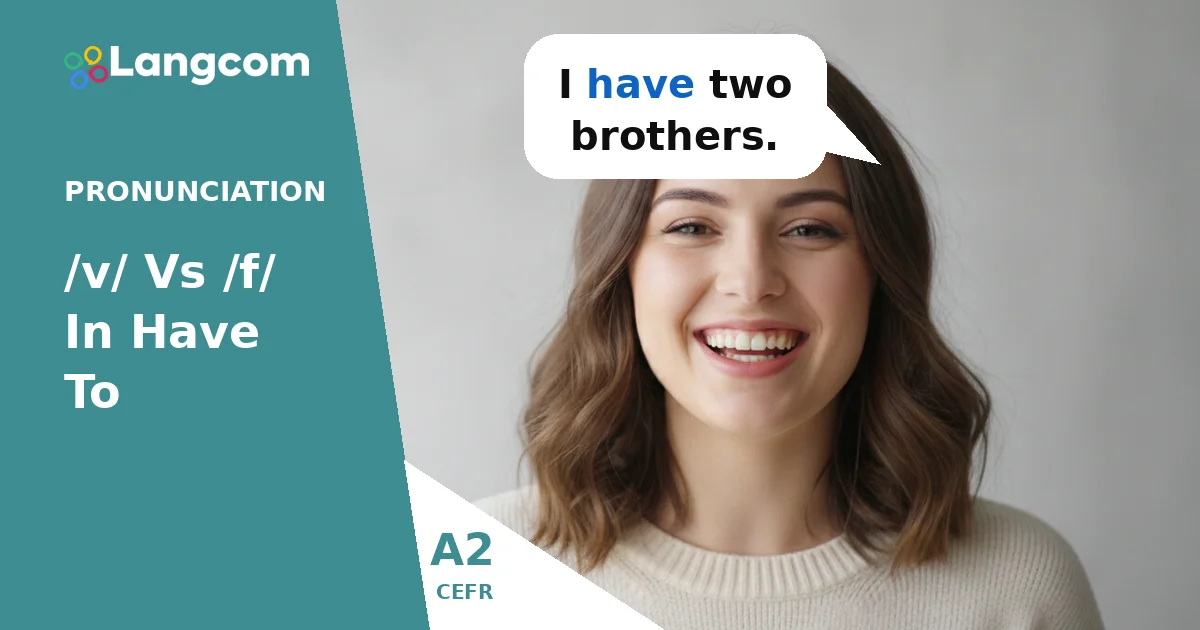

Why is ‘have to’ pronunciation tricky?
الكلمة have can be confusing for English learners. It is spelled the same, but it can have two different sounds. This happens depending on what words come after it.
Many students pronounce have with a /v/ sound all the time. But this is not always correct, especially when we use have to.
✍️ لست متأكدًا من مستواك؟
خُذ اختبار تحديد المستوى المجاني الخاص بنا واحصل على تعليقات مخصصة من ممتحنين معتمدين من كامبريدج.
قم بإجراء اختبار تحديد المستوى المجانيWhen do we say /v/ in 'have' (like 'have')?
We use the /v/ sound when have is a main verb. This means it shows possession or an experience.
- When have means 'possess': I have a new phone.
- When have is part of an expression: We have breakfast at 7 AM.
- In negative sentences with don't have: They don't have much time.
In these cases, the sound is like the 'v' in very أو love. You should feel a vibration in your throat when you say it.
When do we say /f/ in 'have to' (like 'hafta')?
We use the /f/ sound when have to means 'must' or 'it is necessary'. This is a modal verb phrase.
- When expressing obligation: I have to study for the exam.
- When talking about rules: You have to wear a uniform.
- This rule also applies to has to (for third person singular): She has to work late.
In these situations, the sound is like the 'f' in fish أو food. You should feel air, but no vibration, in your throat.
Listen and Feel the Difference
The key difference between /v/ and /f/ is 'voicing'.
- For /v/: Put your top teeth lightly on your bottom lip. Push air out. Your vocal cords vibrate. (Try saying vvvvv).
- For /f/: Put your top teeth lightly on your bottom lip. Push air out. Your vocal cords do NOT vibrate. (Try saying fffff).
Practice feeling your throat. When you say I have a car, feel the vibration for /v/. When you say I have to leave, there should be no vibration for /f/.
أمثلة
- I have two brothers. (/hæv/)
- Do you have a pen? (/hæv/)
- We don't have any milk. (/hæv/)
- I have to finish my homework. (/hæf/)
- She has to wake up early. (/hæf/)
- They have to wear masks. (/hæf/)
التدريب
هل أنت مستعد للحصول على شهادتك؟
يُعد برنامج Langcom الطلاب لامتحانات كامبريدج وIELTS وTOEFL وDELE وSIELE وMichigan.
ابدأ مع Langcomالأخطاء الشائعة لدى المتحدثين باللغة الإسبانية
Spanish speakers often pronounce the 'v' in English like a 'b' or a soft fricative 'v' (like in 'vaca'). This sound is usually voiced. Because of this, it's common to keep the /v/ sound even when it should change to /f/ in have to.
خطأ: I /hæv/ to go. (The 'v' sound is voiced, like in have a car.)
الصحيح: I /hæf/ to go. (The 'f' sound is voiceless, like in fast.)
Remember, when have is followed by to, the /v/ sound often changes to a voiceless /f/ sound. This makes your English sound more natural.
الأسئلة الشائعة
Is the pronunciation difference for 'have' and 'have to' always true?
Yes, almost always. When have is a main verb, it's /v/. When it's part of have to (meaning 'must'), it's /f/. This is a very common rule in natural spoken English.
Why does the sound change from /v/ to /f/ in 'have to'?
This change happens because of 'assimilation'. The /v/ sound is voiced, and the /t/ sound in to is voiceless. English speakers naturally change the /v/ to a voiceless /f/ to make it easier to say the voiceless /t/ immediately after it. It's a natural sound connection.
How important is this pronunciation for the A2 Key exam?
For the A2 Key (KET) Speaking test, clear pronunciation is important for good communication. Being able to correctly pronounce have و have to shows good control of basic English sounds. It helps you sound more natural and be easily understood by the examiner.
Does 'has to' follow the same pronunciation rule as 'have to'?
Yes, absolutely! When has is followed by to, the 's' sound often becomes voiceless, similar to an /f/ sound. So, has to is pronounced like /hæs tuː/ or often /hæstə/ in fast speech. The important thing is that the sound before to becomes voiceless, just like with have to. على سبيل المثال،, He has to work sounds like He /hæs tə/ work.



0 تعليق