

The main quantifiers you need to master are some, any, no, none, much, many, ، و a lot of / lots of. Your choice depends on whether the noun is countable or uncountable, and if the sentence is positive, negative, or a question. For example, we use many with countable nouns like books, but much with uncountable nouns like water. A lot of is flexible and can be used with both.
What Are Quantifiers in English?
Quantifiers are words that go before nouns. They tell us how much or how many of something there is.
- For example, some, many, a lot of are all quantifiers. They help us describe amounts.
🎓 تعلم اللغة الإنجليزية باستخدام الطريقة المختلطة
مجموعات صغيرة · مدرس ذكاء اصطناعي متاح على مدار الساعة · التحضير لامتحانات كامبريدج
خطط من $39 $79 في الشهر
When Do We Use "Some" and "Any"?
Some و any are used with both countable and uncountable nouns.
- الاستخدام some:
- In positive statements: I have some friends.
- In offers or requests (questions where you expect 'yes'): Would you like some tea?, Can I have some water?
- الاستخدام any:
- In negative statements: I don't have any money.
- In most questions: Do you have any brothers or sisters?
How Do We Express Zero Quantity with "No" and "None"?
You can express a zero amount using no أو none.
- الاستخدام no:
- Before a noun in a positive sentence structure to give a negative meaning: There is no milk in the fridge. (This means There isn't any milk.)
- الاستخدام none:
- As a pronoun, meaning "not any" or "not one." It stands alone: How many cookies are left? None.
- مع of + a pronoun or a definite noun phrase: None of my friends could come.
"Much," "Many," and "A Lot Of / Lots Of": Large Quantities
These quantifiers describe large amounts. Your choice depends on the noun type.
- الاستخدام many:
- With countable nouns (plural): many books, many people.
- Mostly in questions and negative statements: How many students are there?, She doesn't have many hobbies.
- الاستخدام much:
- With uncountable nouns: much water, much time.
- Mostly in questions and negative statements: How much sugar do you need?, I don't have much patience.
- الاستخدام a lot of / lots of:
- With both countable and uncountable nouns.
- Mainly in positive statements: We have a lot of food., There are lots of cars.
- They are common and flexible, often used instead of much أو many in positive sentences.
Quick Guide: Choosing the Right Quantifier
- Is the noun countable or uncountable?
- Countable (e.g., apples, chairs): Use many, some, any, a lot of.
- Uncountable (e.g., water, information): Use much, some, any, a lot of.
- Is the sentence positive, negative, or a question?
- Positive: some, a lot of / lots of, no.
- Negative: any, not much (uncountable), not many (countable), not a lot of (both).
- السؤال: any, much, many, some (for offers/requests).
| Quantifier | Noun Type | Typical Use |
|---|---|---|
| Some | Countable & Uncountable | Positive statements, offers/requests |
| Any | Countable & Uncountable | Negative statements, most questions |
| No | Countable & Uncountable | Positive sentence structure for negative meaning |
| None (of) | Countable & Uncountable (as pronoun) | To mean 'not any' or 'not one' |
| Much | Uncountable | Questions, negative statements |
| Many | Countable (plural) | Questions, negative statements |
| A lot of / Lots of | Countable & Uncountable | Positive statements (most common) |
أمثلة
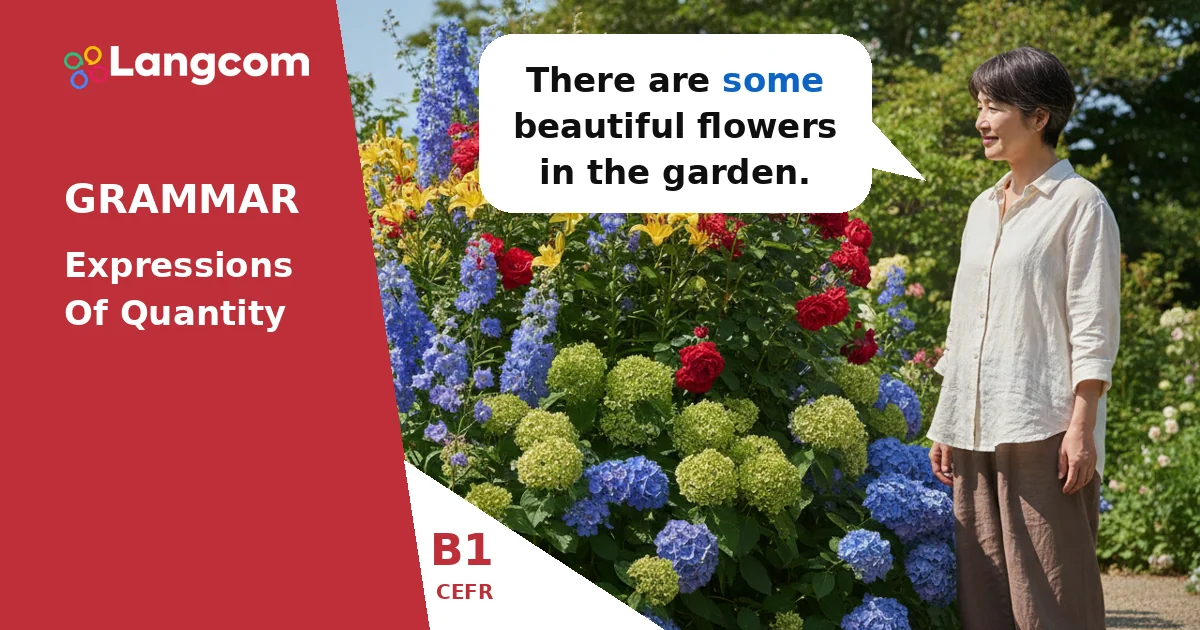
- There are some beautiful flowers in the garden.
- Do you have any plans for the weekend?
- I don't have any free time today.
- Would you like some help with that?
- There is no problem; everything is fine.
- How many people are coming to the party?
- She doesn't drink much coffee.
- We saw a lot of interesting animals at the zoo.
- None of the students failed the exam.
- He has lots of energy in the mornings.
التدريب
✍️ لست متأكدًا من مستواك؟
خُذ اختبار تحديد المستوى المجاني الخاص بنا واحصل على تعليقات مخصصة من ممتحنين معتمدين من كامبريدج.
قم بإجراء اختبار تحديد المستوى المجانيالأخطاء الشائعة لدى المتحدثين باللغة الإسبانية
- Double Negatives: يستخدم المتحدثون باللغة الإسبانية أحيانًا no with a negative verb, like I don't have no money. This is incorrect in English.
- الصحيح: I don't have any money. أو I have no money.
- مربك Much و Many: A common error is using much with countable nouns. Remember:
- Much for uncountable nouns (e.g., much information).
- Many for countable nouns (e.g., many ideas).
- خطأ: I have much books.
- الصحيح: I have many books.
- استخدام Some in General Questions: في حين أن some can be in questions for offers/requests, for general questions, any is usually correct.
- خطأ: Do you have some questions?
- الصحيح: Do you have any questions? (Unless you expect a 'yes' answer, like a teacher asking students if they have questions after a lecture).
الأسئلة الشائعة
Can I use "a lot of" in negative sentences and questions?
Yes, you can, but much و many are more common in formal questions and negative statements. For example, Do you have a lot of work? is acceptable, but Do you have much work? is also correct and often preferred. You can also say I don't have a lot of time.
What is the difference between "a lot of" and "lots of"?
There is no significant difference in meaning. Lots of is slightly more informal than a lot of, but both are widely used in everyday English.
When should I use "none of" instead of "no"?
الاستخدام no directly before a noun (e.g., no money). استخدم none of before a pronoun (e.g., none of them) or a definite noun phrase (e.no-translation>none of the students). None can also stand alone as a pronoun.
Are quantifiers important for B1 exams?
Yes, quantifiers are very important for B1 level English exams. You will need to use them correctly in writing tasks, such as essays or emails, and speaking tasks to describe quantities accurately.


0 تعليق