

What are Cleft Sentences and Why Use Them?
Cleft sentences are grammatical constructions that divide a single clause into two parts. This division helps to emphasize one part of the sentence more than the others.
You use cleft sentences to:
- Emphasize new information: Make a specific detail stand out.
- Correct misunderstandings: Clearly state what is true, often in contrast to what someone else believes.
- Add focus and clarity: Guide your listener’s or reader’s attention to the most important element.
- ليبدو أكثر طبيعية: Native speakers often use clefts in conversation and writing, especially at C1 level.
✍️ لست متأكدًا من مستواك؟
خُذ اختبار تحديد المستوى المجاني الخاص بنا واحصل على تعليقات مخصصة من ممتحنين معتمدين من كامبريدج.
قم بإجراء اختبار تحديد المستوى المجانيHow Do You Form 'It' Cleft Sentences?
The 'It' cleft is one of the most common types. It uses the structure It + be + emphasized element + that/who/which + rest of sentence.
الفعل be must agree with the tense of the original sentence. The emphasized element can be a noun, a noun phrase, or a time/place adverbial.
- Emphasizing a person: الاستخدام who أو that. It was my brother who called me. (Original: My brother called me.)
- Emphasizing a thing: الاستخدام that أو which. It was the loud music that bothered me. (Original: The loud music bothered me.)
- Emphasizing a time: الاستخدام that أو when. It was yesterday that I saw her. (Original: I saw her yesterday.)
- Emphasizing a place: الاستخدام that أو where. It was in Paris where they first met. (Original: They first met in Paris.)
When Do You Use 'What' Cleft Sentences?
'What' clefts are used to emphasize an action or a situation. The structure is What + clause + be + emphasized element.
The 'what' clause acts like a noun, referring to 'the thing that' or 'the action that'. The emphasized element usually comes after the verb be.
- Emphasizing an action/thing: What I need is a long vacation. (Original: I need a long vacation.)
- Emphasizing a feeling: What I love most is spending time with my family. (Original: I love spending time with my family most.)
- Emphasizing a problem: What happened was that the car broke down. (Original: The car broke down.)
How Do 'The Thing/Person/Place/Reason' Clefts Work?
These clefts are similar to 'what' clefts but use specific nouns to introduce the emphasized information. The structure is The thing/person/place/reason + (that/who/which/why) + clause + be + emphasized element.
You choose the introductory noun based on what you want to emphasize:
- Emphasizing a thing: The thing that surprised me was his sudden departure. (Original: His sudden departure surprised me.)
- Emphasizing a person: The person who helped me was my neighbor. (Original: My neighbor helped me.)
- Emphasizing a place: The place where I feel happiest is by the sea. (Original: I feel happiest by the sea.)
- Emphasizing a reason: The reason why I left was because I was tired. (Original: I left because I was tired.)
What About 'All' Cleft Sentences?
'All' clefts are used to emphasize that something is the only thing or action involved. The structure is All + clause + be + emphasized element.
This type of cleft often implies a sense of limitation or exclusivity.
- All I want is a quiet evening at home. (Meaning: I only want a quiet evening at home.)
- All she did was smile. (Meaning: She only smiled.)
- All we need is a little more time. (Meaning: We only need a little more time.)
| Cleft Type | الهيكل | مثال |
|---|---|---|
| It-cleft | It + be + emphasized element + that/who/which + clause | It was Sarah who won the prize. |
| What-cleft | What + clause + be + emphasized element | What I need is a good night's sleep. |
| The thing/person/place/reason-cleft | The thing/person/place/reason + (relative pronoun) + clause + be + emphasized element | The reason why I came was to see you. |
| All-cleft | All + clause + be + emphasized element | All I want is peace and quiet. |
أمثلة
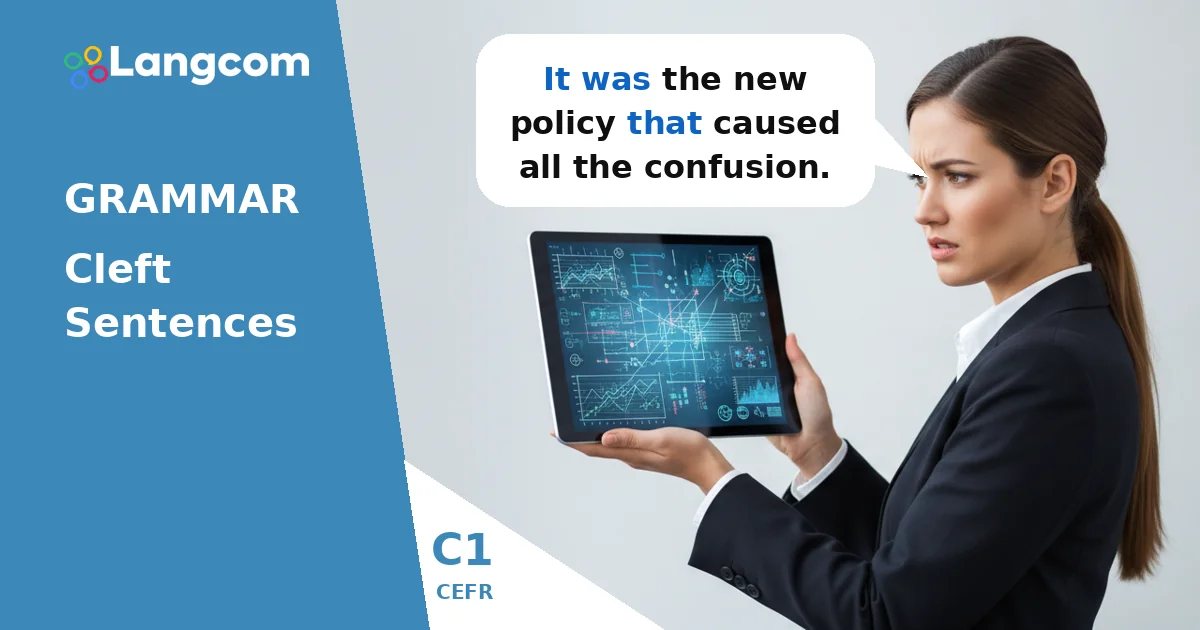
- It was the new policy that caused all the confusion.
- What I really appreciate is your honest feedback.
- The person who inspired me most was my grandmother.
- It wasn't until midnight that they finally arrived.
- All he ever talks about is his new project.
- The reason why she resigned was to pursue her dreams.
التدريب
هل أنت مستعد للحصول على شهادتك؟
يُعد برنامج Langcom الطلاب لامتحانات كامبريدج وIELTS وTOEFL وDELE وSIELE وMichigan.
ابدأ مع Langcomالأخطاء الشائعة لدى المتحدثين باللغة الإسبانية
Spanish speakers sometimes make specific errors with cleft sentences:
- Omitting the verb be: In Spanish, you might directly translate, but English requires be.
خطأ: What I want, a new car.
الصحيح: What I want is a new car. - Using the wrong relative pronoun: Choosing which بدلاً من who for people, or omitting that/ who/ which when it's needed.
خطأ: It was my friend which helped me.
الصحيح: It was my friend who helped me. - Direct translation of emphasis: Spanish often uses intonation or word order for emphasis. Clefts are a specific English structure, not always a direct translation.
خطأ: The thing that I like it is chocolate. (Redundant 'it')
الصحيح: The thing that I like is chocolate.
الأسئلة الشائعة
What is the main purpose of a cleft sentence?
The main purpose is to add emphasis to a specific part of a sentence, making that information stand out. For example, in It was John who broke the vase, the focus is clearly on John.
Are cleft sentences formal or informal?
Cleft sentences are versatile. They can be used in both formal and informal contexts. They are very common in spoken English to add natural emphasis, but also appear in written English for clarity and rhetorical effect.
Can I use cleft sentences with any verb tense?
Yes, the verb be in a cleft sentence can be in any tense (present, past, future, perfect, etc.) to match the original meaning of the sentence. For example, It will be tomorrow that we leave أو It has been raining all week that has made me sad.
What is the difference between 'It was...' and 'What...' clefts?
It was... clefts usually emphasize a noun, pronoun, or adverbial (person, thing, time, place). What... clefts typically emphasize an action or a situation, often expressed as a noun phrase or a gerund phrase.

0 تعليق