

What are ‘Can’ and ‘Can’t’ for?
نحن نستخدم can و can’t to talk about abilities. An ability is something you know how to do or something you are physically able to do.
- Use can for positive sentences. It means you have the ability.
- Use can’t (أو cannot) for negative sentences. It means you do not have the ability.
🎓 تعلم اللغة الإنجليزية باستخدام الطريقة المختلطة
مجموعات صغيرة · مدرس ذكاء اصطناعي متاح على مدار الساعة · التحضير لامتحانات كامبريدج
خطط من $39 $79 في الشهر
How do we form sentences with ‘Can’?
The structure for sentences with can is very simple. We use can after the subject and before the main verb. The main verb is always in its base form (infinitive without ‘to’).
- Positive: Subject + can + base verb
- مثال: I can speak English.
- Negative: Subject + can’t / cannot + base verb
- مثال: She can’t swim.
Can is a modal verb. This means it does not change its form for he, she, ، أو it. You do not add ‘-s’.
- الصحيح: He can play the guitar.
- خطأ: He cans play the guitar.
How do we ask questions with ‘Can’?
To ask a question about ability, we put can at the beginning of the sentence, before the subject.
- Question: Can + subject + base verb?
- مثال: Can you cook Italian food?
For short answers, we use can أو can’t.
- Positive short answer: Yes, + subject + can.
- مثال: Yes, I can.
- Negative short answer: No, + subject + can’t.
- مثال: No, she can’t.
What about ‘Could’ and ‘Couldn’t’ for Past Ability?
Just like can و can’t are for the present, could و couldn’t are for the past.
- Use could for positive sentences about past ability.
- مثال: When I was five, I could ride a bike.
- Use couldn’t (أو could not) for negative sentences about past ability.
- مثال: My grandfather couldn’t use a computer.
The rules for questions and short answers are similar to can.
- Question: Could + subject + base verb? (e.g., Could you speak French when you were young?)
- Short Answer: Yes, I could. / No, I couldn’t.
| Form | Present Ability | Past Ability |
|---|---|---|
| Positive | Subject + can + base verb (e.g., I can sing.) | Subject + could + base verb (e.g., I could sing.) |
| Negative | Subject + can’t + base verb (e.g., She can’t sing.) | Subject + couldn’t + base verb (e.g., She couldn’t sing.) |
| Question | Can + subject + base verb? (e.g., Can you sing?) | Could + subject + base verb? (e.g., Could you sing?) |
| Short Answer | Yes, I can. / No, I can’t. | Yes, I could. / No, I couldn’t. |
أمثلة
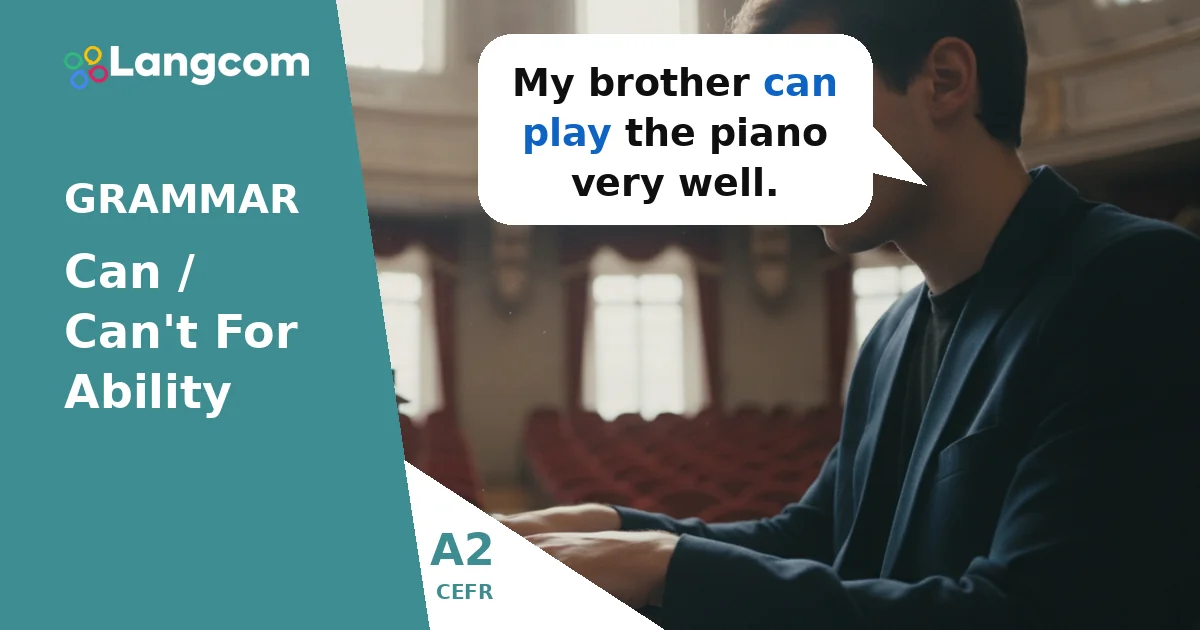
- My brother can play the piano very well.
- I can’t understand this lesson.
- Can they help us tomorrow?
- Yes, they can.
- No, I can’t come to the party.
- When I was a child, I could climb trees easily.
- She couldn’t find her keys yesterday.
التدريب
💬 هل تحتاج إلى إرشادات مخصصة؟
بصفتنا مركزًا معتمدًا للتحضير لاختبارات كامبريدج، يمكننا توجيهك نحو الدورة والشهادة المناسبتين لك. تحدث مع مستشارينا اليوم.
دردش مع مستشار على واتسابالأخطاء الشائعة لدى المتحدثين باللغة الإسبانية
Spanish speakers sometimes make mistakes with can because of direct translation from Spanish or using incorrect auxiliary verbs.
- Incorrect Auxiliary Verb: In Spanish, you might use ‘do’ or ‘don’t’ with verbs. In English, can is a modal verb and acts as its own auxiliary.
- خطأ: Do you can swim?
- الصحيح: Can you swim?
- خطأ: I don’t can speak English.
- الصحيح: I can’t speak English.
- Using ‘to’ after ‘can’: Remember, the verb after can is always in its base form without ‘to’.
- خطأ: He can to play football.
- الصحيح: He can play football.
الأسئلة الشائعة
What is the difference between ‘can’ and ‘could’?
Can is for abilities in the present (e.g., I can run fast now.). Could is for abilities in the past (e.g., I could run fast when I was young.).
Can I use ‘can’ for permission?
Yes, you can also use can to ask for or give permission, but this lesson focuses on ability. For example, Can I go home now?
Is ‘can’t’ the same as ‘cannot’?
Yes, can’t is the common contraction (short form) of cannot. They mean exactly the same thing.
Do I add ‘-s’ to ‘can’ for ‘he/she/it’?
لا،, can is a modal verb, so it never changes form. You always say he can, she can, it can.

0 تعليق