
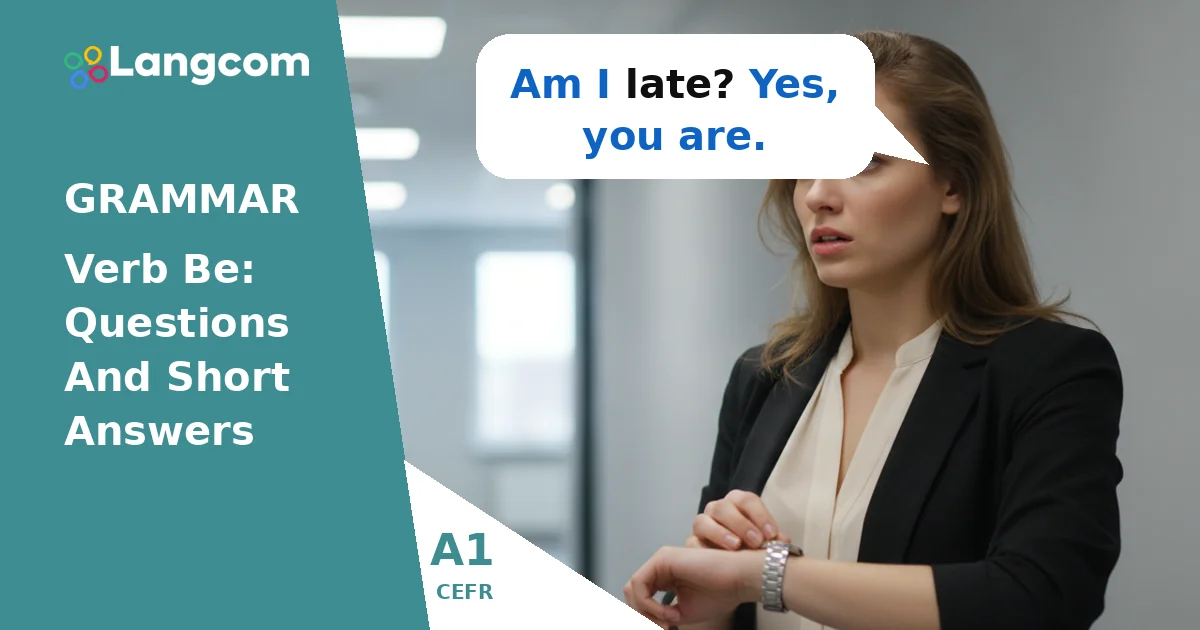

How Do We Form Questions with Be?
Forming questions with the verb be is easy. You just need to change the order of the words. Put the form of be (am, is, are) at the beginning of the sentence, before the subject.
- For example, if the statement is You are a student., the question is Are you a student?
- If the statement is He is tired., the question is Is he tired?
This is called subject-verb inversion.
🎓 تعلم اللغة الإنجليزية باستخدام الطريقة المختلطة
مجموعات صغيرة · مدرس ذكاء اصطناعي متاح على مدار الساعة · التحضير لامتحانات كامبريدج
خطط من $39 $79 في الشهر
How Do We Give Short Answers with Be?
When someone asks a question with be, we often use a short answer. This is more natural and polite than just saying ‘Yes’ or ‘No’.
Affirmative Short Answers (Yes)
Use Yes, + subject pronoun + form of be.
- Yes, I am.
- Yes, you are.
- Yes, he is.
- Yes, she is.
- Yes, it is.
- Yes, we are.
- Yes, they are.
Negative Short Answers (No)
Use No, + subject pronoun + form of be + not. Always use contractions for negative short answers to sound more natural.
- No, I’m not.
- No, you aren’t.
- No, he isn’t.
- No, she isn’t.
- No, it isn’t.
- No, we aren’t.
- No, they aren’t.
When Do We Use Be Questions?
We use questions with be for many basic situations. They help us ask about identity, location, feelings, and descriptions.
- Asking about identity: Are you Maria?
- Asking about location: Is he at home?
- Asking about feelings or states: Are they tired?
- Asking about descriptions: Is it cold?
| الموضوع | Question Form | Affirmative Short Answer | Negative Short Answer |
|---|---|---|---|
| I | Am I…? | Yes, I am. | No, I’m not. |
| You (singular/plural) | Are you…? | Yes, you are. | No, you aren’t. |
| He | Is he…? | Yes, he is. | No, he isn’t. |
| She | Is she…? | Yes, she is. | No, she isn’t. |
| It | Is it…? | Yes, it is. | No, it isn’t. |
| We | Are we…? | Yes, we are. | No, we aren’t. |
| They | Are they…? | Yes, they are. | No, they aren’t. |
أمثلة
- Am I late? Yes, you are.
- Are you from Spain? No, I’m not.
- Is she a doctor? Yes, she is.
- Is he happy? No, he isn’t.
- Is it sunny today? Yes, it is.
- Are we ready? Yes, we are.
- Are they students? No, they aren’t.
التدريب
💬 هل تحتاج إلى إرشادات مخصصة؟
بصفتنا مركزًا معتمدًا للتحضير لاختبارات كامبريدج، يمكننا توجيهك نحو الدورة والشهادة المناسبتين لك. تحدث مع مستشارينا اليوم.
دردش مع مستشار على واتسابالأخطاء الشائعة لدى المتحدثين باللغة الإسبانية
Spanish speakers sometimes make these common mistakes when forming questions and short answers with be:
- Incorrect Word Order: A common mistake is to keep the subject-verb order, like in Spanish. For example, saying You are happy? instead of the correct Are you happy? Remember to always invert the subject and be for questions.
- Too Short Answers: Just saying Yes. أو No. can sound abrupt in English. It’s better to use the full short answer, like Yes, I am. أو No, I’m not. Avoid saying things like Yes, am. أو No, am not.
الأسئلة الشائعة
Can I just say ‘Yes’ or ‘No’?
You can, but using a short answer like Yes, I am. أو No, I’m not. is more polite and sounds more natural in English conversations.
Why do we use ‘am’ with ‘I’?
Am is the special form of the verb be that we use only with the subject pronoun I. It’s a unique conjugation.
Are contractions always necessary in negative short answers?
For negative short answers, contractions like isn’t و aren’t are very common and make your English sound more natural. I’m not is also always used for I am not.
What is the difference between ‘Are you happy?’ and ‘You are happy?’
Are you happy? is a direct question, asking for information. You are happy. is a statement. While you can make a statement sound like a question with your voice, the correct grammatical form for a question with be is to invert the subject and verb.

0 تعليق