

What Are Multi-Word Verbs?
Multi-word verbs are combinations of a verb and one or two other words. These extra words are usually prepositions or adverbs. They are also often called phrasal verbs.
The important thing is that the meaning of the multi-word verb is often different from the meaning of the individual words. For example, give means to offer something, but give up means to stop trying.
🎓 تعلم اللغة الإنجليزية باستخدام الطريقة المختلطة
مجموعات صغيرة · مدرس ذكاء اصطناعي متاح على مدار الساعة · التحضير لامتحانات كامبريدج
خطط من $39 $79 في الشهر
Why Are Multi-Word Verbs Important for B1 English?
Multi-word verbs are very common in spoken and written English. Native speakers use them all the time. Learning them helps you understand everyday conversations and texts better.
- They make your English sound more natural and fluent.
- They help you understand different situations and contexts.
- They expand your vocabulary with useful, everyday expressions.
Essential Multi-Word Verbs for B1 Learners
Here are some important multi-word verbs that B1 learners should know. Remember that the meaning changes when the words combine.
- Look after: To take care of someone or something.
- Can you look after my cat while I'm on holiday?
- Put off: To delay doing something until a later time.
- Don't put off your homework until the last minute.
- Carry on: To continue doing something.
- Please carry on with your work.
- Hand in: To give something to a person in authority, like a teacher or boss.
- Students must hand in their essays by Friday.
- Pass on: To give something to someone else, or to transmit information.
- Could you pass on this message to Maria?
- Come round: To visit someone's house.
- Why don't you come round for coffee this weekend?
- Break up: To end a relationship; also, when school or a meeting finishes.
- They decided to break up after five years together.
- School breaks up for the summer holidays next week.
- Turn down: To refuse an offer or request; also, to reduce the volume or intensity.
- She turned down the job offer because it was too far away.
- Can you turn down the music? It's too loud.
- Join in: To participate in an activity with other people.
- Everyone was singing, so I decided to join in.
- Feel like: To want to do or have something.
- I don't feel like cooking tonight. Let's order pizza.
| Multi-Word Verb | المعنى |
|---|---|
| look after | To take care of someone or something. |
| put off | To delay doing something; postpone. |
| carry on | To continue doing something. |
| hand in | To give something to an authority (teacher, boss). |
| pass on | To give something to someone else; transmit information. |
| come round | To visit someone's house. |
| break up | To end a relationship; to finish for holidays (school). |
| turn down | To refuse an offer; to reduce volume/intensity. |
| join in | To participate in an activity. |
| feel like | To want to do or have something. |
أمثلة
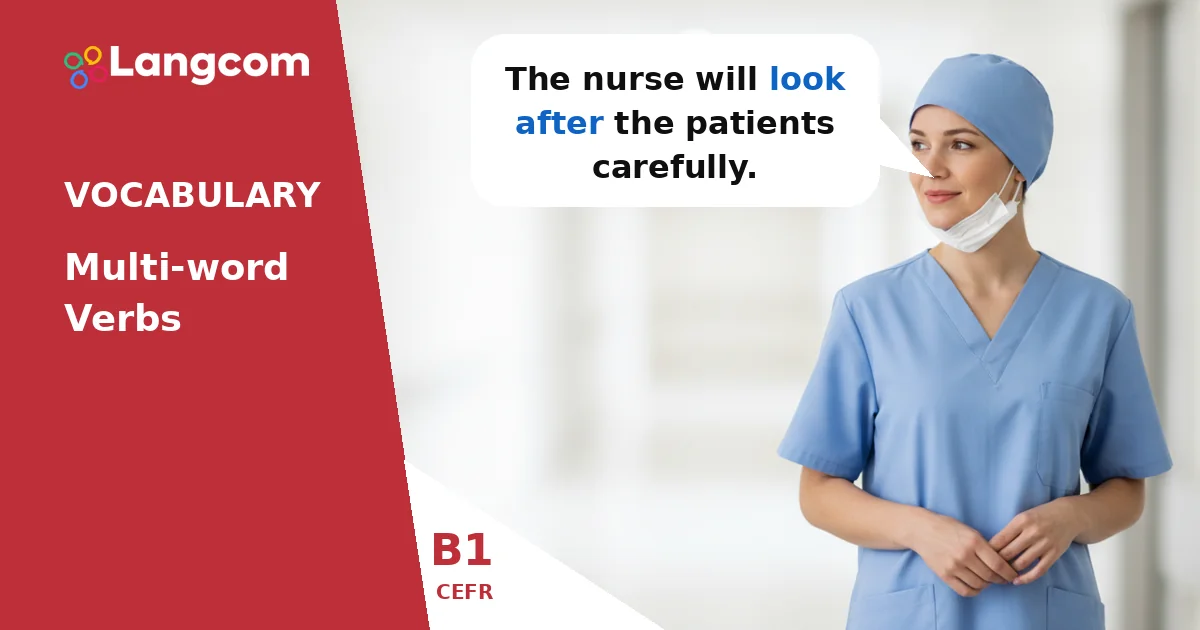
- The nurse will look after the patients carefully.
- I always put off cleaning my room until Sunday.
- Even though it was raining, they carried on playing football.
- Remember to hand in your project before the deadline.
- Please pass on my regards to your family.
- My friends often come round to watch movies.
- The band broke up after their last concert.
- He had to turn down the invitation because he was busy.
- We invited her to join in the game, and she accepted.
- Do you feel like going for a walk?
التدريب
✍️ لست متأكدًا من مستواك؟
خُذ اختبار تحديد المستوى المجاني الخاص بنا واحصل على تعليقات مخصصة من ممتحنين معتمدين من كامبريدج.
قم بإجراء اختبار تحديد المستوى المجانيالأخطاء الشائعة لدى المتحدثين باللغة الإسبانية
Spanish speakers often make mistakes with multi-word verbs because they try to translate directly from Spanish. The meaning of a multi-word verb is usually not literal.
- Literal Translation: You might think look after means "mirar después" (look after) but it means "cuidar" (take care of).
- خطأ: I will look after my dog. (Meaning "mirar después")
- الصحيح: I will look after my dog. (Meaning "cuidar")
- Using a single verb instead of a multi-word verb: Sometimes, a multi-word verb is more natural than a single verb.
- Less natural: I will postpone the meeting.
- More natural: I will put off the meeting.
- Confusing similar verbs: Be careful with verbs that look similar but have different particles.
- Look for (search) is different from look after (take care of).
الأسئلة الشائعة
What is a multi-word verb?
A multi-word verb is a verb combined with a preposition or an adverb, or both. This combination creates a new meaning. For example, get up means to rise from bed.
Are multi-word verbs difficult to learn?
They can be challenging because their meanings are not always obvious. However, with practice and by learning them in context, they become easier. Focus on the most common ones first.
How can I remember multi-word verbs?
Try to learn them in groups by topic, or with example sentences. Use flashcards and practice using them in your own sentences. Reading and listening a lot will also help you see them in context.
Are all multi-word verbs separable?
No, some are separable, and some are inseparable. For example, you can turn the music down أو turn down the music (separable). But you must look after your cat, ، وليس look your cat after (inseparable). It's best to learn which ones are which as you go.
Why are they sometimes called "phrasal verbs"?
"Phrasal verb" is another common name for multi-word verbs. They are the same thing. The term phrasal verb is often used in grammar books.

0 تعليق