
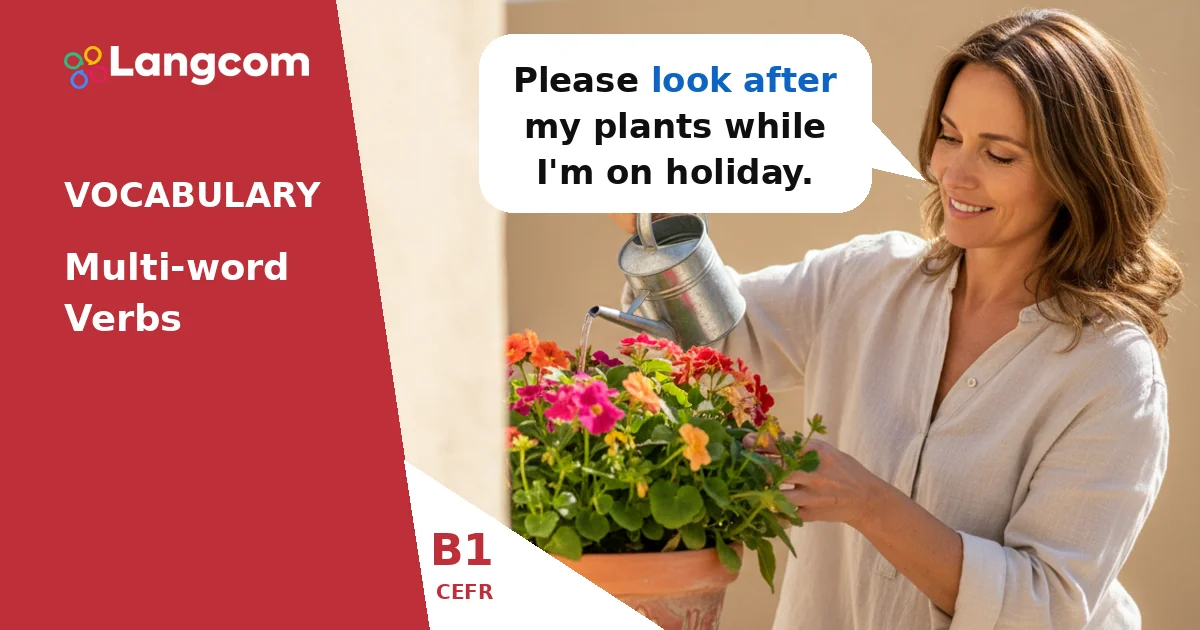

What Are Multi-Word Verbs?
Multi-word verbs are groups of words that work together as a single verb. They usually consist of a main verb and one or two other words, like prepositions or adverbs.
The important thing to remember is that the meaning of a multi-word verb is often not clear from the individual words. It’s a new, unique meaning.
- “Look” means to direct your eyes.
- “After” means later in time or following.
- But “look after” means to care for someone or something.
🎓 تعلم اللغة الإنجليزية باستخدام الطريقة المختلطة
مجموعات صغيرة · مدرس ذكاء اصطناعي متاح على مدار الساعة · التحضير لامتحانات كامبريدج
خطط من $39 $79 في الشهر
Why Are Multi-Word Verbs Important for B1 Learners?
Multi-word verbs are a big part of English. You will hear them all the time in movies, songs, and conversations. They make your English sound more natural and fluent.
- Natural Communication: Native speakers use them constantly. Understanding them helps you follow conversations easily.
- Express Yourself Clearly: They allow you to express complex ideas with simple words.
- Expand Vocabulary: Learning multi-word verbs is like learning many new words at once, as each combination has a distinct meaning.
Common B1 Multi-Word Verbs and Their Meanings
Let's look at some common multi-word verbs that are useful at the B1 level. Remember to learn their meanings as a whole phrase.
- Look after: To take care of someone or something. "Can you look after my cat this weekend?"
- Put off: To postpone or delay doing something. "Don't put off your homework until the last minute."
- Carry on: To continue doing something. "Please carry on with your work while I'm gone."
- Hand in: To submit something, usually to a person in authority. "Students must hand in their essays by Friday."
- Pass on: To give something to someone else, or to transmit information. "Could you pass on this message to Maria?"
- Come round: To visit someone's house, or to regain consciousness. "Why don't you come round for coffee tomorrow?"
- Break up: To end a relationship, or for school/work to finish for a holiday. "They decided to break up after five years."
- Turn down: To refuse an offer or request, or to reduce the volume/heat. "She had to turn down the job offer."
- Join in: To participate in an activity with others. "Everyone was singing, so I decided to join in."
- Feel like: To want to do something, or to have a desire for something. "I don't feel like cooking tonight."
Separable or Inseparable: Understanding Word Order
Some multi-word verbs can be separated by an object, and some cannot. This is an important detail for B1 learners.
- Separable Multi-Word Verbs: The object can go between the verb and the particle, or after the particle. If the object is a pronoun (e.g., it, them, her), it must go between the verb and the particle.
- "I will put off the meeting." (صحيح)
- "I will put the meeting off." (صحيح)
- "I will put it off." (صحيح)
- "I will put off it." (غير صحيح)
- Inseparable Multi-Word Verbs: The verb and the particle always stay together. The object always comes after the particle.
- "I will look after the children." (صحيح)
- "I will look the children after." (غير صحيح)
- "I will look after them." (صحيح)
- "I will look them after." (غير صحيح)
| Multi-Word Verb | المعنى | جملة مثال |
|---|---|---|
| look after | Care for | Who will look after the dog? |
| put off | Postpone | Don't put off your studies. |
| carry on | Continue | Please carry on working. |
| hand in | Submit | I need to hand in my report. |
| pass on | Transmit/Give to someone else | Pass on the message. |
| come round | Visit / Regain consciousness | Come round for tea. |
| break up | End a relationship / Finish school | They broke up last month. |
| turn down | Refuse / Lower volume | He turned down the offer. |
| join in | Participate | Everyone can join in the game. |
| feel like | Want to do/have | I feel like pizza tonight. |
أمثلة
- Please look after my plants while I'm on holiday.
- We had to put off the picnic because of the rain.
- Even though it was difficult, she decided to carry on with her studies.
- Don't forget to hand in your application form by Friday.
- Could you pass on my regards to your family?
- He fainted, but he soon came round.
- The school will break up for summer next week.
- They offered him a great job, but he turned it down.
- The children were playing, and I wanted to join in.
- I don't feel like going out tonight; I'm too tired.
التدريب
✍️ لست متأكدًا من مستواك؟
خُذ اختبار تحديد المستوى المجاني الخاص بنا واحصل على تعليقات مخصصة من ممتحنين معتمدين من كامبريدج.
قم بإجراء اختبار تحديد المستوى المجانيالأخطاء الشائعة لدى المتحدثين باللغة الإسبانية
Spanish speakers sometimes make mistakes with multi-word verbs because they try to translate them directly from Spanish, or they struggle with word order.
- الترجمة الحرفية: Do not try to translate multi-word verbs word-for-word. For example, "look after" does not mean "mirar después". It means "cuidar". Always learn the complete meaning of the multi-word verb.
- Incorrect Word Order (Separable Verbs): Remember that if the object is a pronoun, it must go between the verb and the particle for separable multi-word verbs.
- خطأ: "I will turn down it."
- الصحيح: "I will turn it down."
- Using a single verb instead of a multi-word verb: While often possible, using a single verb can sound less natural. For example, saying "I postponed the meeting" هذا صحيح، لكن "I put off the meeting" is very common and natural.
الأسئلة الشائعة
What is the difference between a phrasal verb and a multi-word verb?
The term "multi-word verb" is a general term for any verb that has more than one word. "Phrasal verb" is a specific type of multi-word verb where the second word is an adverb (e.g., "turn off"). Other types include prepositional verbs (e.g., "look at") and phrasal-prepositional verbs (e.g., "look forward to"). For B1, it's most important to understand the concept of a verb + small word(s) creating a new meaning.
How can I remember so many multi-word verbs?
The best way is to learn them in context, not just as a list. Read English texts, listen to English speakers, and pay attention to how they use these verbs. Try to create your own sentences with them. Focus on the most common ones first, like "look after" أو "put off".
Are multi-word verbs formal or informal?
Multi-word verbs are very common in both informal and formal English. Some are more informal (e.g., "hang out"), while others are perfectly acceptable in formal contexts (e.g., "carry out" a task). The ones we discussed here are generally suitable for everyday B1 communication.
Can multi-word verbs have more than one meaning?
Yes, many multi-word verbs have multiple meanings, just like single verbs. For example, "turn down" can mean to refuse an offer or to reduce the volume. You need to understand the context to know which meaning is intended.

0 تعليق