

What is the main difference between ‘all’ and ‘whole’?
Both all و whole mean ‘every part of something’. However, they are used differently depending on the type of noun and the specific meaning you want to express.
- All emphasizes the individual parts or members of a group. It means ‘every single one’.
- Whole emphasizes the completeness of a single thing. It means ‘the entire thing’ or ‘undivided’.
✍️ لست متأكدًا من مستواك؟
خُذ اختبار تحديد المستوى المجاني الخاص بنا واحصل على تعليقات مخصصة من ممتحنين معتمدين من كامبريدج.
قم بإجراء اختبار تحديد المستوى المجانيWhen do we use 'all'?
نحن نستخدم all in several situations:
- With plural countable nouns: This refers to every member of a group. All can be used with or without the.
- With uncountable nouns: This refers to the entire amount of something.
- With pronouns: غالبًا ما نستخدم all of before object pronouns (us, them, it) or demonstrative pronouns (this, that, these, those).
- To talk about general truths: When we mean 'every' or 'in general'.
When do we use 'whole'?
نحن نستخدم whole primarily in these cases:
- With singular countable nouns: This refers to a single, complete item or unit.
- Often with the definite article the or a possessive pronoun: For example, the whole أو my whole.
- To emphasize completeness: It means 'from beginning to end' or 'every part of one thing'.
- مع the whole of: This structure is also possible before singular countable nouns or proper nouns.
Can 'all' and 'whole' be used interchangeably?
في بعض الأحيان،, all و whole can seem similar, but there is usually a subtle difference in focus.
- When talking about a single, complete unit (like a book or a day), both might be possible, but whole is more common. For example, I read the whole book is more natural than I read all the book.
- When referring to a group of individual items, all هو الخيار الصحيح.
| ميزة | <span data-no-translation>All</span> | <span data-no-translation>Whole</span> |
|---|---|---|
| Noun Type | Plural countable, uncountable, pronouns | Singular countable |
| Focus | Every single part/member (quantity) | Complete, undivided item (entirety) |
| Common Prepositions | Often of (على سبيل المثال،, all of us) | Often the or possessive (e.g., the whole day) |
| Example | All the students | The whole class |
أمثلة
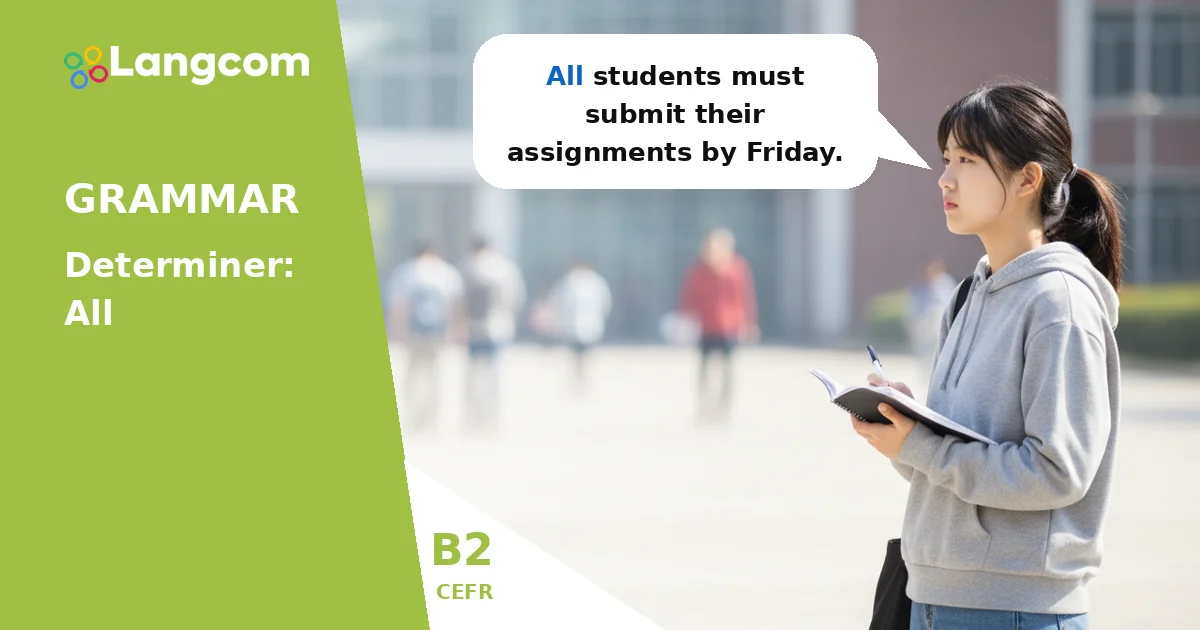
- All students must submit their assignments by Friday.
- All the information is available online.
- She ate the whole cake by herself.
- My whole family is coming to visit.
- All of us enjoyed the concert.
- The whole of the city was affected by the power cut.
- All birds have feathers.
- He spent his whole life working for that company.
التدريب
هل أنت مستعد للحصول على شهادتك؟
يُعد برنامج Langcom الطلاب لامتحانات كامبريدج وIELTS وTOEFL وDELE وSIELE وMichigan.
ابدأ مع Langcomالأخطاء الشائعة لدى المتحدثين باللغة الإسبانية
Spanish speakers sometimes confuse all و whole because the Spanish word 'todo/a/os/as' can translate to both. Here are common errors:
- استخدام all with a singular countable noun without of:
❌ All the company is moving.
✅ The whole company is moving. (Or All of the company is moving.) - استخدام whole with a plural noun:
❌ The whole students passed the exam.
✅ All the students passed the exam. - Forgetting the or a possessive with whole:
❌ Whole day was rainy.
✅ The whole day was rainy.
الأسئلة الشائعة
What is the difference between 'all the' and 'the whole'?
All the is typically used with plural nouns (e.g., all the books) or uncountable nouns (e.g., all the water) to mean 'every single one' or 'the entire quantity'. The whole is used with singular countable nouns (e.g., the whole book) to mean 'the complete, undivided item'.
Can 'all' be used without 'the'?
نعم،, all can be used without the when talking about general statements or categories. For example, All children need love (general) versus All the children in this room are happy (specific).
How is this topic relevant for the B2 First exam?
Understanding the correct usage of all و whole is crucial for the B2 First (FCE) exam, especially in the 'Use of English' paper. You might encounter questions testing these determiners in Part 1 (Multiple-choice cloze) or Part 2 (Open cloze), where choosing the correct word is essential for grammatical accuracy and meaning.



0 تعليق