
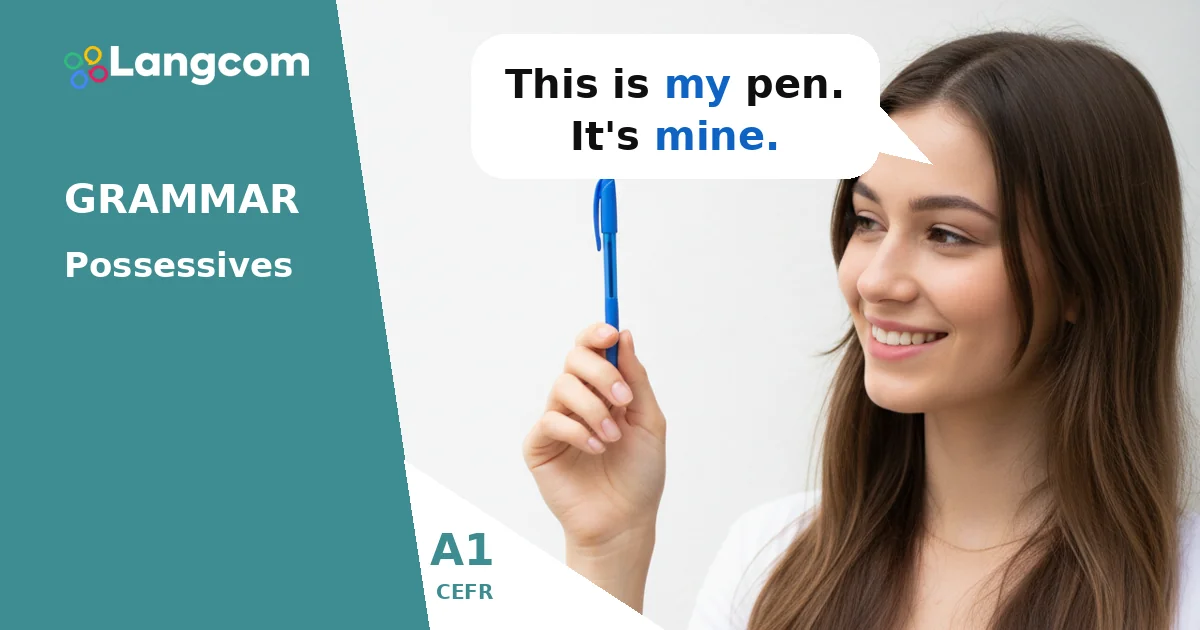

What are Possessive Adjectives and Possessive Pronouns?
Possessive adjectives and possessive pronouns both show who owns something. They are similar but work in different ways.
- Possessive Adjectives always come before a noun. They describe the noun.
Examples:
- This is my car.
- Is that your phone?
- She lives with her parents.
- Possessive Pronouns stand alone. They replace a possessive adjective + a noun. This helps us avoid repeating words.
Examples:
- This car is mine. (Instead of ‘my car’)
- Is that phone yours? (Instead of ‘your phone’)
- That house is theirs. (Instead of ‘their house’)
Remember, the possessive adjective its does not have a possessive pronoun form.
🎓 تعلم اللغة الإنجليزية باستخدام الطريقة المختلطة
مجموعات صغيرة · مدرس ذكاء اصطناعي متاح على مدار الساعة · التحضير لامتحانات كامبريدج
خطط من $39 $79 في الشهر
How Do We Use the Possessive ‘s?
We use the apostrophe ‘s to show that a person or animal owns something. It is very common in English.
- For singular nouns and names: Add ‘s to the end of the word.
Examples:
- This is Maria’s book. (The book belongs to Maria.)
- That is the dog’s toy. (The toy belongs to the dog.)
- For plural nouns ending in -s: Just add an apostrophe ‘ after the -s.
Examples:
- These are the students’ desks. (The desks belong to the students.)
- My parents’ car is new. (The car belongs to my parents.)
Be careful! ‘s can also be a short form for is أو has. The meaning depends on the sentence.
- He‘s a doctor. (He is a doctor.)
- She‘s got a new phone. (She has got a new phone.)
How Do We Ask About Possession?
To ask who something belongs to, we use the word Whose.
- You can use Whose before a noun.
Examples:
- Whose jacket is this?
- Whose keys are those?
- You can also use Whose alone, after the verb.
Examples:
- Whose is this jacket?
- Whose are those keys?
| الموضوع | Possessive Adjective | Possessive Pronoun |
|---|---|---|
| I | my | mine |
| You | your | yours |
| He | his | his |
| She | her | hers |
| It | its | – |
| We | our | ours |
| They | their | theirs |
أمثلة
- This is my pen. It’s mine.
- That is your bag. Is it yours?
- He has a new phone. It’s his.
- She loves her cat. The cat is hers.
- We live in our house. The house is ours.
- They found their dog. The dog is theirs.
- This is my brother’s room.
- The children’s toys are everywhere.
- Whose car is parked outside?
التدريب
💬 هل تحتاج إلى إرشادات مخصصة؟
بصفتنا مركزًا معتمدًا للتحضير لاختبارات كامبريدج، يمكننا توجيهك نحو الدورة والشهادة المناسبتين لك. تحدث مع مستشارينا اليوم.
دردش مع مستشار على واتسابالأخطاء الشائعة لدى المتحدثين باللغة الإسبانية
Many Spanish speakers sometimes make these mistakes:
- Using a possessive adjective without a noun: In Spanish, you can often use a possessive word alone (e.g., ‘es mío’). In English, possessive adjectives always need a noun after them. You must use a possessive pronoun instead.
- Wrong: This book is my.
- الصحيح: This book is mine.
- Wrong: That is your.
- الصحيح: That is yours.
- Confusing it’s و its:
- It’s means it is أو it has. Example: It’s a beautiful day.
- Its is a possessive adjective. Example: The dog wagged its tail.
الأسئلة الشائعة
What is the difference between ‘my’ and ‘mine’?
My is a possessive adjective. It always comes before a noun, like in my book. Mine is a possessive pronoun. It replaces ‘my + noun’, so it stands alone, like in This book is mine.
When do I use ‘s and when do I use ‘ for possession?
You use ‘s for singular nouns and names (e.g., John’s car, the cat’s toy). You use just ‘ (the apostrophe after the -s) for plural nouns that already end in -s (e.g., the students’ books, my parents’ house).
Does ‘its’ have a possessive pronoun form?
لا،, its is only a possessive adjective (e.g., The tree lost its leaves.). There is no possessive pronoun form for it.
Can I use ‘whose’ to ask about people and things?
Yes, you can use Whose to ask about possession for both people and things. For example, Whose jacket is this? (for a person) or Whose car is that? (for a thing).

0 تعليق