
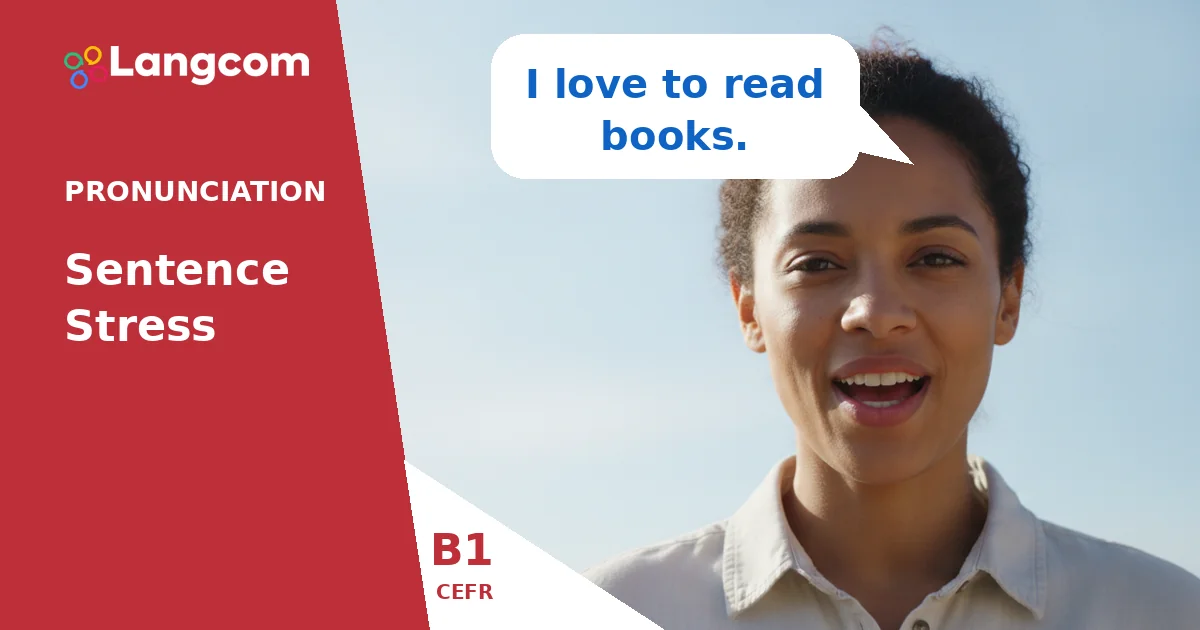

What is Sentence Stress?
Sentence stress is the emphasis we place on certain words within a sentence. It’s how we make some words stand out more than others when we speak.
- English is a ‘stress-timed’ language. This means the time between stressed syllables is usually similar, regardless of the number of unstressed syllables.
- This creates a natural rhythm and flow in spoken English.
Why is Sentence Stress Important for B1 Learners?
Understanding and using sentence stress correctly is vital for several reasons:
- Clarity: It helps listeners understand your message more easily.
- Natural Sound: Your English will sound more natural and fluent, less like you are reading from a book.
- Listening Skills: When you know which words are usually stressed, it's easier to understand native speakers.
- Meaning: Stress can sometimes change the focus or even the meaning of a sentence.
Which Words Do We Usually Stress?
Generally, we stress 'content words' because they carry the main meaning of the sentence. 'Function words' are usually unstressed.
- Content words give information. They are the keywords that help us understand the message.
- Function words are grammatical words. They help connect the content words and make the sentence grammatically correct, but they don't carry much meaning themselves.
Content Words vs. Function Words: Examples
Let's look at the types of words that typically get stress and those that don't:
Content Words (usually stressed):
- Nouns: book, teacher, coffee
- Main Verbs: eat, go, understand
- Adjectives: beautiful, important, new
- Adverbs: quickly, always, carefully
- Demonstratives: this, that, these, those
- Question Words: who, what, where, why, how
Function Words (usually unstressed):
- Articles: a, an, the
- Prepositions: in, on, at, for
- Conjunctions: and, but, or
- Auxiliary Verbs: is, are, do, have (when not main verbs)
- Pronouns: I, you, he, she, it, we, they
How Does Stress Change Meaning?
Sometimes, changing the stressed word can change the focus or even the meaning of a sentence. Consider this example:
- I didn't say he stole the money. (Someone else said it, not me.)
- I didn't say he stole the money. (I deny saying it.)
- I didn't say he stole the money. (I implied it, but didn't use those exact words.)
- I didn't say he stole the money. (Someone else stole it, not him.)
- I didn't say he stole the money. (He borrowed it, didn't steal it.)
- I didn't say he stole the money. (He stole something else, not money.)
This shows how powerful sentence stress can be in English communication.
Tips for Practicing Sentence Stress
To improve your sentence stress, try these techniques:
- Listen Carefully: Pay attention to stressed words when listening to English speakers (movies, music, podcasts).
- Shadowing: Repeat what you hear immediately after a native speaker, trying to match their rhythm and stress.
- Record Yourself: Speak a sentence and then listen back. Does it sound natural? Are you stressing the important words?
- Read Aloud: Practice reading texts aloud, consciously deciding which words to stress.
| Type of Word | 示例 | Typical Stress |
|---|---|---|
| Content Words (meaning) | nouns, main verbs, adjectives, adverbs, question words | Stressed (louder, longer) |
| Function Words (grammar) | articles, prepositions, conjunctions, auxiliary verbs, pronouns | Unstressed (quieter, shorter, often reduced) |
示例
- I love to read books.
- She went to the store quickly.
- What are you doing tonight?
- They always play football on Saturdays.
- The new teacher is very kind.
练习
西班牙语母语者常犯的错误
Spanish speakers often make these mistakes with sentence stress:
- Stressing every word: In Spanish, syllables often have more equal stress. In English, stressing every word makes speech sound unnatural and difficult to understand. For example, saying I AM GOING TO THE STORE 而不是 I'm going to the store.
- Not reducing function words: Function words (like to, a, for) are often reduced and said very quickly in English. Spanish speakers might pronounce them fully, which sounds less natural. For instance, pronouncing for as /fɔːr/ 在 I'm waiting for you, instead of the reduced /fər/.
- Incorrectly stressing function words: Sometimes, a function word might be stressed for emphasis, but if done incorrectly, it can confuse the listener. For example, saying I HAVE a car (stressing the auxiliary verb) when you mean I have a car (stressing the noun).
常见问题
What is the main rule for sentence stress?
The main rule is to stress 'content words' (nouns, main verbs, adjectives, adverbs) because they carry the most meaning, and to reduce 'function words' (articles, prepositions, auxiliary verbs, pronouns) so they are said more quickly and quietly.
Can function words ever be stressed?
Yes, function words can be stressed for emphasis or to correct information. For example, if someone asks, Did you go TO the party? and you want to emphasize the preposition, you might say, No, I went FROM the party.
How can I hear sentence stress better?
Listen to native English speakers in natural conversations, movies, or podcasts. Try to identify the words that sound louder, longer, and higher in pitch. These are usually the stressed words. You can also use online dictionaries that provide audio examples for sentences.
Does sentence stress affect my B1 English exam score?
Yes, correct sentence stress contributes to your pronunciation score in speaking exams. Using natural rhythm and stress helps you communicate more effectively and demonstrates a higher level of fluency and control over spoken English.



0 条评论