

What Are English Collocations?
Collocations are words that naturally go together. They are not random combinations. For example, we say fast food, 而不是 quick food. We say make an effort, 而不是 do an effort.
- Learning collocations helps your English sound more natural.
- It also helps you understand native speakers better.
- 动词 get is famous for having many collocations.
The Versatile Verb 'Get'
Get is a very common verb in English. It has many different meanings depending on the words it combines with. At a B1 level, it's important to learn these common expressions.
We will look at how get is used for changes, receiving things, and relationships.
'Get' for Changes and States
One common use of get is to mean 'become'. We use it to talk about changes in state, health, or emotions.
- Get ill / sick: To become unwell. I started to get ill yesterday.
- Get better: To improve in health or condition. I hope you get better soon!
- Get rich: To become wealthy. He wants to get rich quickly.
- Get angry / tired / cold: To become angry, tired, or cold. She gets angry easily.
'Get' for Receiving or Obtaining
Another frequent use of get is to mean 'receive' or 'obtain' something. This is very common in everyday English.
- Get a job: To find employment. It's hard to get a job without experience.
- Get an offer: To receive a proposal, often for work or a purchase. She got an offer from a big company.
- Get paid: To receive money for work. When do you get paid?
- Get a present / a letter / an email: To receive these items. Did you get my email?
'Get' for Relationships
Get can also describe how people interact with each other.
- Get on well (with someone): To have a good relationship with someone. I get on well with my new colleagues.
| Collocation | Meaning / Context |
|---|---|
| get a job | To find employment |
| get an offer | To receive a proposal (e.g., for work, a house) |
| get paid | To receive money for work |
| get rich | To become wealthy |
| get ill / sick | To become unwell |
| get better | To improve in health or condition |
| get on well (with someone) | To have a good relationship with someone |
| get angry / tired / cold | To become angry, tired, or cold |
示例
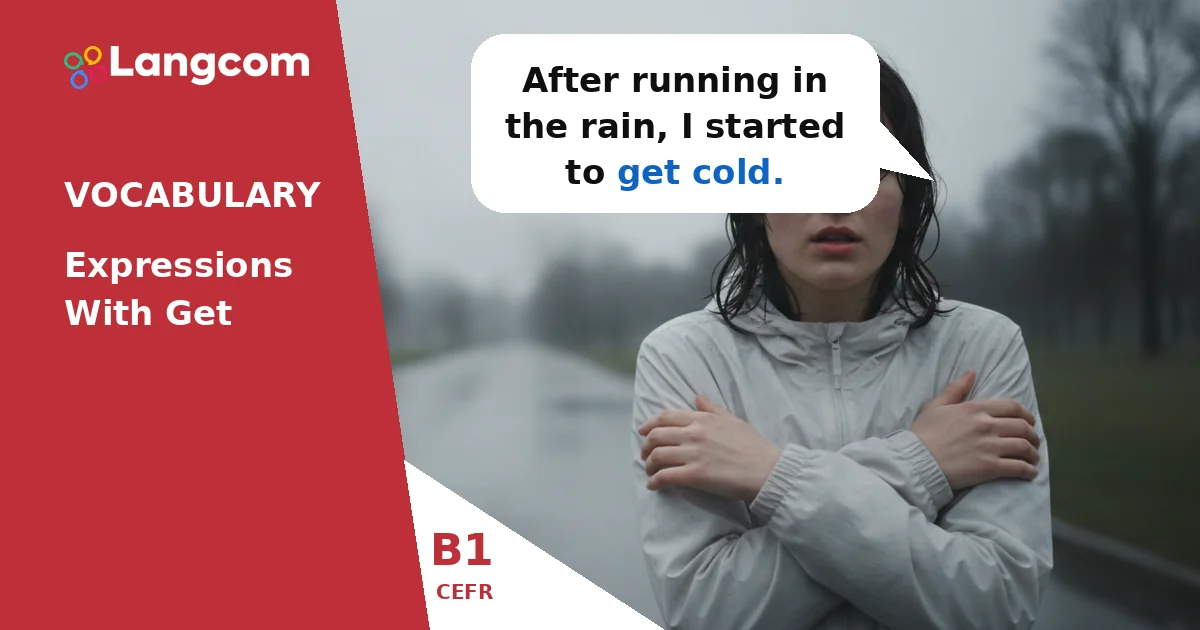
- After running in the rain, I started to get cold.
- She was so happy when she got a job at the university.
- He hopes to get rich by investing in new technology.
- I hope you get better soon from your cold.
- They got an offer for their house, but it was too low.
- We usually get paid on the last Friday of the month.
- My children get on well with their cousins.
练习
西班牙语母语者常犯的错误
Spanish speakers sometimes translate directly from their native language, which can lead to common errors with get collocations.
- 使用 become 而不是 get for changes: 虽然 become is grammatically correct, get is much more common and natural for everyday changes in health, mood, or state.
- 错误: I became ill yesterday.
- 正确: I got ill yesterday.
- 使用 obtain 或 receive when get is more natural: For many common situations, get is preferred for obtaining or receiving.
- Less natural: I obtained a job last week.
- More natural: I got a job last week.
Remember that collocations are fixed phrases. It's best to learn them as complete units.
常见问题
What is a collocation in English?
A collocation is a natural combination of words that are frequently used together by native speakers. For example, heavy rain is a collocation, but strong rain is not, even though both words have similar meanings.
Why is 'get' so common in English?
Get is common because it is a very versatile verb. It can replace many other verbs in informal contexts, especially when talking about changes, receiving, or moving. This makes it essential for everyday conversation.
Can I always use 'become' instead of 'get' for changes?
不,并非总是如此。虽然 become is correct for formal situations or significant transformations, get is much more common and natural for everyday changes in state, health, or emotion. For example, get tired is more common than become tired.
How can I remember all the 'get' collocations?
The best way to remember get collocations is to learn them in context. Read, listen, and practice using them in sentences. Try to group them by meaning, like 'get for changes' (get ill, get better) or 'get for receiving' (get a job, get paid).



0 条评论