

What are Countries and Nationalities?
A country is a nation or a land. It has its own government and borders. For example, Brazil is a country.
A nationality describes where a person is from. It is an adjective. For example, someone from Brazil 是 Brazilian.
- We always write countries and nationalities with a capital letter.
- This is different from some other languages, like Spanish.
How Do We Use Countries and Nationalities?
You can use two main phrases to talk about where you or someone else is from:
- 使用 "I am from [Country]." This tells us your origin.
- 使用 "I am [Nationality]." This tells us your nationality.
These phrases work for other people too. For example, "She is from Japan" 或 "He is Japanese."
Common Endings for Nationalities
Many nationalities follow common patterns. Learning these patterns can help you guess new nationalities.
- -an: Many countries use this ending. Mexico → Mexican, America → American, Brazil → Brazilian.
- -ish: This ending is common for some European countries. Britain → British, Spain → Spanish.
- -ese: This ending is often for countries in Asia. Japan → Japanese, China → Chinese.
- -ian: Similar to -an, but for specific countries. Russia → Russian.
Remember, some nationalities are irregular and do not follow these patterns. For example, France → French.
| Country | Nationality |
|---|---|
| Mexico | Mexican |
| Japan | Japanese |
| Russia | Russian |
| China | Chinese |
| Brazil | Brazilian |
| Britain | British |
| America | American |
| Spain | Spanish |
| France | French |
| Germany | German |
示例
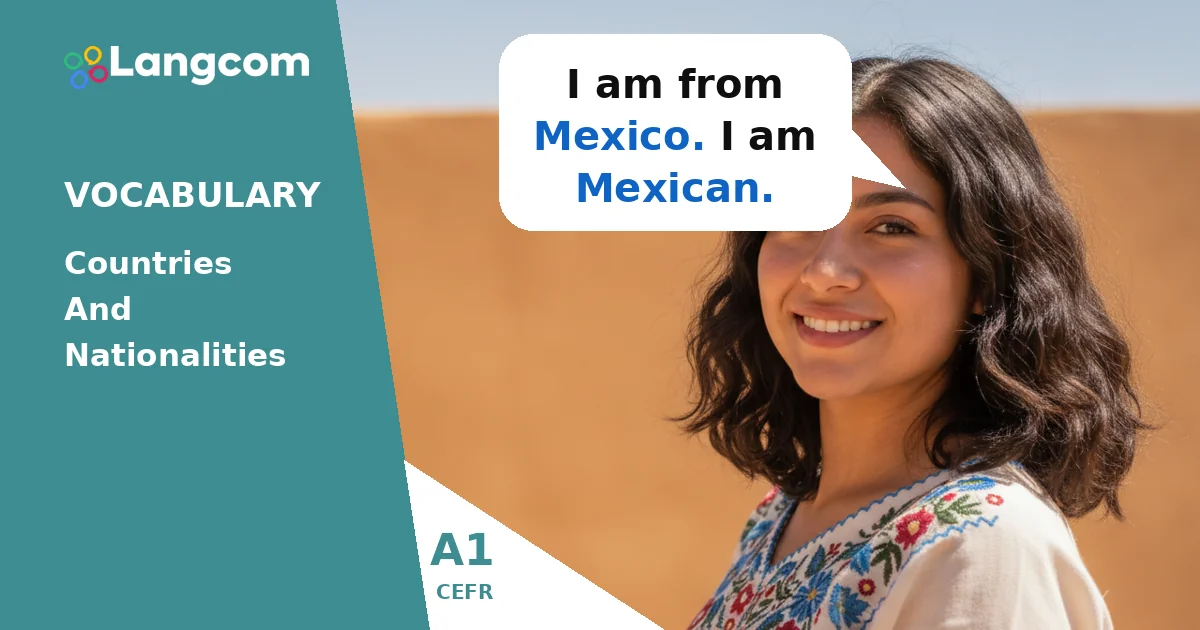
- I am from Mexico. I am Mexican.
- She is from Japan. She is Japanese.
- He is from Russia. He is Russian.
- We are from China. We are Chinese.
- They are from Brazil. They are Brazilian.
- You are from Britain. You are British.
- Is she from America? Yes, she is American.
- Are you from Spain? Yes, I am Spanish.
练习
西班牙语母语者常犯的错误
Spanish speakers often make these mistakes:
- Not capitalizing nationalities: In Spanish, nationalities are not capitalized (e.g., español). In English, they always are.
✗ I am spanish.
✓ I am Spanish. - Using "the" before a nationality as a personal description: In English, we don't say "I am the Spanish." We say "I am Spanish."
✗ He is the Mexican.
✓ He is Mexican. - Using "of" instead of "from": To talk about your country of origin, use "from."
✗ I am of China.
✓ I am from China.
常见问题
Why do I need to capitalize nationalities in English?
In English, all proper nouns, including names of countries and the adjectives derived from them (nationalities), are always capitalized. This is a basic rule of English grammar.
Is 'American' only for people from the USA?
Yes, in everyday English, American almost always refers to someone or something from the United States of America. While geographically North and South America are continents, the term American is specifically linked to the USA.
Can I use 'the' with nationalities?
您可以使用 the with a nationality to refer to the people of that country as a group (e.g., the Spanish are friendly). But you do not use the when describing an individual's nationality (e.g., I am Spanish, 而不是 I am the Spanish).




0 条评论