

How do we make ‘be’ negative for ‘he’, ‘she’, and ‘they’?
要将包含该动词的句子变为否定句 be, we simply add the word not 之后 is 或 are.
- 对于 he 和 she, 我们使用 is not.
- 对于 they, 我们使用 are not.
We often use shorter forms called contractions in everyday English. These are:
- is not 变成 isn’t
- are not 变成 aren’t
How do we ask 'yes/no' questions with 'be'?
To ask a question that can be answered with 'yes' or 'no', we change the word order of the sentence. We put Is 或 Are at the beginning.
- 其结构如下: Is/Are + subject (he/she/they) + rest of the sentence?
When someone asks a 'yes/no' question with be, you can give a short answer.
- For positive answers, use Yes, + subject + is/are. Do not use contractions here.
- For negative answers, use No, + subject + isn't/aren't. We usually use contractions here.
How do we ask 'Wh-' questions with 'be'?
'Wh-' questions ask for specific information, not just 'yes' or 'no'. Common 'Wh-' words include who, what, where, , 和 when.
- 其结构如下: Wh- word + is/are + subject (he/she/they) + rest of the sentence?
| 主题 | Positive | 否 | 是/否问题 | Wh- Question Example |
|---|---|---|---|---|
| He | He is happy. | He isn't happy. | Is he happy? | Where is he? |
| She | She is a student. | She isn't a student. | Is she a student? | Who is she? |
| They | They are friends. | They aren't friends. | Are they friends? | What are they? |
示例
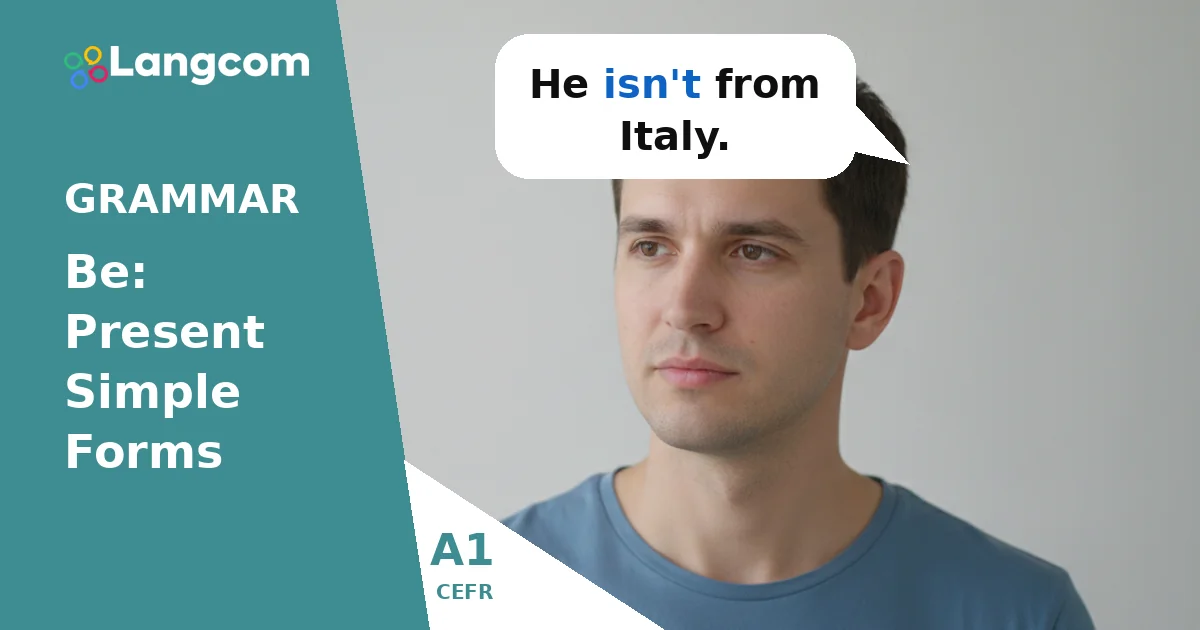
- He isn't from Italy.
- She is not a doctor.
- They aren't sad.
- Is he happy? Yes, he is.
- Is she a teacher? No, she isn't.
- Are they students? Yes, they are.
- Where is he?
- Who is she?
- What are they?
练习
西班牙语母语者常犯的错误
西班牙语学习者常犯的错误
When learning English, Spanish speakers sometimes make specific mistakes with be negative and questions:
- Missing Subject Pronoun: In Spanish, you often don't need a subject pronoun. In English, you always need one.
- 错误: Is happy?
- 正确: Is he happy?
- Incorrect Word Order for Questions: In English, the verb be moves to the beginning for questions.
- 错误: He is happy?
- 正确: Is he happy?
- Using Contractions in Positive Short Answers: We do not use contractions for positive short answers.
- 错误: Yes, he's.
- 正确: Yes, he is.
- 'Not' in the Wrong Place: 这个词 not always comes after is 或 are.
- 错误: Not he is happy.
- 正确: He is not happy. 或 He isn't happy.
常见问题
What does the verb 'be' mean?
动词 be means "ser" or "estar" in Spanish. It helps us talk about who someone is, what something is, where someone is, or how someone feels.
Why do we use contractions like 'isn't' and 'aren't'?
Contractions are very common in spoken English and in informal writing. They make sentences sound more natural and help you speak more quickly.
Can I always say 'is not' or 'are not' instead of 'isn't' or 'aren't'?
Yes, you can. The full forms is not 和 are not are always correct. They are often used in more formal writing or when you want to emphasize the 'not'.
Do these rules apply to 'I' and 'you' too?
Yes, the basic idea is similar. For I, you use am not (I'm not) and for questions, Am I...? 对于 you, you use are not (you aren't) and for questions, Are you...?

0 条评论