
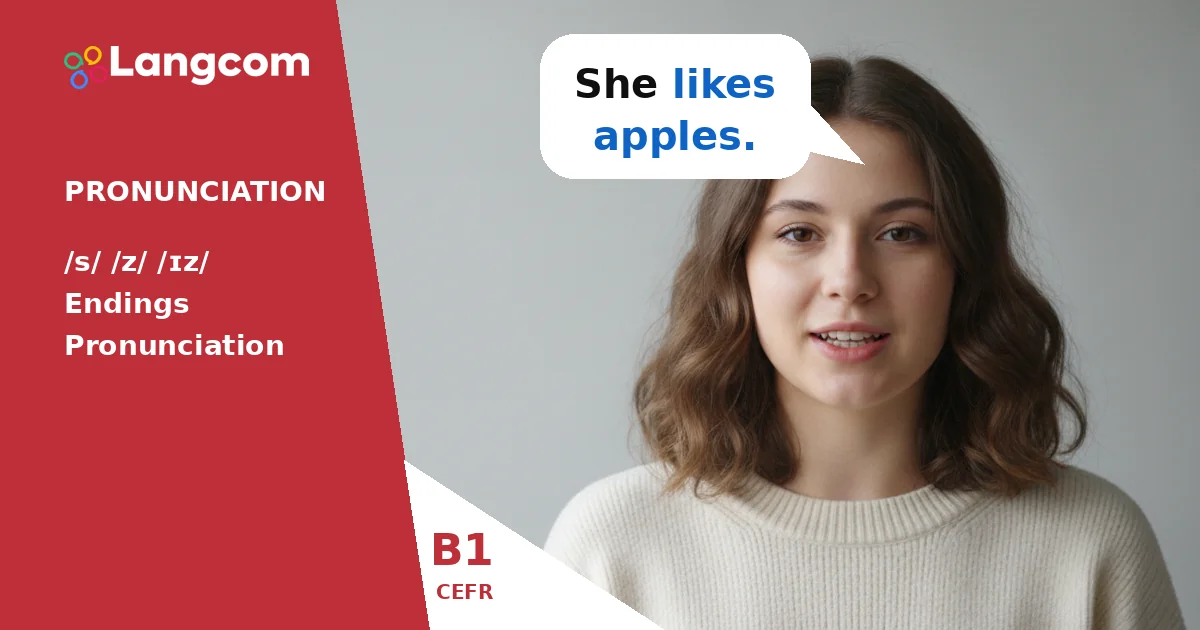

What are the three sounds for ‘s’ endings?
In English, the letter ‘s’ at the end of words can sound different. This happens with plural nouns (cats), third-person singular verbs (she works), and possessives (John’s book).
There are three main sounds for these endings:
- /s/: This sound is voiceless. Your vocal cords do not vibrate.
- /z/: This sound is voiced. Your vocal cords vibrate.
- /ɪz/: This sound has an extra vowel sound before the /z/. It is also voiced.
When do we use the /s/ sound?
我们使用 /s/ sound when the letter or sound before the 's' ending is voiceless. This means your vocal cords do not vibrate when you make the sound.
Voiceless sounds include:
- /p/ (as in stop)
- /t/ (as in cat)
- /k/ (as in book)
- /f/ (as in laugh)
- /θ/ (as in bath)
When you add 's' to words ending with these sounds, the 's' becomes /s/.
When do we use the /z/ sound?
我们使用 /z/ sound when the letter or sound before the 's' ending is voiced. This means your vocal cords vibrate when you make the sound.
Voiced sounds include:
- /b/ (as in club)
- /d/ (as in word)
- /g/ (as in dog)
- /v/ (as in love)
- /m/ (as in dream)
- /n/ (as in train)
- /l/ (as in ball)
- /r/ (as in car)
- Vowel sounds (as in see, go)
When you add 's' to words ending with these sounds, the 's' becomes /z/.
When do we use the /ɪz/ sound?
我们使用 /ɪz/ sound when the letter or sound before the 's' ending is a sibilant sound. These are sounds that have a 'hissing' or 'buzzing' quality.
Sibilant sounds include:
- /s/ (as in bus)
- /z/ (as in prize)
- /ʃ/ (as in wash)
- /ʒ/ (as in garage)
- /tʃ/ (as in watch)
- /dʒ/ (as in change)
When you add 's' or 'es' to words ending with these sounds, you add an extra vowel sound /ɪ/ before the /z/ to make it easier to pronounce.
Why is this pronunciation important for your English?
Correct pronunciation makes your English clear and easy to understand. When you use the right sounds for 's' endings, you sound more natural and fluent.
This skill is very important for communication and for exams like the B1 Preliminary (PET). Good pronunciation helps you get a better score in the speaking part of the exam.
| Ending Sound | Rule (Sound Before 's') | 示例 |
|---|---|---|
| /s/ | After voiceless sounds: /p/, /t/, /k/, /f/, /θ/ | stops, cats, books, laughs, baths |
| /z/ | After voiced sounds: /b/, /d/, /g/, /v/, /m/, /n/, /l/, /r/ and all vowel sounds | clubs, words, dogs, loves, dreams, trains, balls, cars, sees, goes |
| /ɪz/ | After sibilant sounds: /s/, /z/, /ʃ/, /ʒ/, /tʃ/, /dʒ/ | buses, prizes, washes, garages, watches, changes |
示例
- She likes apples.
- He walks to work every day.
- The books are on the table.
- My dog loves to play.
- She teaches English.
- The bus stops here.
- He watches TV in the evening.
练习
西班牙语母语者常犯的错误
西班牙语学习者常犯的错误
Many Spanish speakers tend to pronounce all 's' endings as /s/, similar to the 's' in Spanish. They might also add an extra vowel sound, making words like dogs sound like *dog-es* 或 *dogs* (with a voiceless /s/).
错误: He love-s his family. (Incorrect /s/ sound)
正确: He loves his family. (Correct /z/ sound)
错误: I have two cat-es. (Adding an unnecessary vowel)
正确: I have two cats. (Correct /s/ sound)
Remember to pay attention to the sound before the 's' to choose the correct ending sound.
常见问题
How do I know if a sound is voiced or voiceless?
You can check if a sound is voiced or voiceless by touching your throat. Make the sound (e.g., /p/ 或 /b/). If you feel a vibration, it's a voiced sound. If there's no vibration, it's voiceless.
Does this rule apply to all words ending in 's'?
Yes, this rule generally applies to plural nouns (e.g., cars), third-person singular verbs in the present simple (e.g., runs), and possessive 's' (e.g., Mary's).
Why is this important for the B1 Preliminary (PET) exam?
In the B1 Preliminary (PET) exam, clear pronunciation is part of the speaking assessment criteria. Correctly pronouncing /s/, /z/, , 和 /ɪz/ endings shows good control of English phonology, which can help you achieve a higher score in tasks where you describe pictures or discuss topics.
Are there any exceptions to these rules?
The rules for /s/, /z/, , 和 /ɪz/ endings are very consistent. There are very few exceptions for regular plurals and third-person singular verbs. However, some irregular plurals do not end in 's' at all (e.g., children, men).



0 条评论