

动词 get is one of the most versatile and common verbs in English, especially in everyday conversation. It combines with many prepositions and adverbs to form phrasal verbs and idiomatic expressions. These expressions often have meanings very different from the basic sense of ‘receive’ or ‘become’. Learning them is key to sounding more natural and understanding native speakers at a B2 level.
例如,, get rid of means ‘to remove something unwanted’, while get on someone’s nerves means ‘to annoy someone’. Mastering these phrases will significantly improve your fluency and comprehension. This lesson will help you understand and use eight essential expressions with get, making your English more dynamic and precise.
Why are ‘Get’ Expressions Important for B2 English?
At the B2 level, you need to understand and use a wider range of vocabulary. Expressions with get are very common in spoken and written English.
- They help you express ideas more naturally.
- They are often used in informal and semi-formal contexts.
- Understanding them improves your listening and reading comprehension.
What Does 'Get Rid Of' Mean?
The expression get rid of means to remove something you do not want or need.
- You can use it for physical objects, problems, or even people.
- It implies a desire to be free from something.
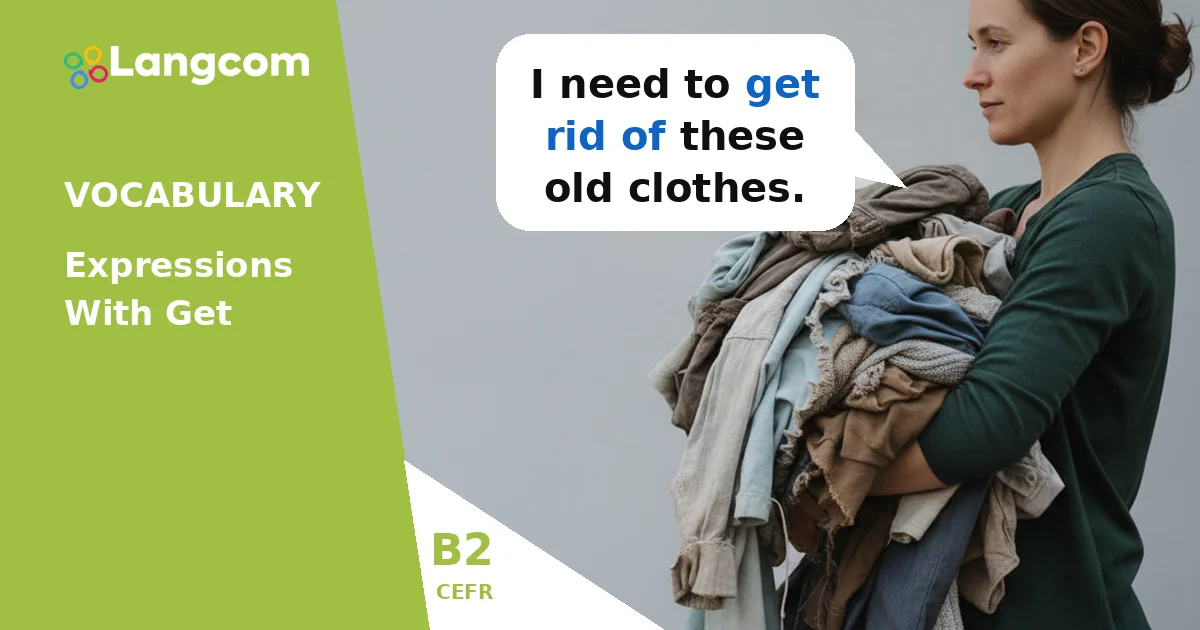
例如 I need to get rid of these old clothes.
When Do We 'Get Carried Away'?
To get carried away means to become too excited or emotional about something and lose control of your actions or feelings.
- It often happens when you are very enthusiastic.
- Sometimes, it can lead to doing too much.
例如 We got a bit carried away with the party planning and ordered too much food.
How Do You 'Get Straight to the Point'?
If you get straight to the point, you talk about the most important thing immediately. You do not waste time with unnecessary details.
- This is useful in meetings or when you have limited time.
- It shows you are direct and efficient.
例如 Let's get straight to the point: we need a new strategy to increase sales.
What Does it Mean to 'Get Involved'?
To get involved means to participate in an activity or situation. You become part of something.
- You can get involved in a project, a community, or a discussion.
- It suggests active participation.
例如 Many students want to get involved in the school play this year.
When Does Someone 'Get on Your Nerves'?
If someone or something gets on your nerves, they annoy you a lot. It causes irritation or frustration.
- This expression is very common in informal conversations.
- It describes a feeling of being bothered.
例如 His constant complaining really gets on my nerves.
How Do You 'Get Across' an Idea?
To get across means to make someone understand an idea, a message, or a feeling. It's about successful communication.
- You might need to explain something clearly to get your point across.
- Sometimes, it can be difficult to get across complex ideas.
例如 It was hard to get my idea across to the team during the noisy meeting.
What Does it Mean if Something 'Gets You Down'?
If something gets you down, it makes you feel sad, unhappy, or depressed. It lowers your spirits.
- Bad news or difficult situations can get you down.
- This expression focuses on emotional impact.
例如 The bad news about the project really got her down for a few days.
When Do You 'Get Through' Something?
To get through means to finish or survive a difficult or unpleasant experience. It can also mean to complete a task.
- It implies overcoming a challenge.
- You can get through exams, a tough period, or a large amount of work.
例如 She got through her final exams with excellent grades, despite being ill.
| Expression | 含义 | 示例 |
|---|---|---|
| get rid of | Remove something unwanted | We need to get rid of old furniture. |
| get carried away | Become too excited/emotional | She got carried away with the shopping. |
| get straight to the point | Talk about the main topic immediately | Let's get straight to the point of this meeting. |
| get involved | Participate in an activity | He wants to get involved in local politics. |
| get on someone's nerves | Annoy someone a lot | Loud music gets on my nerves. |
| get across | Make someone understand an idea | It's hard to get my feelings across. |
| get someone down | Make someone feel sad/depressed | The rain always gets me down. |
| get through | Finish a difficult experience/task | She got through the tough interview. |
示例
- I need to get rid of these old clothes.
- We got a bit carried away with the party planning and ordered too much food.
- Let's get straight to the point: we need a new strategy to increase sales.
- Many students want to get involved in the school play this year.
- His constant complaining really gets on my nerves.
- It was hard to get my idea across to the team during the noisy meeting.
- The bad news about the project really got her down for a few days.
- She got through her final exams with excellent grades, despite being ill.
练习
西班牙语母语者常犯的错误
Spanish speakers often make specific mistakes with get expressions due to direct translation or confusion with similar verbs.
- 直译: Avoid translating 'get' literally. For example, 'obtener' or 'conseguir' for get doesn't work in expressions like get rid of. You cannot say *'obtain rid of'.
- Incorrect Prepositions: Using the wrong preposition is a common error. For instance, it's get rid of, 而不是 *'get rid from'. Similarly, it's get across to someone, 而不是 *'get across for someone's understanding'.
- Confusing Meanings: Sometimes learners confuse the meaning of different get expressions. For example, get down means 'to feel sad', not 'to go downstairs'.
- Using Simpler Verbs: While sometimes possible, using a simpler verb instead of the idiomatic expression can make your English sound less natural. For example, saying 'He annoys me' is correct, but 'He gets on my nerves' is more idiomatic and common at a B2 level.
常见问题
What is a phrasal verb?
A phrasal verb is a verb combined with an adverb or a preposition, or sometimes both, to create a new meaning. For example, get up (to rise from bed) is a phrasal verb. Many expressions with get are phrasal verbs.
Why are 'get' expressions so common?
Get is a very flexible verb in English. It can replace many other verbs and is used in a vast number of idiomatic expressions. This makes it extremely common in everyday conversation and informal writing.
How can I remember these expressions?
The best way to remember get expressions is to:
- Use them: Try to incorporate them into your speaking and writing.
- Context: Learn them in full sentences, not just as single words.
- Review: Regularly review the expressions you've learned.
- 请听: Pay attention to how native speakers use them in movies, music, and podcasts.
Are these expressions formal or informal?
Most expressions with get, including the ones discussed here, are generally informal or semi-formal. They are perfect for daily conversations and casual communication. For very formal academic or business writing, you might choose more formal alternatives.
Are these 'get' expressions useful for B2 exams?
Yes, absolutely! Using these expressions correctly can help you achieve higher scores in B2 exams like Cambridge First (FCE) or IELTS. They demonstrate a wider range of vocabulary and more natural English, especially in speaking and writing tasks.



0 条评论