
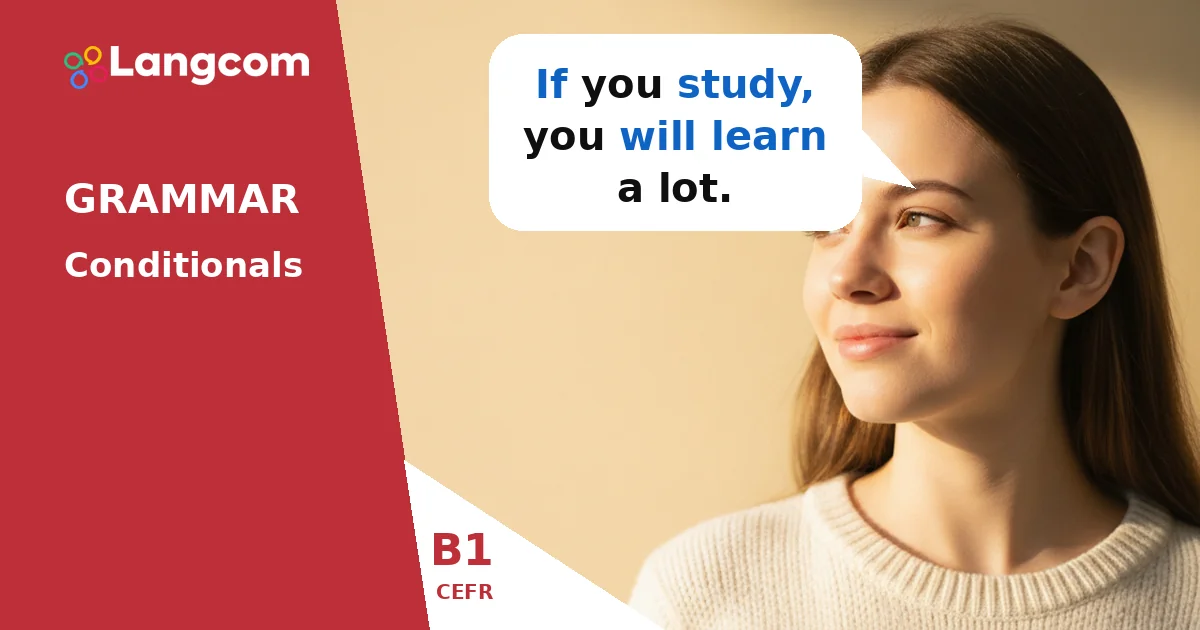

What is the First Conditional?
The First Conditional is a grammar structure we use to talk about things that might happen in the future. It describes a possible condition and its likely result.
- It’s for situations that are real or very probable.
- It connects a condition (the ‘if’ part) with a consequence (the main part).
How Do We Form the First Conditional?
The basic structure of the First Conditional is simple:
- The 'if' clause: 我们使用 present simple tense. This part states the condition.
- The main clause (result): 我们使用 will + base form of the verb. This part states the likely result.
Look at this pattern:
If + present simple, will + base form of verb.
For example:
- If I study hard, I will pass the exam.
- If she calls me, I will tell her the news.
When Do We Use the First Conditional?
We use the First Conditional for several purposes related to future possibilities:
- To talk about real possibilities: Things that are likely to happen. For example, If the weather is good tomorrow, we will go to the beach.
- To make predictions: Based on current information or beliefs. For example, If he doesn't train, he won't win the race.
- To give warnings or advice: About potential future problems. For example, If you touch that, you will burn your hand!
- To make promises or offers: Related to a future action. For example, If you help me, I will buy you dinner.
Comma Rules for the First Conditional
The position of the 'if' clause affects whether you need a comma:
- If the 'if' clause comes first: Use a comma to separate the two clauses. For example, If it rains, we will stay inside.
- If the main clause comes first: Do not use a comma. For example, We will stay inside if it rains.
Variations in the First Conditional
虽然 will is common, you can use other words in the main clause:
- Other modal verbs: 使用 can, may, might, 或 should to express different levels of certainty or possibility.
- If you finish your homework, you can watch TV. (permission/ability)
- If it's sunny, we might go for a walk. (less certainty)
- If you feel sick, you should see a doctor. (advice)
- Imperative: Use an imperative (a command) in the main clause. This is common for instructions or warnings.
- If you see John, tell him to call me.
- If you are hungry, eat something.
- Other conjunctions: You can use words like when, as soon as, unless, 或 in case 而不是 if.
- When I arrive, I'll call you.
- Unless it stops raining, we won't go out. (meaning 'if it doesn't stop')
| Clause Type | 结构 | 示例 |
|---|---|---|
| If Clause (Condition) | If + Present Simple | If I have time... |
| Main Clause (Result) | will + Base Form | ...I will visit you. |
| Full Sentence | If + Present Simple, will + Base Form | If I have time, I will visit you. |
| Reversed Sentence | will + Base Form if + Present Simple | I will visit you if I have time. |
示例
- If you study, you will learn a lot.
- She will be happy if she gets the job.
- If it snows tomorrow, we won't go to school.
- They might miss the bus if they don't hurry.
- If you need help, ask me.
- I will buy a new car when I save enough money.
练习
西班牙语母语者常犯的错误
Spanish speakers often make a common mistake by using will in the 'if' clause. Remember, in English, the 'if' clause always uses the present simple, even though it refers to a future event.
- 错误: If I will go to the party, I will see my friends.
- 正确: If I go to the party, I will see my friends.
Another mistake is forgetting the comma when the 'if' clause starts the sentence:
- 错误: If it's cold I'll wear a jacket.
- 正确: If it's cold, I'll wear a jacket.
常见问题
What is the main difference between the First Conditional and the Zero Conditional?
The Zero Conditional talks about general truths or facts, things that always happen if a condition is met (e.g., If you heat ice, it melts.). The First Conditional talks about specific, real possibilities in the future (e.g., If it's hot tomorrow, I'll go swimming.).
Can I use 'going to' instead of 'will' in the main clause?
是的,你可以使用 be going to in the main clause to express a future intention or a prediction based on present evidence. For example, If I get a promotion, I'm going to buy a new car.
Is the First Conditional important for B1 English exams?
Yes, understanding and correctly using the First Conditional is very important for B1 level exams. You might need it for writing tasks, speaking about future plans, or understanding texts that discuss future possibilities and consequences.
Can I use 'unless' in the First Conditional?
是的,, unless means 'if not'. It introduces a negative condition. For example, Unless you study, you won't pass the exam means the same as If you don't study, you won't pass the exam.



0 条评论