
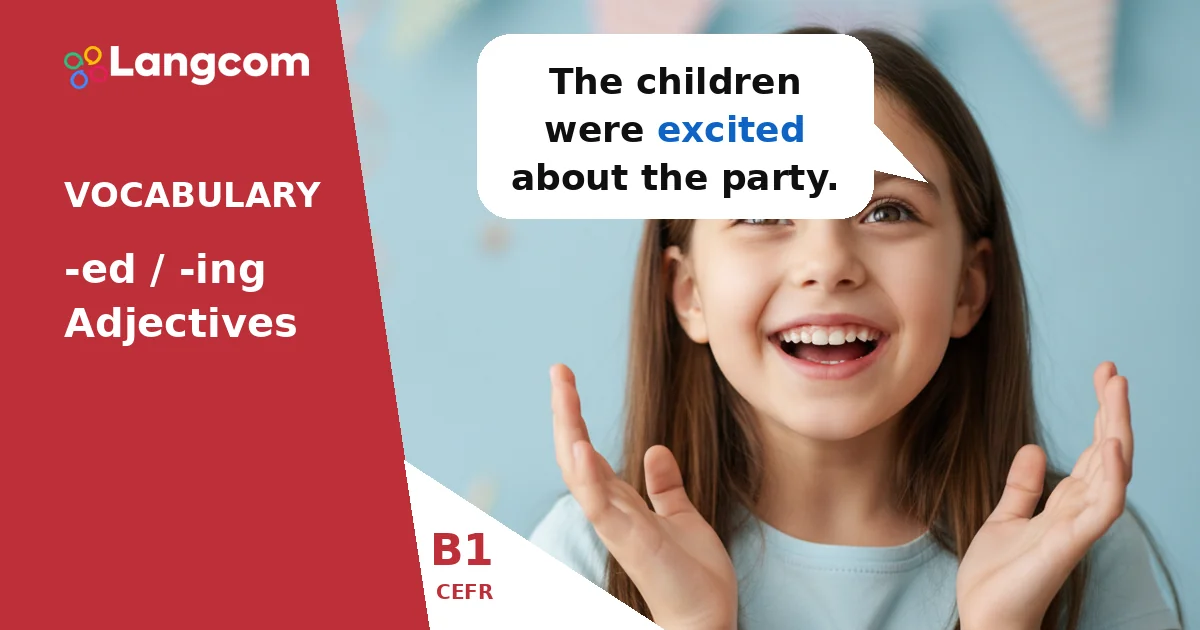

What Are -ed and -ing Adjectives?
Adjectives are words that describe nouns (people, places, things, ideas). In English, many adjectives that describe feelings or the things that cause feelings come from verbs.
These adjectives often end in -ed 或 -ing. They look similar, but they have very different meanings.
When Do We Use -ed Adjectives?
We use adjectives ending in -ed to describe a feeling or an emotion. These adjectives tell us how a person or an animal feels.
- 使用 -ed adjectives to talk about an internal state.
- They answer the question, "How do you feel?"
For example:
- I am bored. (I feel boredom.)
- She was surprised by the news. (The news caused her to feel surprise.)
- He felt tired after the long journey. (The journey made him feel tired.)
When Do We Use -ing Adjectives?
We use adjectives ending in -ing to describe the person, thing, or situation that causes the feeling. These adjectives tell us about the characteristic of something.
- 使用 -ing adjectives to talk about the cause of a feeling.
- They answer the question, "What is it like?" or "What causes the feeling?"
For example:
- The movie was boring. (The movie caused boredom.)
- That news was surprising. (The news caused surprise.)
- The journey was tiring. (The journey caused tiredness.)
Common Pairs of -ed / -ing Adjectives
Many verbs can form both -ed 和 -ing adjectives. Here are some common pairs:
- Bored / Boring: I am bored. (I feel it) / The book is boring. (It causes it)
- Tired / Tiring: She is tired. (She feels it) / The work is tiring. (It causes it)
- Interested / Interesting: He is interested in art. (He feels it) / The exhibition is interesting. (It causes it)
- Excited / Exciting: We are excited about the trip. (We feel it) / The trip will be exciting. (It causes it)
- Surprised / Surprising: They were surprised by the gift. (They felt it) / The gift was surprising. (It caused it)
- Annoyed / Annoying: I was annoyed by the noise. (I felt it) / The noise was annoying. (It caused it)
- Confused / Confusing: She felt confused by the instructions. (She felt it) / The instructions were confusing. (They caused it)
- Disappointed / Disappointing: He was disappointed with the results. (He felt it) / The results were disappointing. (They caused it)
- Embarrassed / Embarrassing: I felt embarrassed when I fell. (I felt it) / Falling was embarrassing. (It caused it)
- Frightened / Frightening: The children were frightened. (They felt it) / The storm was frightening. (It caused it)
- Shocked / Shocking: We were shocked by the news. (We felt it) / The news was shocking. (It caused it)
| Adjective Type | What it Describes | 示例 |
|---|---|---|
| -ed Adjectives | How someone feels (the emotion felt) | I am bored. |
| -ing Adjectives | The thing/person/situation that causes the feeling | The movie is boring. |
示例
- The children were excited about the party.
- The party was exciting.
- I feel very tired after running a marathon.
- Running a marathon is very tiring.
- She was annoyed by her brother's loud music.
- Her brother's music was annoying.
- He found the lecture very confusing.
- The student was confused by the complex topic.
- We were disappointed with the restaurant service.
- The restaurant service was disappointing.
练习
西班牙语母语者常犯的错误
A very common mistake for Spanish speakers is to confuse -ed 和 -ing adjectives, especially when talking about themselves.
- 错误: I am boring. (This means YOU cause boredom in other people.)
- 正确: I am bored. (This means YOU feel boredom.)
Another common error is using the wrong adjective to describe a thing:
- 错误: The film was bored. (Films cannot feel emotions.)
- 正确: The film was boring. (The film caused boredom.)
Always remember: people feel -ed, and things/situations are -ing (because they cause the feeling).
常见问题
Can a person be described with an -ing adjective?
Yes, a person can be described with an -ing adjective if they are the cause of a feeling in others. For example, He is an annoying person means he causes annoyance in other people. She is an interesting speaker means she causes interest in her audience.
How can I easily remember the difference between -ed and -ing adjectives?
A simple way to remember is: think "I feel -ed" and "It is -ing." For example, I am interested (my feeling), The book is interesting (the book causes the feeling).
Do all verbs form -ed and -ing adjectives?
No, not all verbs form these types of adjectives. This pattern is common for verbs related to emotions or states of mind, like bore, excite, surprise, annoy, interest, , 和 tire.


0 条评论