
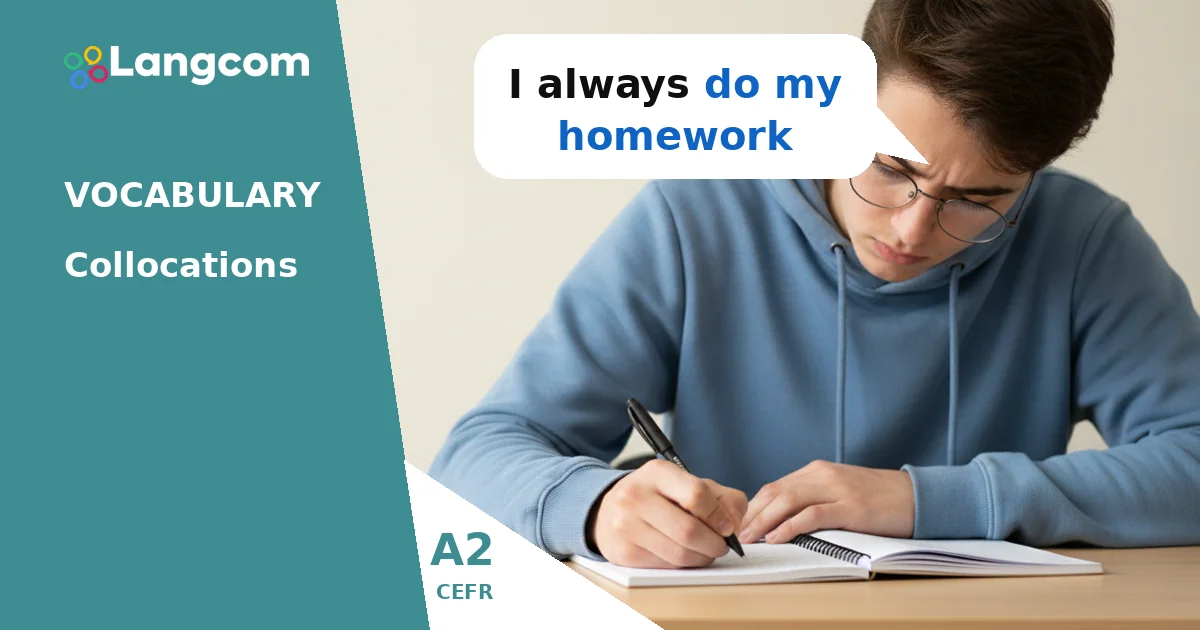

What Are Collocations in English?
Collocations are simply words that often appear together. They are not grammar rules, but rather common word combinations that English speakers use naturally.
Imagine words as friends. Some words are best friends and always go out together! For example:
- Heavy rain (not strong rain)
- Make a decision (not do a decision)
Why Are Collocations Important for Your A2 English?
Learning collocations helps you in several ways:
- Sound more natural: Your English will sound more like a native speaker's.
- 提高流利度: You won't hesitate trying to find the "right" word.
- 更好地理解: You will recognize common phrases when listening or reading.
- Prepare for exams: Collocations are often tested in exams like the A2 Key (KET).
Knowing collocations means you can express yourself more accurately and effectively.
Common A2 Verb Collocations
At A2 level, you will encounter many collocations involving verbs and nouns. Here are some important ones, especially those that can be tricky:
- Do vs. Make: These verbs are often confused.
- 使用 do for general activities or tasks: do homework, do the shopping, do a good job.
- 使用 make for creating or producing something: make a cake, make a noise, make a decision.
- Special case: do 200 kph (for speed).
- Have: Used for experiences, meals, or relationships.
- have a holiday, have breakfast, have a good time.
- Keep vs. Break: Often used with promises or rules.
- keep a promise, keep a secret, keep awake.
- break a promise, break the rules.
- Spend: Used for time or money.
- spend time, spend money, spend a fortune.
- Taste: Used for the flavour of food.
- taste good, taste funny.
How Can You Learn Collocations Effectively?
Learning collocations is an ongoing process. Here are some tips for A2 learners:
- Notice them: When you read or listen, pay attention to which words appear together. Keep a collocation notebook.
- Group them: Instead of learning single words, learn phrases. For example, don't just learn "promise", learn keep a promise 和 break a promise.
- Use them: Try to use new collocations in your speaking and writing. Practice makes perfect!
- Use a dictionary: Good dictionaries often show common collocations for words.
| Verb | Noun |
|---|---|
| do | homework, the shopping, a favour |
| make | a mistake, a noise, a decision, a fortune |
| have | a holiday, breakfast, a good time |
| keep | a promise, a secret, calm |
| break | a promise, the rules, a record |
| spend | time, money, a fortune |
| take | a photo, a break, a bus |
示例
- I always do my homework after school.
- They had a great holiday in Spain last year.
- Please keep your promise and help me tomorrow.
- This cake tastes delicious!
- She spends a lot of time reading books.
练习
西班牙语母语者常犯的错误
Spanish speakers often make mistakes with collocations because they translate directly from Spanish. For example:
- Do vs. Make: In Spanish, you might use "hacer" for both.
- 错误: I need to do a decision.
- 正确: I need to make a decision. (hacer una decisión -> tomar una decisión)
- Have vs. Take: "Tener" can cover many meanings.
- 错误: We will take a holiday. (While "take a holiday" is possible, "have a holiday" is more common for the experience itself at A2).
- 正确: We will have a holiday. (tener unas vacaciones)
- Adjectives with rain:
- 错误: It was strong rain yesterday. (lluvia fuerte)
- 正确: It was heavy rain yesterday.
Remember to learn the English word partnerships, not just individual words.
常见问题
What exactly is a collocation?
A collocation is a pair or group of words that are commonly used together by native English speakers. They just sound "right" together, like fast food 或 take a photo.
Why can't I just translate words from my language?
Direct translation often leads to incorrect collocations. Words that go together in Spanish might not go together in English. For example, you make a mistake in English, but "hacer un error" in Spanish.
Are collocations important for the A2 Key exam?
Yes, absolutely! The A2 Key exam tests your ability to use natural English. Knowing common collocations will help you with reading, writing, and speaking tasks, making your English sound more accurate and fluent.
How many collocations should I know at A2 level?
At A2, focus on common, everyday collocations, especially verb-noun pairs related to daily life, hobbies, and simple actions. There isn't an exact number, but recognizing and using the most frequent ones will greatly improve your communication.


0 条评论