
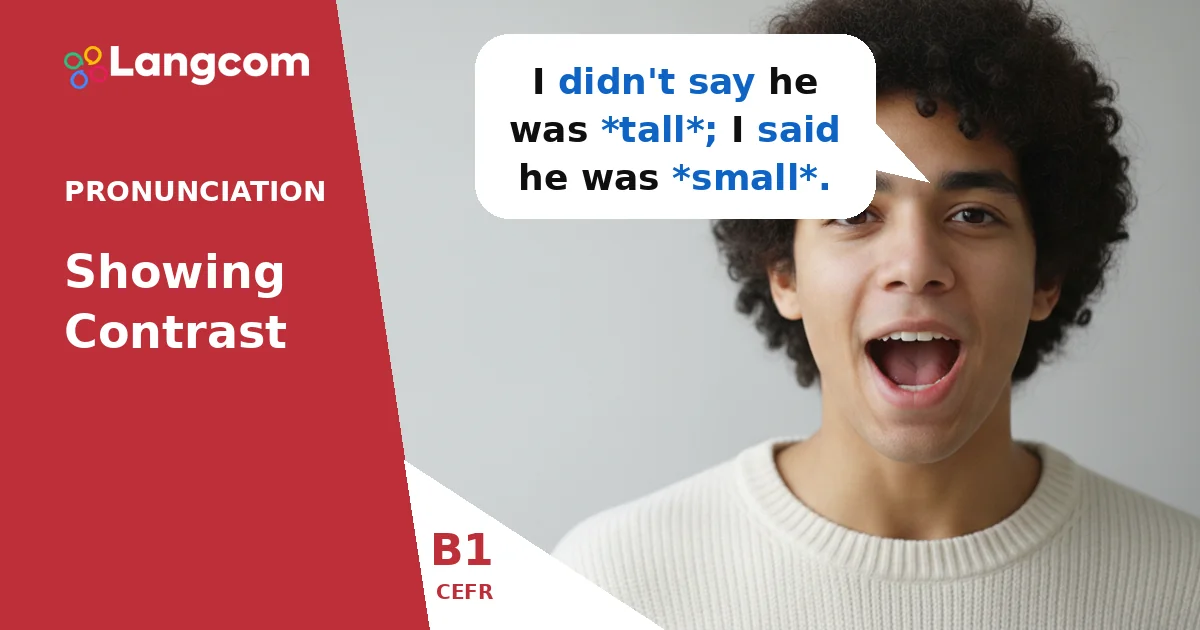

What is Contrastive Stress?
Contrastive stress is when you put extra emphasis on a specific word in a sentence. You do this to highlight a difference or to correct information.
- It helps your listener understand exactly what you mean.
- It makes your speech clearer and more natural.
How Do We Show Contrast with Our Voice?
When you want to stress a word for contrast, you change your voice in a few ways:
- Volume: Say the word louder than the words around it.
- Length: Make the vowel sound in the stressed word a little longer.
- Pitch: Your voice might go slightly higher or lower on that word.
Think of it like pointing with your voice. You are pointing to the most important word for the contrast.
When Do We Use Contrastive Stress?
We use contrastive stress in many everyday situations:
- To correct information: If someone says something wrong, you stress the correct word.
- To highlight a choice: When there are two or more options, you stress the one you mean.
- To emphasize a difference: When you want to show that something is not the same as something else.
This type of stress often appears in responses to questions or statements.
Listen and Practice: Examples of Contrast
Listen to these sentences. Notice how the stressed word changes the meaning:
- A: Did *you* go to the party? (Not someone else)
- B: No, *she* went to the party. (It was her, not me)
- A: Did you buy the *red* car? (Not another color)
- B: No, I bought the *blue* car. (The color was blue, not red)
The stressed word is the one that is different from what was expected or previously mentioned.
示例
- I didn't say he was *tall*; I said he was *small*.
- She likes *tea*, not *coffee*.
- We went there *yesterday*, not *today*.
- He lives in *Canada*, not the *United States*.
- You should call *me*, not *him*.
练习
西班牙语母语者常犯的错误
Spanish speakers sometimes find contrastive stress challenging because Spanish uses emphasis differently. In Spanish, you might change word order or use specific phrases for emphasis, but not always the same strong vocal stress on a single word.
- Not enough stress: Learners might say "No, I bought the blue shoes" with flat intonation. This can make the contrast unclear. The correct way is to stress "blue": "No, I bought the *blue* shoes."
- Stressing the wrong word: Sometimes, a learner might stress a word that isn't the point of contrast. For example, if asked "Did you go to the *cinema*?", they might say "No, I *went* to the theatre", stressing "went" 而不是 "theatre". The correct contrast is on the place: "No, I went to the *theatre*."
- Over-reliance on 'yes/no' without follow-up stress: While saying "No" is correct, the contrast needs to be clear in the full sentence that follows. Practice making the contrast clear in the entire phrase.
常见问题
Why is contrastive stress important in English?
Contrastive stress is important because it changes the meaning or focus of a sentence. It helps you correct misinformation or highlight a specific difference, making your communication much clearer. Without it, your listener might misunderstand your point, for example, "I like *apples*" (not oranges) is different from "*I* like apples" (not someone else).
Is contrastive stress always about correcting someone?
Not always. While it's often used for corrections, you also use it to emphasize a choice or a difference. For instance, if you have two options, "I prefer the *red* one" shows your preference for red over another color, even if no one made a mistake.
How can I practice contrastive stress?
A great way to practice is by listening to native speakers in conversations, movies, or podcasts. Pay attention to which words they stress when they are correcting someone or making a comparison. Then, try to imitate them. You can also practice with a partner by asking and answering questions where you need to show a contrast, like "Did you say *cat* or *hat*?"
Does contrastive stress appear in B1 English exams?
While B1 exams like the Cambridge Preliminary (PET) or IELTS (Band 4-5) don't usually have specific 'mark the stress' tasks, good pronunciation, including correct stress and intonation, is part of the speaking assessment criteria. Using contrastive stress effectively will help you achieve a higher score for 'pronunciation' and 'fluency and coherence' by making your meaning clearer.

0 条评论