

What is Intonation in English?
Intonation is the way your voice goes up and down when you speak. It is like the ‘melody’ of your language.
This ‘melody’ is very important in English because it helps to show your feelings and the meaning of your sentences. It tells the listener if you are asking a question, making a statement, or expressing surprise.
- Rising intonation: Your voice goes up at the end of a sentence or phrase.
- Falling intonation: Your voice goes down at the end of a sentence or phrase.
- Fall-rise intonation: Your voice falls and then rises, often used to show uncertainty or a partial agreement.
How Does Intonation Make You Sound Polite?
In English, intonation plays a key role in politeness. The same words can sound very different depending on the intonation you use.
A flat or sharply falling intonation can sometimes sound direct, or even impolite, especially when making requests or asking questions. A rising or gentle intonation, however, often softens your speech.
- Rising intonation makes requests sound like suggestions, not commands.
- Gentle falling intonation for statements can show friendliness and openness.
- Sharp falling intonation can sometimes sound abrupt or demanding.
Rising Intonation for Polite Questions and Requests
When you ask a 'yes/no' question or make a request, a rising intonation at the end of the sentence is usually more polite.
It makes your question or request sound less direct and more like you are asking for permission or offering a choice.
Compare these:
- Less polite (falling intonation): “Can you help me?” (sounds like a command)
- More polite (rising intonation): “Can you help me?” (sounds like a polite request)
This pattern is especially useful with modal verbs like could, would, , 和 might.
Gentle Falling Intonation for Polite Statements
Most statements in English use a falling intonation. However, the *way* your voice falls can affect politeness.
A gentle, natural fall sounds polite and friendly. A very sharp or abrupt fall can sometimes sound dismissive or uninterested.
- Polite (gentle fall): “It’s lovely to meet you.” (friendly and welcoming)
- Less polite (sharp fall): “I'm fine.” (can sound dismissive if too sharp)
When you are expressing positive feelings or making an offer, a gentle falling intonation is key.
The Power of Modal Verbs with Polite Intonation
Combining polite intonation with specific modal verbs makes your English even more polite. Words like could, would, may, , 和 might are naturally polite, and intonation enhances this.
- “Could you possibly open the window?” (Rising intonation makes it a very soft request.)
- “Would you like some tea?” (Rising intonation makes it a friendly offer.)
- “May I come in?” (Rising intonation makes it a respectful question.)
Remember, it's the combination of polite words and polite sound that creates the best impression.
示例
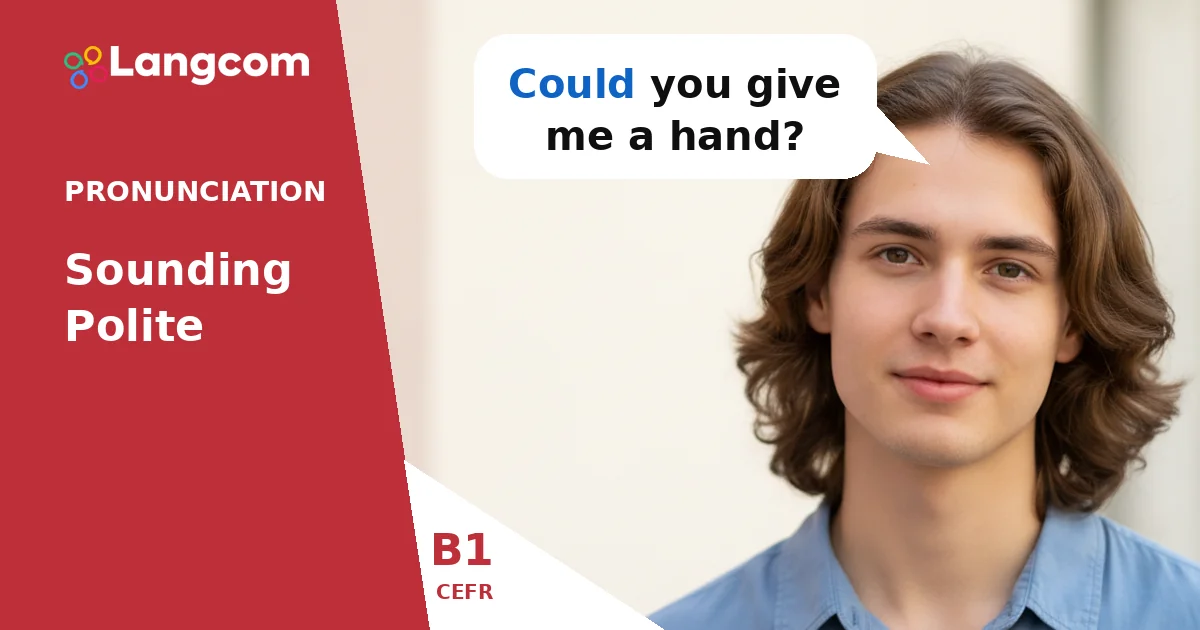
- Could you give me a hand?
- It's lovely to meet you at last.
- How long are you staying?
- She seems really great.
- I'm really happy to hear that.
- Would you mind closing the door?
- May I ask a question?
练习
西班牙语母语者常犯的错误
西班牙语学习者常犯的错误
Spanish speakers sometimes use a flatter intonation for questions or requests, which can sound less polite in English. In Spanish, the politeness is often conveyed more by specific words or verb conjugations rather than a strong intonation change.
- Direct requests: A direct request like “Give me the book.” with a falling intonation can sound very impolite in English. In Spanish, a similar structure might be acceptable. In English, you need a rising tone and often a modal verb: “Could you give me the book?”
- Yes/No questions: If you ask a 'yes/no' question with a falling intonation, like “Are you coming?”, it can sound like you are making a statement or being impatient. A rising intonation, “Are you coming?”, is much more natural and polite.
- Statements: While statements typically have falling intonation, a very sharp or abrupt fall can sometimes be perceived as rude or dismissive. Aim for a gentle, natural fall.
常见问题
What is the most important rule for polite intonation?
The most important rule is to use a rising intonation for questions and requests to make them sound softer and less demanding. For statements, use a gentle falling intonation to convey friendliness.
Can intonation really change the meaning of a sentence?
Yes, intonation can significantly change how a sentence is perceived, even if the words are the same. It can turn a polite request into a command, or a friendly statement into a dismissive one.
Is there a difference in polite intonation between British and American English?
While there are some regional accents and slight variations, the general principles of using rising intonation for politeness in questions/requests and gentle falling intonation for statements are very similar across most standard English varieties.
How can I practice polite intonation effectively?
A great way to practice is to listen carefully to native English speakers, especially in polite conversations. Try to imitate their intonation. You can also use listening exercises, like those on Langcom, where you compare different intonation patterns to identify which one sounds more polite.

0 条评论