

What Are Hobbies and Free Time Activities?
Hobbies are activities you enjoy doing in your free time. They are things you do for pleasure, not for work or school. Hobbies help you relax, learn new skills, and meet new people.
Many people have hobbies. They can be active, creative, or quiet activities.
Choosing the Right Verb: Do, Play, or Go?
In English, we use different verbs with hobbies. The most common verbs are do, play, , 和 go.
-
我们使用 play for:
- Games with rules, like play chess.
- Sports with a ball, like play football.
- Musical instruments, like play the guitar.
-
我们使用 go for:
- Activities ending in -ing, especially outdoor activities, like go cycling 或 go camping.
-
我们使用 do for:
- General activities or activities that do not fit play 或 go.
- Examples include do photography, do volunteering, 或 do yoga.
People and Equipment for Your Favorite Hobbies
Each hobby often has a specific name for the person who does it and the equipment they use. Learning these words helps you talk about hobbies in more detail.
-
对于 chess:
- The person is a chess player.
- You need a board 和 pieces.
-
对于 cycling:
- The person is a cyclist.
- You need a bike 和一个 helmet.
-
对于 painting:
- The person is a painter.
- You need paint 和一个 brush.
-
对于 cooking:
- The person is a cook.
- You might use a cooker or an oven.
-
对于 music:
- The person is a musician.
- They play an instrument.
-
对于 photography:
- The person is a photographer.
- You need a camera.
-
对于 volunteering:
- The person is a volunteer.
- There is no specific equipment, but you give your time.
-
对于 camping:
- The person is a camper.
- You need a tent and often a backpack.
Why Are Hobbies Important?
Hobbies are very good for you. They help you relax after work or school. They can also help you learn new things and develop new skills.
Having hobbies is a great way to meet people who share your interests and to improve your well-being.
| Hobby | Verb | Person | Equipment |
|---|---|---|---|
| Chess | Play | Chess player | Board, pieces |
| Cycling | Go | Cyclist | Bike, helmet |
| Painting | Do | Painter | Paint, brush |
| Cooking | Do | Cook | Cooker, oven |
| Music | Play | Musician | Instrument |
| Photography | Do | Photographer | Camera |
| Volunteering | Do | Volunteer | – |
| Camping | Go | Camper | Tent, backpack |
示例
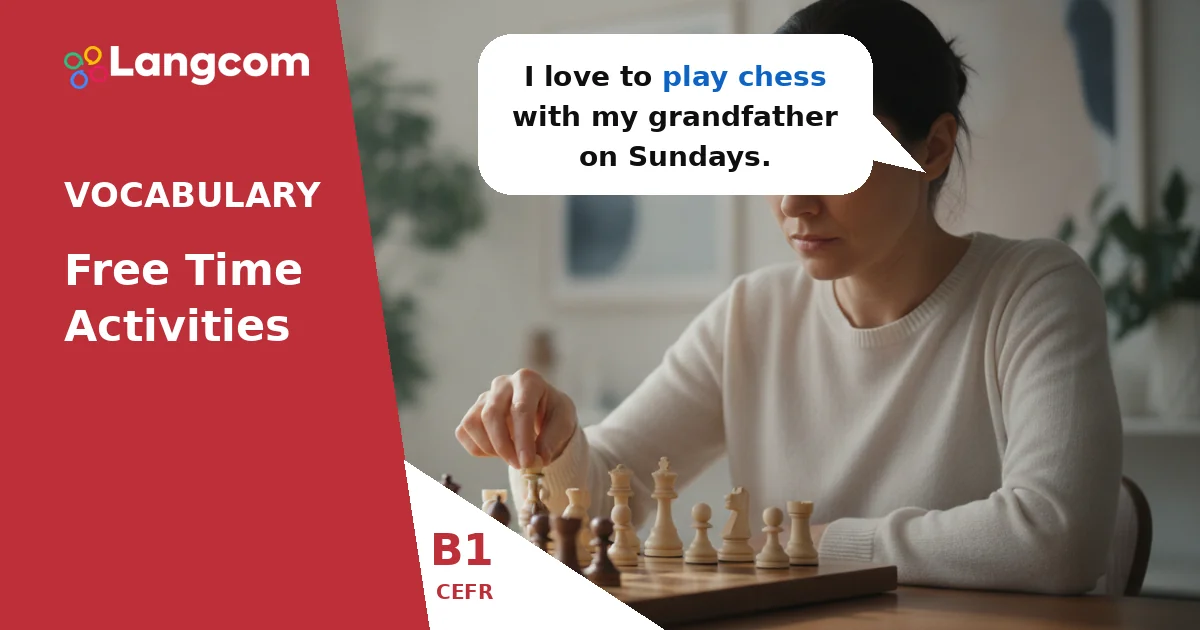
- I love to play chess with my grandfather on Sundays.
- Last summer, we went camping in the mountains.
- She does photography as a hobby and takes amazing pictures.
- He is a talented musician; he plays the guitar and the piano.
- My sister enjoys cooking new recipes every weekend.
- Many people go cycling to stay fit and explore nature.
- Doing volunteering can be a very rewarding free time activity.
练习
西班牙语母语者常犯的错误
Be careful with the verbs do, play, , 和 go:
-
请勿使用 make for hobbies or sports. For example, say I do sports, 而不是 I make sports.
-
请记得使用 go with activities ending in -ing. For example, say I go cycling, 而不是 I play cycling.
-
When talking about musical instruments, use play the. 例如,, She plays the piano, 而不是 She plays piano.
常见问题
What is a hobby?
A hobby is an activity you enjoy doing regularly in your free time, usually for pleasure and relaxation, not for money. Examples include reading, gardening, 或 playing music.
How can I talk about my hobbies in English?
你可以说 My hobby is..., I like to..., I enjoy..., 或 I'm interested in... 例如,, My hobby is photography 或 I enjoy cooking.
Are hobbies important for the B1 Preliminary exam?
Yes, talking about hobbies and free time activities is a common topic in the B1 Preliminary Speaking and Writing parts. You might describe your hobbies or discuss their importance.
Can I have more than one hobby?
Absolutely! Many people have several hobbies. You can enjoy different activities at different times or seasons.

0 条评论