
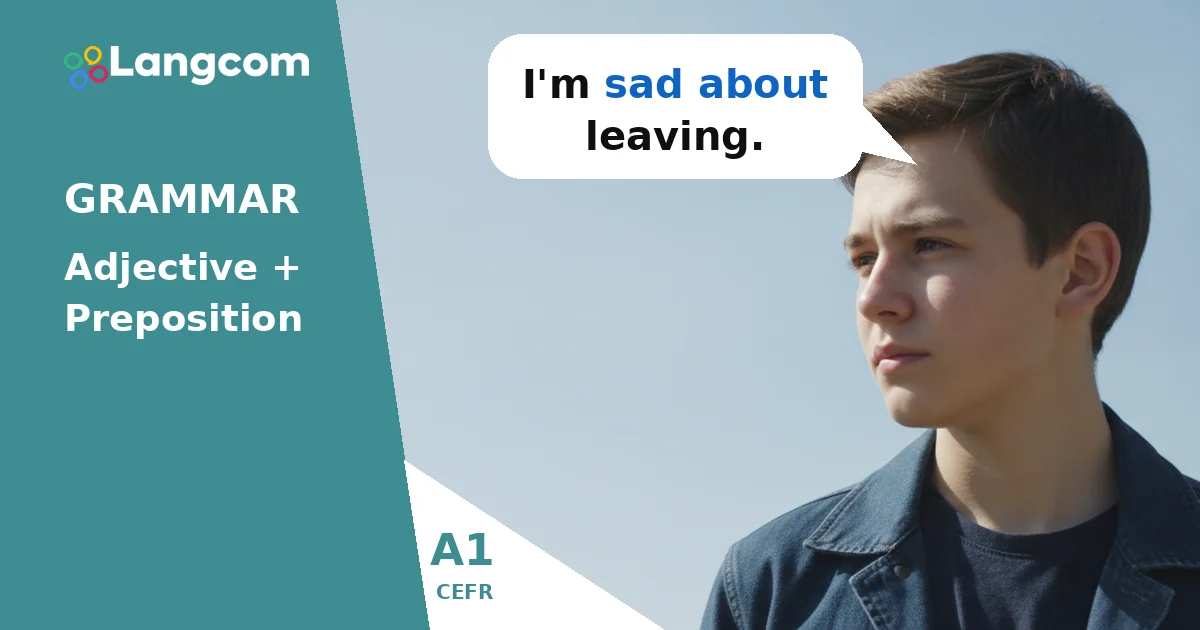

What are adjectives and prepositions?
English words work together in special ways. Sometimes, an adjective and a preposition always go together.
- 形容词是一种用来描述名词(人、地点或事物)的词。例如,, happy, sad, good.
- A preposition is a small word that shows the relationship between words. For example, in, on, at, of, about.
When an adjective and a preposition are used together, they form a fixed phrase. You need to learn these pairs.
When do we use 'about' after an adjective?
我们使用 about after certain adjectives to talk about feelings for a situation, a person, or an event.
- happy about: I am happy about my new job.
- sad about: She is sad about leaving.
- excited about: They are excited about the party.
When do we use 'at' after an adjective?
我们使用 at after certain adjectives to talk about skills or abilities. This means what someone is good or bad at doing.
- good at: He is good at drawing.
- bad at: I am bad at singing.
When do we use 'of' after an adjective?
我们使用 of after certain adjectives to talk about fears or when you are tired of something.
- scared of: Are you scared of spiders?
- tired of: I am tired of waiting.
What comes after the adjective + preposition?
After the adjective + preposition, you can use different types of words:
- A noun: She is happy about her birthday.
- A pronoun: He is good at it.
- A verb in the -ing form (gerund): They are excited about traveling.
示例
- I'm sad about leaving.
- He's good at football.
- They're tired of living on the island.
- AJ is excited about having a shower soon.
- The children are happy about seeing the treasure again.
- The man is good at flying the helicopter.
练习
西班牙语母语者常犯的错误
Be careful with these common mistakes:
- Using the wrong preposition: Spanish often uses different prepositions. For example, "bueno en" translates to good at, 而不是 good in.
- 错误: I am good in English.
- 正确: I am good at English.
- Using the base form of the verb: Remember to use the -ing form (gerund) after the preposition.
- 错误: She is excited about go.
- 正确: She is excited about going.
- Forgetting the preposition: Some adjectives *must* have a preposition to make sense.
- 错误: He is scared spiders.
- 正确: He is scared of spiders.
常见问题
什么是形容词?
形容词是一种用来描述名词(人、地点或事物)的词。例如,, happy describes a person, and big describes a house.
What is a preposition?
A preposition is a small word that shows the relationship between a noun or pronoun and another word in the sentence. Examples are at, in, on, of, about.
Do all adjectives need a preposition?
No, not all adjectives need a preposition. Only some specific adjectives are followed by a particular preposition to complete their meaning. You need to learn these common pairs.
Can I use a verb after an adjective + preposition?
Yes, you can! But the verb must always be in the -ing form (called a gerund). For example, I am excited about learning English.



0 条评论