

What Are Prepositions of Movement?
Prepositions of movement show direction. They tell us where something is going.
- They often come before a noun or pronoun.
How Do We Use "Through"?
使用 through when something moves from one side of an enclosed space to the other.
- Imagine moving inside something, like a tunnel or a forest.
- The train goes through the tunnel.
- We walk through the park.
How Do We Use "Around"?
使用 around when something moves in a circle or passes the side of something.
- It means "on every side" or "in a circular path."
- The car drives around the block.
- The children run around the tree.
How Do We Use "Over"?
使用 over when something moves above another thing, often from one side to the other.
- It can also mean jumping or flying above something.
- The bird flies over the house.
- The dog jumps over the fence.
How Do We Use "Under"?
使用 under when something moves directly below another thing.
- It is the opposite of over.
- The cat crawls under the bed.
- The ball rolls under the table.
How Do We Use "Towards"?
使用 towards when something moves in the direction of a place or person.
- It shows general direction, not necessarily the final destination.
- She walks towards the school.
- The car drives towards the city.
How Do We Use "Away From"?
使用 away from when something moves in the opposite direction of a place or person.
- It is the opposite of towards.
- He runs away from the dog.
- The boat sails away from the shore.
| 介词 | 含义 | 示例 |
|---|---|---|
| through | Inside one side, out the other | Go through the door. |
| around | In a circle, or past the side | Walk around the building. |
| over | Above, often crossing to the other side | Jump over the puddle. |
| under | Below | Crawl under the table. |
| towards | In the direction of | Run towards your friend. |
| away from | In the opposite direction of | Walk away from the noise. |
示例
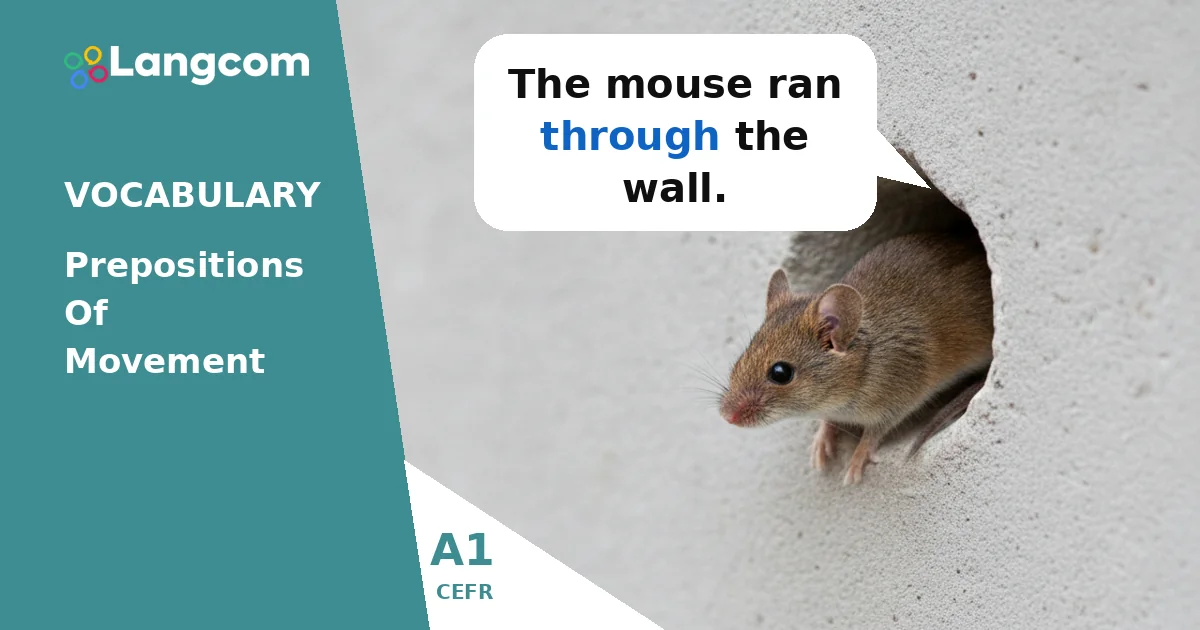
- The mouse ran through the wall.
- We walked around the lake.
- The plane flew over the mountains.
- My keys fell under the chair.
- Come towards me!
- Please step away from the edge.
练习
西班牙语母语者常犯的错误
使用 to 而不是 towards:
- I walk to the park. (Destination)
- I walk towards the park. (Direction, maybe not reaching it)
- 请记住: to means you reach the place. towards means you are moving in that direction.
令人困惑 over 和 on:
- The book is on the table. (Static position)
- The cat jumped over the table. (Movement above)
- on is for things touching a surface. over is for movement above or across.
使用 in 而不是 through for movement:
- He walks in the forest. (Static position inside)
- He walks through the forest. (Movement from one side to the other)
- in describes location. through describes movement inside a 3D space.
常见问题
What is the main difference between towards and to?
Towards shows the direction of movement, but not necessarily the destination. To shows the final destination. For example, I am walking towards the shop means I am moving in that direction, but I am walking to the shop means my goal is to arrive at the shop.
Can I use over and above in the same way?
No. Over often implies movement from one side to another, or covering something. Above means at a higher position, usually without movement. For example, The plane flew over the city (movement), but The clouds are above the city (static position).
Are these prepositions only for people and animals?
No, you can use them for objects too! For example, The ball rolled under the car 或 The water flows through the pipe.




0 条评论